
Wine Chiller Buying Guide: What to Look For

The biggest wine chiller isn’t automatically the best one for your collection. Knowing what to look for when buying a wine chiller starts with how you’ll use it, where it will sit and how much wine you plan to store, not with a long list of attractive extras.
Capacity, temperature zones and controls can be hard to compare when the right fitting style also depends on your available space. Make the decision in order: define your storage needs, check the location and then compare the features that will make the chiller practical to use.
This guide gives you a checklist for shortlisting a wine chiller in Singapore. You’ll compare freestanding, built-in and countertop options, assess capacity and shelving, and learn why placement and clearance matter. You’ll also see how to separate useful storage features from extras that may not suit your needs. Stellez Vine Singapore offers wine storage solutions from Vintec, Kadeka, Liebherr and Eurocave to explore as you narrow your shortlist.
Key Takeaways
Start with your storage plans: long-term storage and high-turnover service call for different choices.
Match capacity and fitting style to your collection and available space. Freestanding wine fridges store between 40 bottles to 300 bottles.
For what to look for when buying a wine chiller, focus on temperature settings and shelving that suit your routine, not feature count alone.
Plan placement carefully: leave at least 5 cm of clearance on all sides and keep the unit away from heat and direct sunlight.
Use your shortlist to explore wine storage options from Vintec, Kadeka, Liebherr and Eurocave.
Table of Contents
Start with your wine collection: what should a chiller help you do?
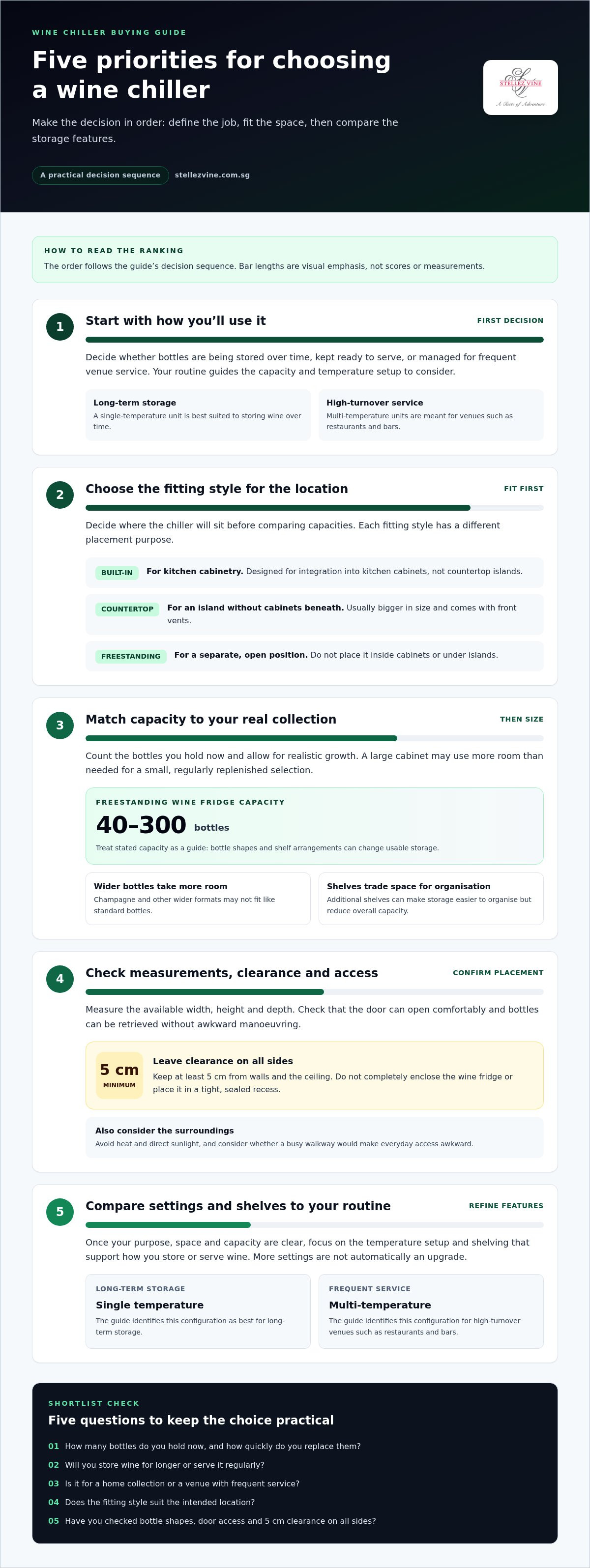
Begin with the purpose, not the feature list. Are you storing wines for longer, keeping bottles ready to serve, or managing regular service in a restaurant or bar? Your answer affects the capacity and temperature setup to consider. A collection you replenish and drink regularly has different needs from one you plan to keep over time.
A wine chiller is designed for wine storage, while a household refrigerator serves a broader range of food and drinks. That distinction can help you decide which appliance fits the task, but it doesn’t mean every wine drinker needs the same setup. For a wider look at storage considerations, read the wine fridge storage guide. For background on cellar storage, explore this overview of the wine cellar.
Everyday serving or long-term wine storage?
Think about how quickly you open and replace bottles. If your selection turns over often, prioritise a setup that suits your serving routine. If you’re building a collection to keep for longer, a single-temperature unit is best for long-term storage. Start by deciding whether you’re storing bottles over time or keeping them ready for near-term enjoyment. That simple distinction will help you assess the rest of the features.
Home collection or high-turnover venue?
At home, start with the bottles you actually keep and how often you reach for them. A restaurant or bar also needs to account for frequent service and replenishing stock. Multi-temperature units are meant for high-turnover venues such as restaurants and bars, while single-temperature units are best for long-term storage. Choose a configuration to match the use, not because more settings sound like an upgrade.
Before comparing models, use these questions to define your needs:
How many bottles do you hold now, and how quickly do you replace them?
Will you store the wine for longer or serve it regularly?
Is the chiller for a home collection or a venue with frequent service?
Do you need separate temperature zones for the way you plan to use it?
These answers make what to look for when buying a wine chiller much clearer. They give you a practical basis for comparing capacity and temperature configuration before you move on to fitting style and available space. You can then focus on features that support your collection instead of being distracted by options you may not use.
Choose the right wine chiller size and fitting style for your space
Capacity is most useful when it reflects the collection you plan to store. Count your current bottles, then allow for realistic growth. If you keep a few favourites and replenish them regularly, a large cabinet may take up more room than you need. If your collection is growing, choosing a unit only for today’s bottle count could leave you short of space.
Freestanding wine fridges store between 40 bottles to 300 bottles. Treat the stated capacity as a guide to the unit’s storage, not a guarantee that every bottle shape will fit in the same arrangement. Champagne bottles and other wider formats can take up more room. Additional shelves can improve organisation but reduce overall storage space. Before choosing a capacity, consider the bottles you own and how you want to arrange them.
Built-in, countertop or freestanding: which fitting style fits?
Match the unit to its intended position. Built-in models are intended for kitchen cabinet integration. Countertop models suit islands without cabinets beneath, are usually bigger in size and come with front vents. Freestanding units need a separate, open position and should not be placed inside cabinets or under islands. Decide on the fitting style first, then compare capacities that suit that location.
Measure the space before choosing capacity
Measure the intended position before narrowing your shortlist. Check the available width, height and depth, and make sure the door can open comfortably so you can retrieve bottles without awkward manoeuvring. Leave at least 5 cm of clearance on all sides, including from walls and the ceiling. A wine fridge should not be completely enclosed, so don’t plan to install one in a tight, sealed recess.
Think about everyday access as well as dimensions. A chiller in a busy walkway may be awkward to use, and a door that cannot open fully can make retrieving bottles frustrating. Measure the space and check access before comparing finer details. A quick check can rule out fitting styles that won’t work in your home.
Count your current bottles and estimate realistic collection growth.
Allow for larger bottle shapes and shelving that may reduce usable capacity.
Confirm the unit’s fitting style suits its planned location.
Measure the space, door access and required 5 cm clearance on all sides.
This sequence turns what to look for when buying a wine chiller into a space-first decision. It helps you find a capacity and fitting style that work together. Once you have your measurements and preferred placement in mind, explore wine storage options from Stellez Vine.
Compare temperature zones, controls and shelves that suit your wine
Choose storage features by how you’ll use the chiller, not by how many settings appear on the control panel. A long-term collection and a busy service environment have different priorities. Once the unit’s purpose is clear, consider whether its temperature setup, controls, display and shelves will be straightforward to use.
Single-temperature or multi-temperature wine chiller?
A single-temperature unit is best for long-term storage, where the aim is to keep the collection in one consistent storage environment. Multi-temperature units are meant for high-turnover venues such as restaurants and bars, where bottles move through service regularly. If you’re storing a home collection over time, don’t choose multiple zones simply because they seem more versatile. Let your storage plans guide the decision.
Consider how you use the bottles you keep. If your priority is storing a collection rather than organising frequent service, a single-temperature zone is the straightforward fit. In a venue, multiple zones can serve a practical role as bottles are selected and replenished throughout service. Zone count is useful only when it matches the way the wine will be stored and served.
Check the controls, display and shelf design
Assess the controls as part of everyday usability. Compare the temperature control type and display, and consider whether the settings are straightforward to use and the display is easy to read where the chiller will sit. An appealing interface matters less if it is difficult to understand or operate.
Humidity control is another feature to consider in relation to your storage plans. Check how it is managed and whether it fits the way you intend to store your wine. Treat it as one part of the decision, rather than a reason to choose a unit before you’ve worked out what your collection needs.
Shelves affect both access and usable capacity. Roller-type shelves are safer and more accessible, making bottles easier to reach. Consider how often you’ll retrieve bottles and whether the arrangement lets you do so conveniently. Remember that more shelves can reduce overall storage space, so a more compartmentalised interior may hold fewer bottles than you expect.
Temperature zones: Match one or multiple zones to the intended storage purpose and turnover.
Controls and display: Prioritise settings you can use and read easily.
Humidity control: Evaluate it in relation to your storage plans.
Shelves: Consider roller access and the capacity trade-off from extra shelving.
When deciding what to look for when buying a wine chiller, prioritise features you’ll use regularly. Clear controls, considered humidity management and accessible shelving can make the chiller easier to live with. Choose a temperature configuration that supports your storage plans rather than adding zones without a practical reason.
Plan safe placement: ventilation, heat and everyday access
A suitable wine chiller needs a suitable position. Plan for three things before settling on a spot: distance from heat, room for airflow and convenient access to bottles. Consider how the kitchen or living area is used throughout the day, and choose a location away from heat and humidity that allows the chiller to be used as intended.
Keep the chiller away from heat and direct sunlight
Keep the unit out of direct sunlight and away from stoves and other heat sources. Avoid hot or humid areas as well. A bright spot beside a window or a position next to cooking appliances may seem convenient, but it is not a suitable place for a wine chiller. Choose a location with the required clearance and convenient access. For a broader look at storage in Singapore’s tropical climate, consult the long-term wine storage guide.
Protect ventilation and plan for access
Allow at least 5 cm of clearance on all sides, including between the chiller and nearby walls or the ceiling. A wine fridge should not be completely enclosed. Built-in units have front ventilation, but they still require 5 cm clearance on all sides. Freestanding units should not be placed in cabinets or under islands. Match the fitting style to the location instead of forcing a unit into a space that restricts its placement.
Use this placement check before choosing a spot:
Avoid heat: Keep the chiller away from direct sunlight, hot or humid areas, stoves and other heat sources.
Allow airflow: Leave at least 5 cm on every side, including space from walls and the ceiling, and don’t completely enclose the unit.
Confirm access: Make sure the door can open freely and bottles are convenient to retrieve during everyday use.
Access matters in everyday use. A chiller behind a door, in a cramped passage or where its door cannot open fully can make bottle selection awkward. Picture your usual routine: can you reach the bottles you want without moving furniture or blocking a work area? Can the door open without hitting nearby cabinetry? Check the full path, not just the appliance’s footprint.
For built-in placement, plan for kitchen cabinet integration and retain the required clearance. For freestanding placement, choose an open position, not a cabinet or under-island space. These distinctions help prevent a mismatch between the chiller type and the available area.
Before comparing models, check that the intended position is not too hot, exposed to direct sunlight, fully enclosed or short on clearance. If it fails any of these checks, choose another spot. To shortlist a wine chiller with placement in mind, explore wine storage options at Stellez Vine.
Shortlist a wine chiller with Stellez Vine
A confident shortlist follows a clear order: define the intended use, choose a fitting style, estimate capacity, prioritise essential features and confirm safe placement. Work through each decision before comparing brands. This keeps your attention on what will suit your collection and space, rather than on specifications that may not matter to everyday use.
Intended use: Decide whether the chiller is for home storage, everyday serving or a high-turnover venue.
Fitting style: Match the unit to its location, such as kitchen cabinet integration or a separate open position.
Capacity: Consider your current bottle count, realistic collection growth and the space different bottle shapes may require.
Essential features: Prioritise temperature zones, usable controls and accessible shelving according to your storage needs.
Safe placement: Confirm the position allows the required clearance, airflow and convenient access.
Match the shortlist to your storage priorities
For a home collection, start with the available space and fitting style, then choose a capacity that allows for realistic growth. If you plan to store wine long term, a single-temperature unit is best for that purpose. Restaurants and bars with frequent bottle turnover should consider their service needs. Multi-temperature units are meant for high-turnover venues such as these.
Use that distinction to narrow the field, not to assume every model has the same features. A chiller for a home kitchen and a cabinet for venue service may need to meet different priorities. Keep your shortlist anchored to how the wine will be stored and served, then compare relevant features rather than relying on a model name or headline capacity alone.
Explore wine storage with an expert-led retailer
Stellez Vine is a Singapore retailer offering wine chillers and cabinets from Vintec, Kadeka, Liebherr and Eurocave, alongside a curated selection of wines and glassware. Its dedicated wine experts provide customer service as you explore storage options. Compare the available products against your brief: fitting style, collection size, intended use and the features that support your plans. Keep the selection process practical and let your requirements lead.
Before making your final choice, revisit the checklist and make sure each shortlisted option suits the space and purpose you identified. If your priority is long-term storage, keep that in focus. If you’re choosing for a restaurant or bar, account for the pace of service. The practical answer to what to look for when buying a wine chiller is a well-matched combination of fit, capacity, features and placement.
Explore Stellez Vine’s wine storage selection to discover options from Vintec, Kadeka, Liebherr and Eurocave.
Choose a chiller that grows with your wine life
A wine chiller should fit naturally into how you enjoy wine, not create compromises you have to work around. Before deciding, think about how your collection may evolve: you might discover new regions, save bottles for a special occasion or make wine a more regular part of hosting. Consider that future while keeping your present habits in view.
The clearest answer to what to look for when buying a wine chiller is a setup that makes storing and serving your collection straightforward. You don’t need to chase every feature. Focus on what supports your habits and helps you feel confident in your choice.
Stellez Vine’s dedicated wine experts provide customer service as you explore its wine storage selection. Keep your priorities in mind as you compare options, and choose a setup that complements the bottles you love and the occasions you look forward to sharing.
Explore wine storage at Stellez Vine and find a chiller that suits your collection.
Frequently Asked Questions
What should I look for when buying a wine chiller?
Start with how you’ll use it, then match its fitting style and capacity to your space. For what to look for when buying a wine chiller, compare temperature zones, controls, humidity features, display and shelving against your storage plans. Before choosing, check the intended location: leave at least 5 cm on all sides, keep the unit away from heat and direct sunlight, and make sure it will not be completely enclosed.
Is a wine chiller different from a regular refrigerator?
Yes. A wine chiller is designed for wine storage, while a general refrigerator serves broader food-storage needs. Compare the chiller’s temperature controls, zones, humidity features and shelves with how and for how long you plan to store wine. Don’t assume every appliance described as a wine fridge has the same functions or installation requirements. A useful first step is to write down the storage features that matter for your collection.
How much space should I leave around a wine fridge?
Leave at least 5 cm on all sides, including space from walls and the ceiling, and don’t completely enclose the unit. Keep it away from direct sunlight, hot or humid areas, stoves and other heat sources. Match placement to the fitting style: built-in units are intended for kitchen cabinet integration, while freestanding units shouldn’t go inside cabinets or under islands. Consider door swing and access before settling on a position.
Are multi-temperature wine chillers suitable for long-term home storage?
For long-term storage, a single-temperature wine fridge is best. Multi-temperature units are meant for high-turnover venues such as restaurants and bars, where bottles move through service regularly. Choose according to purpose, not the number of zones: more settings don’t automatically make a unit a better fit. If you’re buying for home, consider whether your priority is keeping a collection over time or managing frequent bottle service.
Can I put a freestanding wine fridge under a kitchen island?
No. A freestanding wine fridge shouldn’t be placed under an island or inside a cabinet. Choose a fitting style designed for the location instead. Built-in units are intended for kitchen cabinet integration. Countertop units suit islands without cabinets beneath; they’re usually bigger in size and come with front vents. Before deciding, check the available space and whether the unit’s intended placement suits your kitchen layout.
How many bottles can a freestanding wine fridge hold?
Freestanding wine fridges have a capacity between 40 bottles to 300 bottles. Choose a size based on your current collection and realistic growth, then consider how the interior will hold the bottles you own. More shelves can reduce overall storage space, so headline capacity may not reflect the arrangement you want. Measure the intended location and allow the required clearance before comparing units.
Are roller shelves worth considering in a wine chiller?
Yes. Roller-type shelves are safer and more accessible, particularly if you often retrieve bottles from different parts of the cabinet. Think about your routine: a shelf that lets you reach a bottle without shifting others can make everyday selection easier. Balance that convenience against capacity, since adding shelves reduces overall storage space. Compare the shelf arrangement with your collection and the unit’s stated capacity before choosing.
Where should I place a wine chiller at home?
Choose a spot away from direct sunlight, hot or humid areas, stoves and other heat sources. Allow at least 5 cm on all sides, including space from walls and the ceiling, and don’t completely enclose the unit. Match the location to its fitting style: freestanding models shouldn’t sit in cabinets or under islands, while built-in models are intended for kitchen cabinet integration. Check door access as part of your layout plan.



Comments