
How Long to Let Wine Breathe: A Guide to Better Flavor

More air isn’t always better. If you’re wondering how long to let wine breathe, the answer depends on the bottle, not a universal countdown. A powerful young red may need time, while a delicate or mature wine can lose character if left exposed too long. That’s why advice about opening and decanting can seem conflicting.
A reliable starting point helps you avoid serving a wine before its aromas have a chance to emerge. Think of breathing as a tasting adjustment, not a fixed timer. Take a first sip and notice whether the wine seems closed, overly firm, or already expressive. Give it air only if it needs it.
This guide will help you choose a sensible starting time, recognise when a wine is ready, and decide whether to open the bottle early, swirl it in the glass, or decant it. You’ll also learn which wines often need little or no extra air, so you can serve confidently with the glassware you have.
Table of Contents
How long to let wine breathe: the quick answer and what changes it
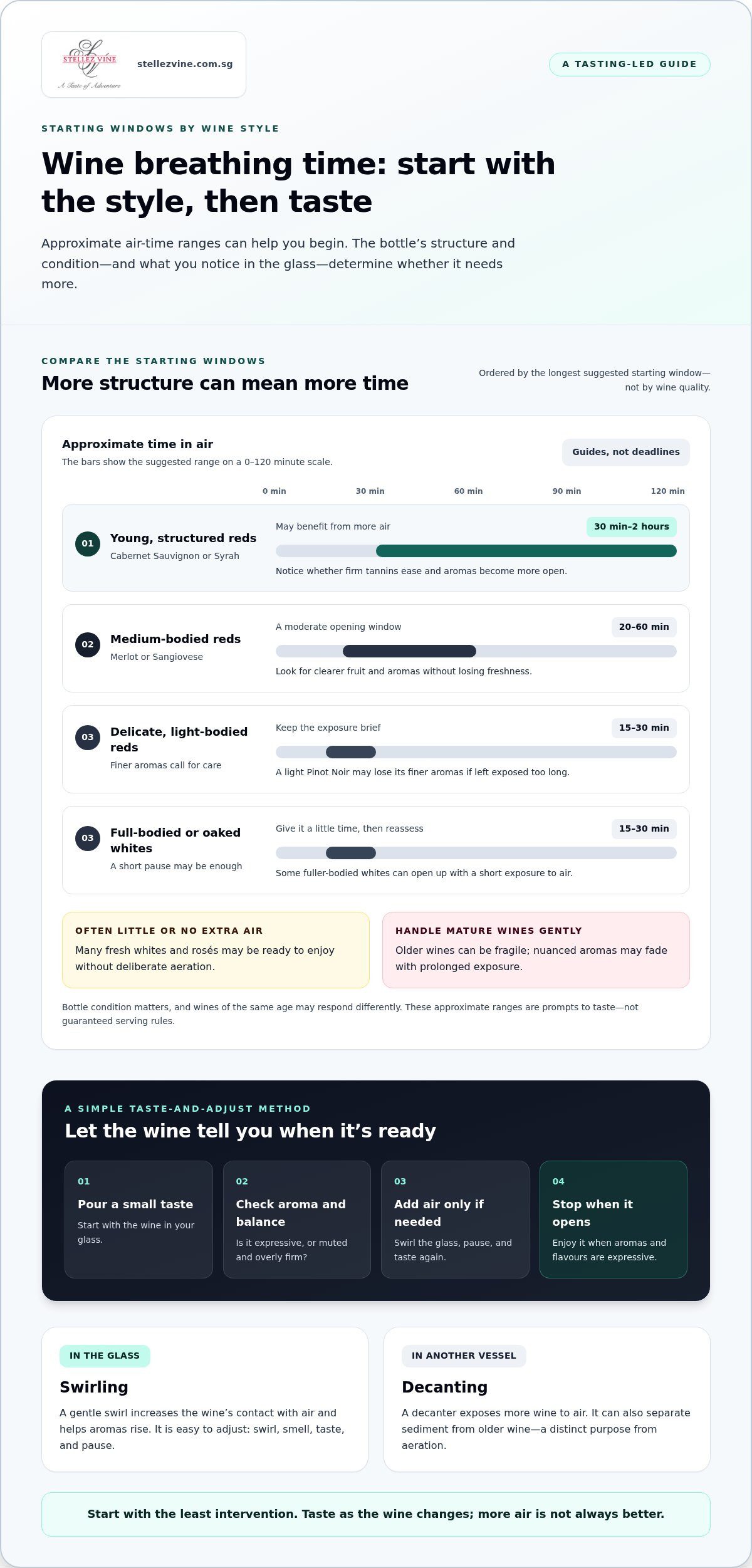
There’s no single breathing time that suits every bottle. As a practical starting point, a young, structured red may benefit from around 30 minutes to two hours, while a delicate, light-bodied red may need only 15 to 30 minutes. A full-bodied or oaked white can sometimes open up with 15 to 30 minutes of air. These are approximate guides, not serving deadlines. Taste the wine as it changes and adjust to what’s in your glass.
Wine breathing is the controlled exposure of wine to air before drinking, allowing its aromas and flavours to develop in the glass or a decanter. The aim isn’t to improve every wine. It’s to give a reserved or firm wine the chance to show more clearly.
What does it mean to let wine breathe?
Air exposure can change how a wine presents itself. Its aromas may become easier to recognise, and a tightly structured red may seem less firm. Simply pulling the cork doesn’t quickly aerate the whole bottle. Only a small surface of wine meets the air through the narrow neck, so pouring into a glass or decanter creates more contact.
In a glass, the wine changes gradually. Swirling renews its contact with air and releases aromas for you to assess. A decanter exposes a larger volume at once. It can also help separate sediment from older wine, which is a distinct purpose from aeration. For more on what is a decanter and its uses, see the overview of decanting.
Why wine-breathing times vary
Style and structure offer a useful first clue. A young Cabernet Sauvignon or Syrah, with firm tannins and a broad structure, may welcome more air than a light Pinot Noir, whose finer aromas can fade if it’s left exposed too long. Many fresh whites and rosés are ready to enjoy without deliberate aeration, while a fuller-bodied, oaked white may benefit from a short pause.
Age calls for care, too. Mature wines can be more fragile, and their nuanced aromas may fade with prolonged exposure. Bottle condition matters, so don’t assume two wines of the same age will respond identically. Serving temperature affects how aromas and flavours come across, and your preference matters as well. You may enjoy a wine while it’s still firm, or prefer to wait as it opens.
Use timing as a starting point, not a promise. Pour a small taste and notice whether the aroma is clear and the flavours feel balanced or muted. Give the wine more air only if it seems to need it. The next section looks at how different wine styles respond and where to begin.
What happens when wine meets air: breathing, swirling, and decanting
Air changes wine gradually, but not predictably. As oxygen meets the wine, some aromas become easier to notice, while exposure can also alter its freshness over time. A tightly wound wine may seem more expressive after a little air; another may show best straight away. Let your senses guide the process rather than assuming every bottle will improve.
Letting wine breathe describes its exposure to air; decanting describes transferring it into another vessel, often for aeration, sediment removal, or both. The terms are related, but they aren’t interchangeable. Decanting doesn’t guarantee a better wine, and a wine can breathe in a glass without ever entering a decanter.
Does swirling a glass help wine breathe?
Yes. A gentle swirl spreads wine across the inside of the glass, increasing its contact with air and helping aromas rise toward your nose. Try a small pour before swirling, then smell and taste it again after a few turns. Notice whether the aroma becomes clearer or the flavours seem more open. If it’s already expressive, there’s no need to keep swirling.
This is an easy, adjustable way to monitor change. You can pause between sips, swirl again, or simply enjoy the wine as it is. A glass with room to move the wine makes the technique easier. Suitable wine glassware can support the experience, but it isn’t a substitute for tasting attentively.
When does decanting make a difference?
A decanter exposes a larger volume of wine to air than a glass, so it can be useful when you want to aerate a young, structured wine before serving. The result still depends on the bottle. Taste as you go, because extended exposure can mute aromas or make a wine seem less fresh rather than more appealing.
Decanting may also serve a separate purpose: older bottles can develop sediment, which you may want to leave behind when pouring. Handle a delicate, mature wine gently and check it frequently, since its aromas may be more fragile. For broader guidance on breathing time for different wines, consult Bonterra Organic Estates’ guide, then use your own tasting to tailor the approach.
Keep the distinction simple: a swirl gives one glass a little air, while decanting changes how the wine is poured and may also separate sediment. Neither method is compulsory. Start with the least intervention, taste, and choose the next step only if the wine calls for it.
How long different wines may need: and when they may need none
Use these approximate ranges as prompts to taste, not guaranteed serving rules. The answer to how long to let wine breathe depends on the wine’s structure and condition. Begin with a small pour, then decide whether more air brings clarity or starts to soften the wine’s character.
Do all red wines need time to breathe?
No. A young, tannic red may feel firm at first and become more expressive with air, but a tight first impression alone doesn’t prove it needs prolonged aeration. Try a small taste, wait briefly, and compare. A lighter Pinot Noir can lose delicate notes if exposed too long, while an older red may be more fragile still. Red wine colour isn’t a timer.
Should white, sparkling, or older wine breathe?
Most whites can be enjoyed soon after opening. Don’t apply bold-red timing automatically. A fuller-bodied or oaked white may reveal more with a short pause, so taste before deciding. For sparkling wine, preserve its lively fizz by pouring and serving rather than leaving it open to air. With an older bottle, pour a little and observe it closely before giving it further exposure.
Temperature and bottle condition can also shape what you notice, so let the wine’s aroma, balance, and freshness guide your next move. Stop adding air when it tastes expressive to you. The most useful range is the one that helps this particular bottle show at its best.
How to let wine breathe: a simple taste-and-adjust method
Let the wine guide you rather than leaving the bottle open by the clock. This three-step approach gives you a clear first impression, a way to assess change, and room to adjust without committing the whole bottle to a decanter.
1. Open and pour. Pour a modest sample into a suitable glass. A small taste lets you judge the wine before choosing a longer aeration method.
2. Taste and observe. Notice the aroma, structure, and overall balance. Does the wine smell clear and inviting, or are its aromas muted? Do the flavours feel balanced, or particularly firm or harsh? Take a sip, then gently swirl and taste again. Look for changes rather than treating one sensation as a verdict.
3. Adjust gradually. If the wine still seems closed or overly firm, give it more time in the glass or transfer it to a decanter for broader air exposure. Revisit it at intervals and stop once it’s showing well to you.
Start with a small pour and a first taste
Begin with a small sample before deciding whether to decant. Give it a moment, smell, and taste without trying to identify every note. After a gentle swirl, compare the aroma and flavour with your first impression. A little more clarity or balance may be all the adjustment the wine needs. If it already feels expressive, pour and enjoy it.
Adjust the method to the bottle and occasion
A glass allows gradual, easy-to-monitor exposure; a decanter brings more of the wine into contact with air at once. Choose based on the bottle’s first impression and how carefully you want to track its development. Suitable glassware can make aromas easier to notice, but it doesn’t replace tasting.
For a meal, open the bottle when it fits your preparation, then check it as you set the table or serve the first course. Don’t leave it unattended for a fixed duration. If the wine is becoming less aromatic or losing freshness, stop aerating and serve it. The practical answer to how long to let wine breathe is the point at which it tastes open and balanced to you.
Good serving begins before opening. Read our guide to long-term wine storage in Singapore for helpful bottle-care context. To pair your next bottle with suitable glassware, explore curated wines and glassware.
Serve wine at its best: avoid over-aeration and enjoy the result
More air isn’t automatically better. A wine can become less expressive if it’s exposed for too long, and waiting longer won’t necessarily resolve a muted or unbalanced first impression. Taste as you go instead of relying on the clock. The right moment is when the wine is enjoyable to drink, not when it reaches a prescribed number of minutes.
How can you tell when a wine is ready?
Check in with the wine more than once. Its aromas may become clearer, or its flavours may seem more integrated, but these are possible signs rather than guarantees. Notice whether the wine still feels fresh and balanced to you. If another taste is as appealing as the last, serve it. Personal preference matters: some drinkers enjoy a wine’s firmer, more restrained opening, while others prefer it after it has had time to open.
Stop aerating if the wine seems to be losing its aroma, freshness, or definition. No single cue applies to every bottle, so compare what you smell and taste over time rather than expecting a particular change.
What if the wine seems flat or less expressive?
Don’t assume more air is the answer. First consider serving temperature: a wine that’s too warm or too cold may not show its aromas and flavours as you expect. Try a clean glass with enough room to smell the wine, then taste again. Suitable glassware can support presentation and help you notice aromas, but it can’t replace good judgement or guarantee that the wine will open up.
If the wine remains subdued, give it a little time and reassess rather than leaving it unattended for a long stretch. The practical answer to how long to let wine breathe is to stop when additional air no longer makes the wine more enjoyable. For a meal with guests, choose a bottle that suits the gathering and the food you plan to serve.
Each wine responds in its own way, so trust your palate and serve with confidence. Explore Stellez Vine Singapore’s curated wine selection to discover wines for different styles and occasions.
Trust Your Taste and Serve with Confidence
The best answer to how long to let wine breathe is the moment it tastes right to you. Timing ranges can help you begin, but each bottle responds differently. Start with a small pour, notice its aromas and balance, then give it more air only if it seems muted or overly firm.
Remember, swirling offers gentle aeration in the glass, while decanting exposes more wine to air and can also separate sediment. Neither is essential for every bottle. Taste again as the wine opens, and stop when its character is enjoyable rather than waiting for a timer to decide.
Make the experience your own with thoughtfully chosen wines and suitable glassware. Stellez Vine curates international bottles from established regions including South Africa, Thailand, Italy, France, and Argentina, with glassware to complement the serving experience. Explore Stellez Vine’s curated wine selection and find a bottle that suits your table. Pour, taste, and enjoy discovering what each wine has to offer.
Frequently Asked Questions
How long should you let red wine breathe?
It depends on the wine’s body, structure, and age. As approximate starting points, young, tannic reds may benefit from 30 minutes to two hours; medium-bodied reds often need around 20 to 60 minutes, while light-bodied reds may need only 15 to 30 minutes. Mature reds are more delicate, so start with a small pour and taste frequently. These ranges are guides, not fixed rules for every bottle.
Does opening a bottle of wine let it breathe?
Opening a bottle exposes the wine to air, but it won’t quickly aerate all the wine inside. Only the small amount at the neck has much contact with air, so uncorking well ahead of serving may make little immediate difference. Pour a taste into a glass instead. You can swirl it gently and compare its aroma and flavour before deciding whether it needs more time or a decanter.
Should you let white wine breathe?
Most white wines can be enjoyed soon after opening and don’t need deliberate aeration. A fuller-bodied or oaked white may benefit from about 15 to 30 minutes of air, but treat that as an approximate starting point. Pour a small taste first and check whether its aromas seem muted. If it already smells expressive and tastes balanced, serve it rather than waiting simply because it’s wine.
Can you let wine breathe for too long?
Yes. Extended air exposure can make a wine seem less fresh or expressive, and delicate older bottles can lose nuanced aromas quickly. There’s no universal moment when every wine becomes over-aerated, so taste at intervals rather than leaving it unattended. If its aroma starts to fade or its flavours seem less lively, stop exposing it to air and serve it. More aeration doesn’t guarantee better flavour.
Do you need a decanter to let wine breathe?
No. A glass is enough to start: pour a modest sample, smell and taste, then swirl gently if you want to encourage more air contact. A decanter exposes a larger volume of wine to air and can also help separate sediment from an older bottle. Those are distinct purposes. Choose a decanter only if it suits the wine and your serving plan; careful tasting matters more than equipment.
Should sparkling wine breathe before serving?
Usually, no. Sparkling wine is best poured and served without deliberate extended aeration, since prolonged air exposure can reduce its lively bubbles and fresh character. Open it shortly before serving, pour gently, and enjoy while the fizz is vibrant. If you’re unsure whether it’s showing well, taste a small pour rather than leaving the bottle open to breathe. A still-wine aeration routine doesn’t automatically suit sparkling wine.
How can you tell if wine needs to breathe?
Taste a small pour before deciding. A wine may benefit from air if its aromas seem muted or its structure feels particularly firm, but those impressions don’t prove it needs a long wait. Swirl gently, smell, and taste again to see whether the wine becomes clearer and more balanced. If it already feels expressive and enjoyable, serve it. Your palate and the wine’s changing character are better guides than a timer.

Comments