
Wine Serving Temperature Singapore: The Connoisseur’s Guide to Tropical Pouring

Updated: Aug 24
In Singapore, serving wine at "room temperature" is the quickest way to destroy a vintage's character. You've likely felt the frustration of a premium South African Pinotage tasting unpleasantly boozy or a delicate French white losing its soul because it's been trapped in a standard food fridge. It's a common struggle for connoisseurs who want to respect the winemaker's intent in a climate that rarely cooperates. When the mercury hits 30°C, the traditional rules of the cellar simply don't apply.
We'll show you how to master the art of tropical pouring, ensuring every glass unlocks its full aromatic potential despite the relentless humidity. You'll learn how to chill wine fast Singapore style using professional techniques that protect the wine's delicate structure. This guide explores the precision of Eurocave and Kadeka storage solutions, explains how to prevent condensation from ruining your labels, and provides the benchmark temperatures for everything from crisp Sauvignon Blanc to robust Bordeaux. Prepare to elevate your hosting and savor the true profile of every bottle.
Table of Contents
The Room Temperature Fallacy: Why Singapore’s Climate Demands Precision
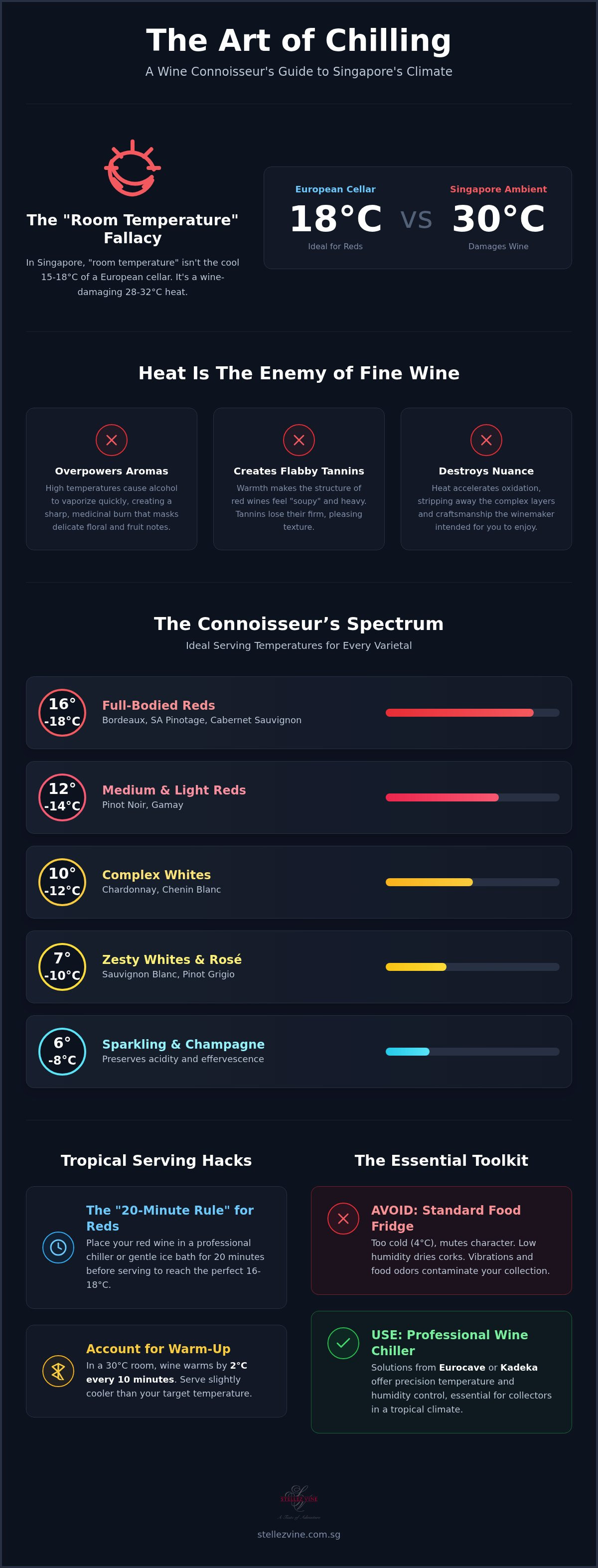
Stop treating "room temperature" as a universal constant. For a winemaker in Bordeaux or the Stellenbosch highlands, this term refers to a cool, stable environment of 15°C to 18°C. In Singapore, your ambient reality is a sweltering 28°C to 32°C. Serving a premium red at these temperatures is a recipe for disappointment. Heat is a catalyst for oxidation; it strips away the nuance of a fine vintage and leaves you with a glass that feels "soupy," heavy, and aggressively alcoholic. Precision is not a luxury here; it's the only way to respect the craftsmanship behind every bottle.
The term chambré historically described the process of bringing a bottle from a cold cellar to a slightly warmer dining room. In our tropical context, we must flip this logic. We aren't warming the wine; we're fighting to keep it cool. If you've just received a delivery or pulled a bottle from a warm cupboard, you need to know how to chill wine fast Singapore style without shocking the liquid. Rapid temperature shifts are dangerous, but serving a South African Pinotage at 30°C is worse. It destroys the delicate esters, those volatile compounds responsible for the beautiful floral and fruity aromas you paid to enjoy.
The Science of Heat and Volatile Aromas
High temperatures cause the alcohol in wine to vaporize more quickly, which overwhelms your olfactory senses. Instead of detecting layers of dark fruit or spice, you're met with a sharp, medicinal burn. This loss of structural balance is particularly devastating for high-tannin reds like Cabernet Sauvignon. When the wine is too warm, the tannins feel flabby rather than firm. Understanding The Connoisseur’s Spectrum: Ideal Temperatures for Every Varietal is the first step toward reclaiming the tasting experience. Without thermal control, the most expensive labels from Savage Wines or Chateau Canon Chaigneau lose their identity before the first sip.
Why Your Kitchen Fridge is Not the Answer
Don't assume your domestic food fridge is a suitable substitute for a professional cellar. Standard refrigerators are designed to keep perishables at a bone-chilling 4°C. While this is great for milk, it's catastrophic for wine service. Serving a complex white at near-freezing temperatures mutes its character entirely, locking away the vibrant acidity and fruit. Furthermore, the low humidity in food fridges can dehydrate corks over time, while the vibration of the compressor and the lingering scents of last night's dinner risk contaminating your collection. A dedicated solution like a Kadeka or Eurocave unit is essential for those who value purity.
The Connoisseur’s Spectrum: Ideal Temperatures for Every Varietal
Precision is the hallmark of a true collector. While generic advice suggests serving all reds at room temperature, an expert knows that a structured French Bordeaux requires a different thermal profile than a vibrant Pinot Noir. In Singapore's heat, these nuances become even more pronounced. Serving a bottle just two degrees off its peak can be the difference between an exceptional experience and a forgettable one. Follow this benchmark spectrum to ensure your pour is always perfect:
Full-bodied Reds (Bordeaux, SA Pinotage): 16-18°C
Medium to Light Reds (Pinot Noir, Savage Wines): 12-14°C
Complex Whites (Chardonnay, Chenin Blanc): 10-12°C
Zesty Whites and Rosé (Sauvignon Blanc): 7-10°C
Sparkling and Champagne: 6-8°C
Red Wines: Finding the Sweet Spot for Tannins
High temperatures emphasize alcohol and flabby tannins, masking the delicate fruit profiles of premium labels. A Matias Riccitelli Malbec, for example, possesses a bold structure that only truly sings when served with a slight chill. If your bottle has been sitting in a cupboard, you'll need to know how to chill wine fast Singapore style. We recommend the "20-minute rule." Place your red in a professional wine chiller or a gentle ice bath for twenty minutes before service to hit that crucial 16°C mark. Always account for the warm-up factor. In a 30°C dining environment, a glass of wine can rise by 2°C every ten minutes. Start slightly cooler than your target to ensure the mid-palate remains balanced throughout the meal.
Whites and Bubbles: Preserving Acidity and Effervescence
The temptation to serve whites ice-cold is strong in the tropics, but over-chilling is a common mistake that mutes the nose. Premium South African white wines, especially barrel-fermented Chenin Blanc, lose their creamy texture and honeyed aromatics if served below 10°C. For Champagne and sparkling wines, temperature dictates the "bead," which is the persistence and size of the bubbles. At 6-8°C, the carbon dioxide remains integrated, providing a fine, elegant mousse. If the bottle is too warm, the bubbles escape aggressively, leading to a flat and prickly mouthfeel. Aromatic whites benefit from the lower end of the spectrum to highlight their zesty acidity, while a complex Chardonnay needs a few extra degrees to reveal its depth.
Explore our curated selection of professional glassware to help maintain these perfect temperatures from the first pour to the final sip.
Tropical Serving Hacks: How to Chill Wine Fast in Singapore
Singapore's relentless 80% humidity turns a chilled bottle into a sweating mess in seconds. This isn't just an aesthetic issue; it's a practical one. Condensation ruins expensive labels, makes the bottle slippery for the pour, and leaves unsightly rings on your mahogany table. To counter this, a professional host must think beyond the bucket. While we've established that precision storage in a Eurocave or Kadeka unit is the gold standard, the final transition to the table requires its own set of tactics to combat the tropical air.
Managing Condensation and Presentation
If you're wondering how to chill wine fast Singapore hosts often fall for the wet paper towel myth. In reality, air is a poor conductor of heat, even in a freezer. The most effective method is a concentrated ice salt bath. By adding a generous handful of table salt to your ice water, you lower the water’s freezing point. This allows the sub-zero liquid to envelop the bottle, dropping its temperature by as much as 5°C in just ten minutes. It's a reliable, science based hack for the last minute entertainer.
For even faster results, pour the wine into a chilled decanter. The increased surface area allows the liquid to shed heat rapidly compared to the thick glass of a bottle. Always verify your progress with an infrared thermometer; it's the only way to guarantee you aren't serving your South African Chenin Blanc too cold or your Malbec too warm. Finally, don't neglect your glassware. Pouring perfectly tempered wine into a glass that’s been sitting in a 30°C room will immediately raise the liquid’s temperature by several degrees. Give your glasses a quick five minute rest in the chiller before the first pour to maintain the connoisseur’s spectrum.
The Essential Toolkit: Professional Chillers and Glassware
While rapid cooling hacks are invaluable for emergencies, a serious collector understands that consistent precision requires the right hardware. In our tropical environment, a dedicated wine fridge for Singapore weather is more than a luxury; it's a fundamental tool for quality control. Relying on ice baths every evening is tedious and imprecise. Investing in professional-grade equipment from Eurocave, Kadeka, or Liebherr ensures your bottles are always at the exact degree required to reveal their true character. These units are specifically engineered to maintain thermal stability even when the external humidity is soaring.
If you're constantly looking for how to chill wine fast Singapore style, you're likely reacting to the heat rather than managing it. Eurocave remains the undisputed gold standard for those seeking serving-temperature precision, offering sophisticated airflow systems that prevent the label damage we discussed earlier. For modern Singaporean homes where space and aesthetics are paramount, Kadeka and Liebherr provide sleek, reliable solutions that integrate seamlessly into any kitchen or entertaining area. These tools remove the guesswork, allowing you to focus on the art of the pour.
Dual-Zone vs. Single-Zone Serving Cabinets
A multi-zone cabinet is a game changer for the versatile host. These units allow you to keep full-bodied reds at 16°C in one section while simultaneously chilling Champagne to 7°C in another. Kadeka models are particularly popular for their flexibility in compact spaces, offering dual-zone technology in smaller footprints. This setup eliminates the need for last-minute temperature adjustments. You simply pull the bottle and pour. It's the most efficient way to manage a mixed collection without sacrificing the integrity of either varietal.
Premium Glassware: The Final Interface
The glass itself plays a critical role in temperature retention. Thin-walled crystal is prized by connoisseurs for its elegance, but it also facilitates a faster thermal transfer between the wine and the ambient air. To combat this in a 30°C room, look for glassware with longer stems. A generous stem ensures your hand-heat stays far away from the bowl, preserving the chill you worked so hard to achieve. The shape of the bowl also matters; wider bowls increase surface area, which causes wine to warm up faster. Collectors of South African vs Argentinian wine will know that a structured Malbec and a delicate Pinotage require specific bowl geometries to balance their unique aromatic profiles while managing heat exposure.
Ready to upgrade your home setup? Browse our exclusive range of Eurocave and Kadeka wine chillers to ensure every bottle is served at its absolute peak.
Elevate Your Experience: Curated Service with Stellez Vine
Mastering the tropical pour is a sophisticated journey that begins long before the cork is pulled. At Stellez Vine, we believe that the true value of a premium vintage is only realized when it meets the glass at its absolute peak. By integrating the convenience of a premier online wine shop Singapore with the technical precision of high end storage, we provide a holistic ecosystem for the modern collector. We don't just sell bottles; we curate the entire experience from acquisition to the final, perfectly tempered sip.
While the emergency hacks on how to chill wine fast Singapore style are essential for unexpected guests, the goal of a refined home setup is to remove the element of chance. The synergy between our handpicked South African labels and Eurocave technology ensures that your wine is never stressed by the heat. Whether you're savoring a bold Pinotage or a delicate French white, our systems maintain the structural integrity that the winemaker intended. It's time to audit your home serving setup for 2026 to ensure your collection is protected against the rising tropical mercury.
Expert Consultation for Singapore Collectors
Every collector has unique drinking habits that dictate their hardware needs. We offer tailored consultations to help you navigate the nuances of our range. Discover whether a compact Kadeka serving cabinet or a sprawling Liebherr cellar best fits your lifestyle. Our expertise allows us to recommend exclusive labels that demand specific, stable temperatures to reveal their complexity. We provide ongoing support to ensure your storage remains optimized for the local environment, acting as a reliable partner in your pursuit of the perfect pour. Knowing how to chill wine fast Singapore is useful, but having a perfectly maintained Eurocave is the true mark of a connoisseur.
Beyond the home cellar, the mark of a true host is ensuring that every aspect of an evening is handled with care. For special occasions or private tastings, arranging luxury chauffeured transport through Pomp Limousine allows your guests to enjoy your collection with peace of mind and arrive in style.
The Stellez Vine Promise of Quality
Quality control is the cornerstone of our service. Every bottle reaches your doorstep in benchmark condition, protected by temperature controlled logistics that mitigate the risks of the Singaporean climate. Our deep understanding of long term wine storage Singapore informs every piece of serving advice we share. We understand that a bottle is a living thing, and its journey from our cellar to your glass must be seamless. We invite you to explore our curated range of exceptional wines and professional glassware accessories to elevate your hosting standards and celebrate the finer things in life.
Master the Art of the Perfect Pour
Navigating Singapore's tropical heat doesn't mean you have to compromise on the integrity of your collection. We've explored how the traditional "room temperature" fallacy can mask the true character of a fine vintage, and why precision is the only way to unlock the complex aromatics of a premium South African Pinotage or a structured Bordeaux. While knowing how to chill wine fast Singapore style is a vital skill for any host, the ultimate goal is a seamless transition from a stable, professional environment to the table.
Since 2009, Stellez Vine has specialized in tropical climate wine management. As an official distributor for Eurocave and Kadeka, we provide the benchmark tools necessary to maintain the connoisseur’s spectrum. Don't let the humidity dictate your experience. With the right storage and a curated selection of global labels, you can ensure every glass is an exceptional discovery. Elevate your wine experience with our curated collection and professional chillers today. It’s time to savor your wines exactly as the winemaker intended.
Frequently Asked Questions
What is the best temperature for red wine in Singapore?
The ideal temperature for red wine in Singapore ranges from 12°C to 18°C depending on the varietal. Full bodied reds like French Bordeaux or South African Pinotage shine at 16°C to 18°C. Lighter reds like Pinot Noir benefit from a cooler 12°C to 14°C. Because Singapore’s ambient temperature often exceeds 30°C, serving wine at "room temperature" makes it taste overly alcoholic and flabby. Always aim for a slight chill.
Can I store white wine in a regular refrigerator before serving?
You can use a regular refrigerator for a short pre-service chill, but it isn't suitable for long term storage. Standard food fridges operate at roughly 4°C, which is too cold for premium whites. This temperature mutes the delicate aromatics of a Chardonnay or Chenin Blanc. Additionally, the lack of humidity can dry out corks, while food odors may seep into the bottle. A dedicated Kadeka or Eurocave unit provides the necessary precision.
How long should I chill a bottle of red wine in the fridge?
Chilling a bottle of red wine in a domestic fridge for 20 to 30 minutes is usually sufficient to reach the desired serving temperature. This brief window helps bring a bottle down from Singapore’s ambient heat to the 16°C to 18°C range. If you need to know how to chill wine fast Singapore style, avoid leaving it in too long. Over chilling reds can mask the fruit and make tannins feel unpleasantly harsh.
Does humidity affect the serving temperature of wine?
Humidity doesn't change the wine’s internal temperature, but it dramatically impacts the serving experience. In Singapore’s 80% humidity, condensation forms instantly on chilled bottles, potentially ruining labels and creating a slippery pour. High humidity also causes glassware to warm up faster as moisture condenses on the glass. Using a professional chiller helps manage these variables, ensuring the wine stays at its benchmark temperature from the first pour to the final sip.
Why does my wine taste different in Singapore than it did in Europe?
The primary reason wine tastes different here is the drastic difference in ambient temperature. In Europe, "room temperature" is typically 18°C, which is perfect for reds. In Singapore, the 30°C heat causes alcohol to vaporize faster, making the wine taste hot and boozy. Heat also strips away the delicate esters and fruit nuances. Serving your wine at the correct temperature using a Eurocave fridge restores the balance you experienced in cooler climates.
What is the fastest way to chill wine for a dinner party?
The fastest way to chill wine is an ice water bath with a generous amount of table salt. Salt lowers the freezing point of water, allowing the sub-zero liquid to rapidly pull heat from the bottle. This method can drop the temperature of a white wine by 10°C in about fifteen minutes. If you are rushing to learn how to chill wine fast Singapore hosts should avoid the freezer, as air is inefficient.
Is a wine chiller better than an ice bucket for serving?
A dedicated wine chiller like a Kadeka unit is superior for maintaining precise serving temperatures over several hours. It provides a stable environment without the mess of melting ice. However, an ice bucket is a classic tool for rapid cooling during a dinner party. For the best results, use a chiller for the primary storage and an insulated sleeve or a dry bucket at the table to prevent condensation from ruining presentation.
Should I chill the wine glasses before serving in a tropical climate?
Chilling your wine glasses for five to ten minutes before service is highly recommended in Singapore. When you pour a perfectly tempered wine into a 30°C glass, the liquid’s temperature rises almost immediately. A quick rest in a wine cabinet ensures the glass doesn't shock the wine. Be careful not to make them ice cold, as excessive condensation will form on the bowl, making it difficult to appreciate the wine’s clarity.


Comments