
Wine Fridge Humidity Control: The Collector’s Guide to Preservation in 2026

In the sweltering heart of Singapore, the greatest threat to your vintage Bordeaux isn't the heat you feel; it's the invisible moisture levels you can't see. You've likely spent years curating a collection that reflects your taste and heritage, only to worry that a stray spike in humidity could turn your investment into a moldy, oxidized disappointment. It's a natural anxiety for any serious collector who understands that a premium bottle is only as good as the air surrounding it.
This guide, curated by the experts at Stellez Vine Singapore, helps you master wine fridge humidity control to achieve a stable 60-70% environment, ensuring your labels remain pristine for future enjoyment and your corks stay perfectly supple. Discover how to navigate the technical nuances of professional storage to protect your fine wine investment from the tropical climate. We'll explore the sophisticated technologies behind benchmark brands like Eurocave, Liebherr, and Kadeka, giving you the confidence to select hardware that transforms your home storage into a professional-grade sanctuary. Capture the peace of mind that comes with knowing your collection is aging exactly as the winemaker intended.
Table of Contents
The Invisible Guardian: Why Humidity Control Matters in Singapore
Wine storage is an art of precision. While many beginners obsess over temperature, the seasoned collector knows that moisture is the invisible guardian of quality. Technically, wine fridge humidity control is the deliberate management of water vapor within your cabinet to protect the physical integrity of the cork. Without this balance, your most prized bottles are at risk of premature decay, regardless of how cool you keep the room.
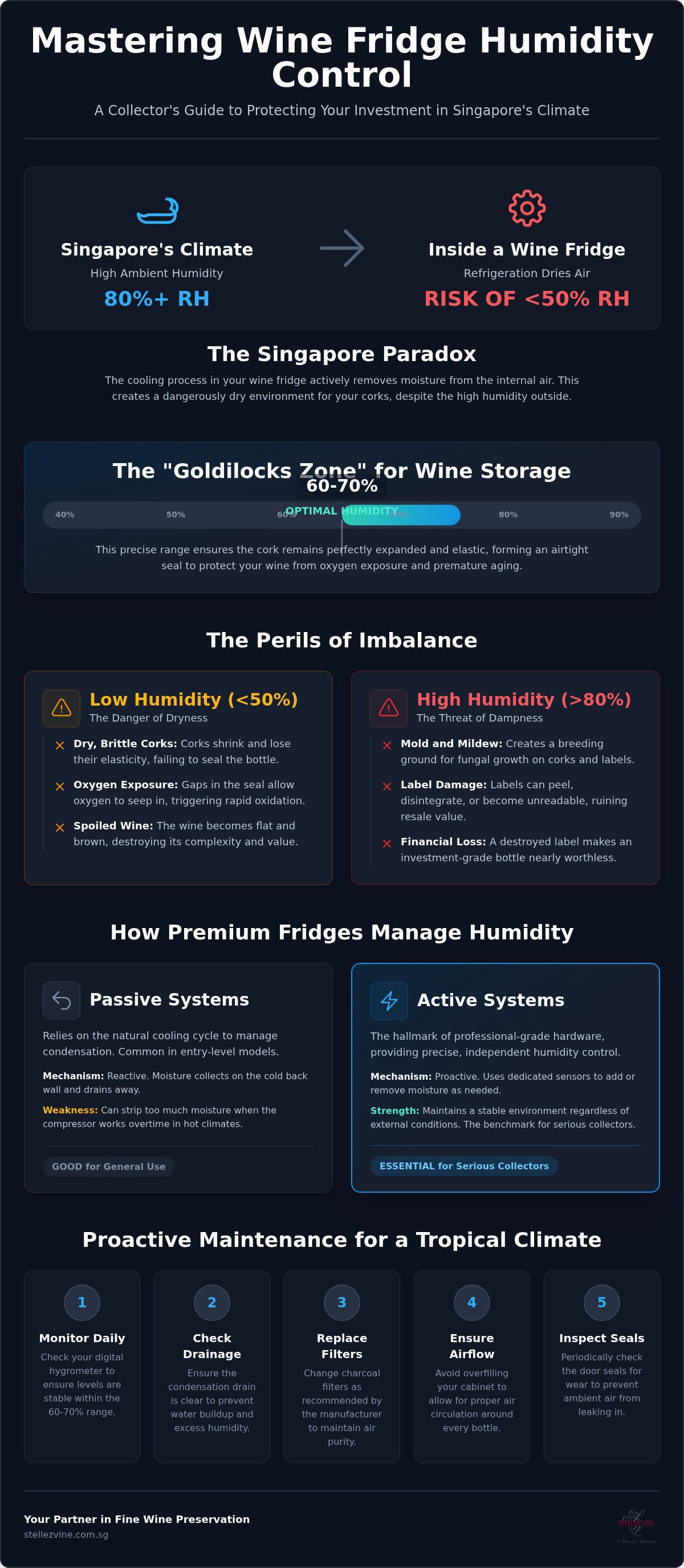
Living in the tropics presents a unique challenge known as the Singapore Paradox. Outside, the heavy, moisture-laden air is thick with humidity. Inside a cooling unit, however, the refrigeration process naturally strips moisture from the environment as it lowers the temperature. This dehumidifying effect can leave your wine gasping for breath in an environment as dry as a desert, despite the tropical storm raging outside your window. Relying on temperature control alone is a common mistake that leads to heartbreak for many collectors. To avoid this, you must aim for the "Goldilocks Zone" of 60% to 70% relative humidity. This specific benchmark ensures the cork remains expanded and elastic, creating a perfect seal against the outside world.
The Perils of Low Humidity: Oxidation and Dry Corks
When moisture levels drop below the 50% mark, the cork begins to lose its elasticity. It shrinks, becomes brittle, and eventually allows microscopic gaps to form between the glass neck and the closure. This physical failure invites oxygen to enter the bottle, triggering the Aging of wine to accelerate uncontrollably. This process, known as oxidation, turns a vibrant vintage into a flat, brown, and vinegar-like disappointment. Standard domestic refrigerators are notorious for this; they are designed to keep food dry to prevent spoilage, making them the primary enemy of a long-term wine investment. Don't let a simple lack of moisture evaporate the value of your cellar.
The Risks of Excessive Moisture: Mold and Label Damage
Conversely, letting humidity climb above 80% creates a breeding ground for fungal growth. While a little cellar dust might seem authentic, actual mold can devour paper labels and even penetrate the top of the cork. For those focused on the resale value of investment-grade bottles, a destroyed label is a financial catastrophe. To ensure your collection's safety, follow the Rule of Three: maintain a stable temperature, enforce strict wine fridge humidity control, and keep your bottles in total darkness. This proactive approach preserves both the liquid gold inside and the pristine presentation outside, ensuring every bottle is ready for the auction block or the dinner table.
The Mechanics of Moisture: How Premium Fridges Manage Air Quality
Mastering the science of air quality is the only way to Store Wine Properly in a tropical setting. While basic chillers focus solely on the thermostat, premium cabinets treat the air as a living component of the aging process. The evaporator acts as the heart of this system, functioning as a thermal pump that removes excess moisture while maintaining a necessary baseline. To prevent stagnant, over-humid air from becoming a breeding ground for mold, high-end units employ active air circulation and replaceable charcoal filters. These components work in tandem with digital hygrometers, which provide you with real-time feedback and total transparency over your storage conditions.
Passive vs. Active Humidity Systems
Passive systems are the industry standard for entry-level models. They utilize the natural cooling cycle to manage condensation; moisture accumulates on the cold back wall and drains into a tray. However, these systems are often reactive and can falter under the pressure of Singapore’s extreme ambient heat. When the compressor works overtime to fight external warmth, passive systems can inadvertently strip too much moisture from the air.
Active wine fridge humidity control is the hallmark of professional-grade hardware. These systems use dedicated sensors to trigger moisture adjustments independently of the temperature settings. Whether the external air is exceptionally dry or saturated by a monsoon, the internal environment remains unwavering. This proactive regulation is why brands like Eurocave are considered the benchmark for serious collectors who refuse to compromise on precision.
The Role of Interior Linings and Materials
Every material inside a high-end cabinet serves a functional purpose. Embossed aluminum walls are preferred over plastic because they facilitate superior moisture distribution across their textured surfaces. This ensures that humidity isn't just present, but uniform. High-quality door seals are equally vital, acting as a fortress that keeps the heavy Singaporean air out and your meticulously managed microclimate in. Some specialized models even incorporate lava rocks or humidity clay balls. These act as a physical buffer, absorbing excess water vapor and releasing it back into the cabinet when the hygrometer detects a dip.
Consider these three structural pillars of moisture management:
Precision Seals: High-quality gaskets form an airtight barrier against tropical humidity.
Moisture Buffers: Specialized materials like lava rocks provide a natural reservoir for moisture regulation.
Thermal Mass: Dense interior linings help maintain stable conditions even when the door is briefly opened.
Selecting the right hardware is a declaration of respect for your collection. If you are ready to elevate your storage, discover our range of premium wine cabinets designed for the connoisseur.
Comparing the Masters: Eurocave, Liebherr, and Kadeka
Selecting a storage cabinet is about choosing a philosophy of preservation. At Stellez Vine Singapore, we curate the world's most respected storage masters to ensure your collection thrives despite the local climate. While the previous sections explored the physics of air quality, this analysis focuses on how Eurocave, Liebherr, and Kadeka execute wine fridge humidity control to meet the diverse needs of modern collectors. Each brand offers a distinct technical path to stability, tailored to different levels of collecting intensity.
Eurocave: The 'Hypro-Control' Innovation
Eurocave stands alone as the professional standard for those who view their collection as a serious investment. In the Royale and Revelation series, they've perfected the Hypro-Control system. This technology doesn't just manage moisture; it meticulously replicates the humid microclimate of a natural limestone cellar. By utilizing a sophisticated thermal pump and embossed aluminum walls, these units maintain a constant, gentle humidity that protects the most fragile corks. Integrated alarm systems provide a final layer of security, alerting you immediately if levels deviate from your chosen setpoint. It's a proactive shield designed for absolute peace of mind.
Liebherr and Kadeka: Reliability for the Modern Collector
Liebherr approaches preservation with the surgical precision of German engineering. Their GrandCru range utilizes active sensors to deliver consistent wine fridge humidity control without requiring constant manual adjustment. It's a "set and forget" solution for the collector who values high-performance automation and sleek, integrated design. The system monitors the environment in real-time, making micro-adjustments to the cooling cycle to ensure the air remains perfectly balanced for long term wine storage in Singapore.
Kadeka has carved a niche as the efficient champion of the urban home. These cabinets are specifically engineered to handle the rapid temperature and humidity fluctuations common in Singaporean high-rise apartments. They offer a streamlined, modern approach to stability that doesn't compromise on the core requirements of preservation. Kadeka units are ideal for collectors who need reliable, localized performance in a compact footprint.
When deciding which master to trust with your collection, consider these three paths:
The Connoisseur's Choice: Eurocave offers the ultimate, cellar-grade precision for rare and delicate vintages.
The Engineer's Choice: Liebherr provides automated, sensor-driven excellence for a seamless storage experience.
The Urban Choice: Kadeka delivers efficient, robust stability tailored for the modern Singaporean lifestyle.
Practical Maintenance: Optimising Your Cabinet in the Tropics
Owning a premium wine cabinet is a commitment to the longevity of your collection. While your hardware does the heavy lifting, consistent maintenance ensures your wine fridge humidity control remains surgical in its precision. In Singapore, where the external environment is perpetually aggressive, a proactive routine is the difference between a thriving cellar and a costly failure.
Follow this five-step maintenance routine to safeguard your investment:
Examine the Seals: Inspect the rubber gaskets monthly for cracks or debris that could compromise the airtight barrier.
Clean the Drainage: Ensure the internal drainage channel is free of dust or biological buildup to prevent water stagnation.
Refresh the Air: Replace your charcoal filters every 12 months to eliminate odors and maintain air purity.
Verify the Reservoir: Check water trays or lava rock moisture levels, especially during drier spells.
Validate the Data: Cross-reference your cabinet’s digital readout with a calibrated external sensor.
Strategic placement is your first line of defense. Position your fridge away from direct sunlight and air conditioning vents, as localized temperature swings force the compressor to work harder, which can inadvertently fluctuate internal moisture levels. Additionally, respect the "open door" rule; every second the door is ajar, the delicate microclimate you've built is replaced by heavy tropical air. Minimize the frequency and duration of access to prevent sudden humidity spikes that stress the corks.
Monitoring with Precision
Trust, but verify. While built-in sensors in brands like Eurocave and Liebherr are exceptionally accurate, using an external digital hygrometer provides a necessary second opinion. Calibrate your sensors annually using the salt-slurry method to ensure the data you're seeing is absolute. Watch for early warning signs: if you notice labels beginning to curl at the edges or a faint musty scent, your humidity balance is drifting. Catching these shifts early prevents permanent damage to your investment-grade bottles.
Troubleshooting Fluctuations
If your readings dip too low, check the water tray and ensure your door seals aren't leaking. Conversely, if moisture levels climb above 75%, inspect the drainage channel for blockages and ensure the cabinet has at least five centimeters of clearance from walls for proper ventilation. Hygroscopic equilibrium is the state where the moisture content of the cork remains in perfect balance with the internal air, keeping it expanded and airtight. If you need expert assistance with your storage hardware, contact our technical team for professional support.
Savour the Results: Choosing Your Next Storage Solution
The ultimate reward of meticulous collecting is the moment the cork is pulled and the first pour reveals a wine in its prime. When you invest in professional-grade wine fridge humidity control, you aren't just buying an appliance; you're securing the future of every sensory detail within the glass. A perfectly preserved vintage offers a clarity of fruit, a silkiness of tannin, and a depth of aroma that simply cannot survive in a compromised environment. By choosing a benchmark solution from a trusted partner like Stellez Vine Singapore, you ensure that the tropical intensity remains outside, while your collection evolves in a sanctuary of stillness. Every sip becomes a testament to your foresight and respect for the craft.
Tailored Selection for the Singapore Lifestyle
Every collector's journey is unique. Whether you're housing a dozen bottles for frequent enjoyment or a sprawling library of investment-grade Bordeaux, your hardware must match your ambition. Consider how capacity for future growth, the precision of active sensors, and the long-term reputation of the manufacturer align with your lifestyle. As a specialized online wine shop Singapore, Stellez Vine Singapore provides the deep technical expertise and dedicated post-purchase support required to navigate the complexities of tropical aging. We act as your knowledgeable filter, curating only the most reliable units from Eurocave, Liebherr, and Kadeka. This ensures you spend less time worrying about technical specifications and more time savoring your acquisitions.
Protecting Your Investment
The financial logic of premium storage is undeniable. The cost of a single rare vintage lost to oxidation or label mold often exceeds the price of a high-quality wine cabinet. When you buy fine wine in Singapore through our curated selection, you deserve the absolute confidence that your liquid assets are safe. Don't leave your heritage to chance or settle for generic cooling solutions that lack active moisture management. These compromises lead to dried corks and heartache. Elevate your storage standards today and join a community of collectors who value heritage as much as taste. Consult with Stellez Vine Singapore for a bespoke storage audit and discover how the right wine fridge humidity control can transform your collection into a lasting legacy of quality and craftsmanship.
Secure Your Legacy: The Future of Your Collection
Protecting a fine wine investment in the tropics requires more than just a cool room; it demands absolute mastery of the internal environment. You've discovered that the "Singapore Paradox" can dry out even the most resilient corks if left to passive systems. By maintaining the 60-70% Goldilocks Zone, you preserve the liquid gold inside and the pristine labels that define your collection's value. Choosing professional-grade wine fridge humidity control is the only way to ensure your bottles age with the grace and character intended by the winemaker.
As an authorized Eurocave and Liebherr retailer, we provide the expert tropical storage advice and curated hardware needed to safeguard your library. Our fast national delivery ensures your new sanctuary arrives exactly when your collection needs it most. Elevate your collection with a premium humidity-controlled wine fridge from Stellez Vine.
Invest in the peace of mind that comes with benchmark technology and savor the rewards of perfectly aged wine for years to come.
Frequently Asked Questions
What is the ideal humidity for a wine fridge in Singapore?
The ideal humidity for a wine fridge in Singapore is between 60% and 75%. This specific range ensures the cork remains expanded and airtight without encouraging excessive mold growth on the labels. While professional facilities often aim for 70%, staying within this benchmark prevents the drying effect of internal cooling cycles. Maintaining this balance is essential for the long-term aging of delicate vintages in our challenging tropical environment.
Can high humidity in Singapore damage my wine fridge?
Yes, the extreme ambient humidity in Singapore can damage your storage unit if it lacks professional-grade insulation. High external moisture often leads to excessive condensation on the cabinet exterior and door seals, which may eventually cause mold or rust. Premium cabinets from brands like Liebherr are engineered with high-quality gaskets and treated glass to resist these climatic pressures, ensuring the internal microclimate remains unaffected by the heavy tropical air outside.
How do I increase the humidity in my wine cooler if it's too low?
To increase internal moisture, you should first check the water reservoir or ensure your unit's lava rocks are sufficiently damp. If levels remain low, minimize how often you open the door to prevent the cooling system from stripping away water vapor. Some collectors use specialized humidity clay balls to act as a natural buffer. If your wine fridge humidity control is still underperforming, it's time to inspect the door seals for leaks.
Is it normal for a wine fridge to have condensation on the glass door?
It is relatively common to see light condensation on the glass door in Singapore's high-dew-point environment. However, premium cabinets use triple-glazed or heated glass to minimize this effect and maintain clear visibility. While external fogging is usually a result of temperature differentials, consistent internal condensation is a sign that the drainage channel may be blocked or the external air is leaking into the cabinet through a compromised seal.
Do all wine fridges come with humidity control systems?
Not all wine fridges are equipped with dedicated humidity control systems. Entry-level chillers often rely on passive condensation management, which can be unreliable in a tropical climate. Professional-grade cabinets, such as those from Eurocave, utilize active regulation sensors and thermal pumps to maintain precise levels regardless of external conditions. For serious collectors, investing in a unit with active wine fridge humidity control is a non-negotiable requirement for long-term preservation.
How often should I change the charcoal filter in my wine cabinet?
You should replace the charcoal filter in your wine cabinet every 12 months. This annual maintenance is vital for ensuring the air inside remains pure and free from environmental odors that could penetrate the cork. A fresh filter prevents stagnant air from affecting the sensory profile of your wine. It's a simple, effective step that works alongside your cabinet's moisture systems to create a pristine aging environment for your collection.
Will a standard kitchen fridge work for wine storage if I only keep it for a month?
A standard kitchen fridge is unsuitable for wine storage, even for a short duration like one month. Domestic refrigerators are designed to remove moisture to keep food fresh, creating an environment that's far too dry for wine corks. Additionally, the frequent vibrations and significant temperature fluctuations of a kitchen unit can agitate the sediment and chemical balance of your wine. For proper preservation, a dedicated wine cabinet is always the superior choice.
Why are Eurocave wine fridges considered the best for humidity control?
Eurocave units are the benchmark for excellence because they utilize active Hypro-Control technology to replicate the environment of a natural limestone cellar. Unlike passive systems, Eurocave cabinets use a thermal pump and embossed aluminum walls to distribute moisture evenly. This proactive approach ensures that the humidity remains stable even when the external Singaporean weather fluctuates. They provide the most sophisticated protection available for investment-grade bottles and rare vintages in the global market.


Comments