
Understanding Wine Vintages: Meaning, Champagne and Value

A wine’s vintage is the year its grapes were harvested, not a guaranteed rating of its quality. Understanding wine vintages starts with that distinction: a vintage-dated bottle reflects one harvest year, while a non-vintage wine can blend wines from different years to create a consistent style. The year offers a clue to the season’s growing conditions, not a verdict on every bottle.
That clue is especially useful when choosing wines from regions where weather varies from year to year. A warm, sunny season often brings riper grapes, while cooler or wetter conditions can produce fresher, lighter wines. A difficult year doesn’t rule out excellent bottles, and a celebrated vintage isn’t the only route to an enjoyable glass.
For shoppers in Singapore, the key is knowing when the year deserves attention and when the producer, region and style matter more. This guide explains how vintage dates work, why Champagne may be vintage or non-vintage, what collectors consider when assessing age and value, and how to use vintage knowledge to find affordable wines worth enjoying.
Table of Contents
What is a vintage wine?
A vintage is the year the grapes used for a wine were harvested. It captures a season’s growing conditions, so the same region can produce different styles from one year to the next.
Year-to-Year Climate Variation
Year-to-year climate variation describes how changing weather affects grape growth and ripening, while longer-term climate change can shift the conditions growers face. For consumers, the vintage year provides context for a wine’s character, not a simple quality score.
Warm, sunny seasons usually produce riper grapes; cooler or wetter seasons may yield fresher, lighter wines. In warm climates, drought can create thick-skinned grapes with little juice, leading to tannic, drying wines. Hail ravaged Beaujolais in France during the 2016 vintage, showing how one event can shape a region’s harvest.
Climate Differences Across Regions
Vintage variation is stronger in regions with unpredictable weather than in places with more reliable climates. Central Spain, Australia, California and southern Italy tend to have less year-to-year variation. In cooler regions such as Champagne, Burgundy, Germany, England and New Zealand, a warm season can help grapes ripen fully.
Australia’s grape-growing season runs approximately from October to April, and its harvest lasts about two to four months, depending on region and varieties. Grapes harvested in the 2020 Australian vintage appear as 2020 on the resulting wine label. The Hunter Valley, established in the 1830s, is one example of Australia’s varied wine regions.
Grape varieties also respond differently to climate. Early-ripening grapes can mature sooner, while later-ripening grapes need suitable conditions for longer. In a cool or wet season, that timing can determine whether grapes develop ripe fruit flavours or retain a fresher, more restrained profile. Read a vintage chart alongside the region and grape variety, not as a single verdict on every bottle.
For Australian wine labelled as a vintage wine, at least 85% of the grapes must come from the stated year. That makes the printed year a useful starting point for understanding the harvest behind the wine. However, a vintage is not uniformly good or poor across an entire region: individual locations and varieties can still produce appealing bottles in a challenging year.
Where can you find reliable wine vintage charts and ratings? Look for published charts that assess specific wine regions and indicate drinking windows, then compare their guidance with the producer and grape variety. Spanish wine regulators also publish official classifications of each vintage, offering region-specific context for Spanish wines.
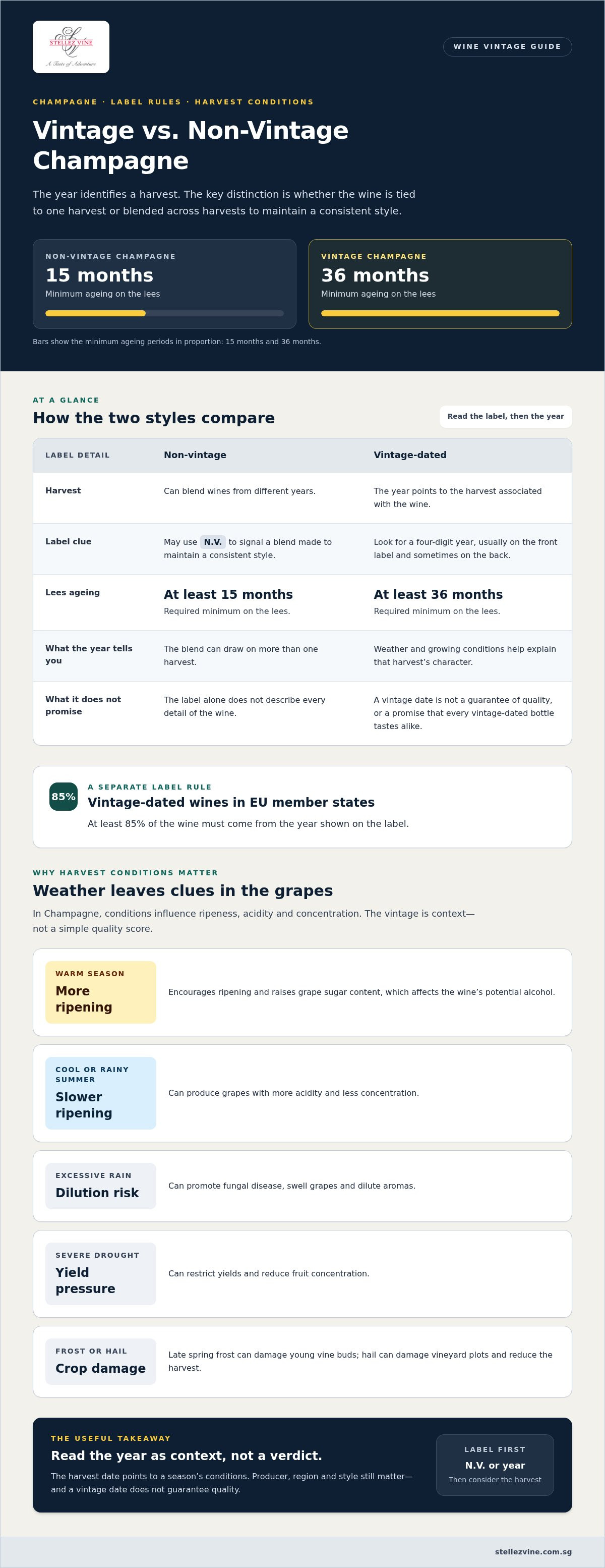
What Are the Rules for Vintage Champagne?
Champagne can be vintage-dated or non-vintage, and its year reflects the harvest behind the wine. Weather helps explain why producers blend harvests or declare a vintage for a particular bottle.
Weather, Grape Quality, and Ripeness
Weather shapes grape ripeness, acidity and concentration, influencing Champagne’s character. A warm season encourages ripening and raises grapes’ sugar content, affecting the wine’s potential alcohol. A cool or rainy summer can slow ripening, producing grapes with more acidity and less concentration.
Rainfall matters throughout the vineyard, not just on harvest day. Excessive rain can promote fungal disease, swell grapes and dilute aromas. Severe drought can restrict yields and reduce fruit concentration. Late spring frost can damage young vine buds, while hail can destroy vineyard plots and reduce the remaining harvest.
Harvest Weather and Wine Characteristics
Conditions near harvest affect both grape quality and the amount of fruit available. Rain can swell grapes, reducing concentration or causing rot. Hail and frost can cut the number of grapes on the vine, lowering yields for that season. These pressures give producers practical reasons to adjust picking dates and other vineyard decisions.
Heat also changes the fruit’s balance. Excessively hot weather can make grapes overripe, altering a wine’s taste and viscosity. Temperatures above 92 ºF / 33 ºC for too many days can cause grapes to raisin before fully ripening. Day-to-night temperature differences also affect acidity, shaping the contrast between freshness and ripe fruit.
Reading Vintage Details on Labels
Look for a four-digit year on the bottle, usually on the front label and sometimes on the back, especially for sparkling wine. It identifies the harvest associated with a vintage-dated wine. A non-vintage label may instead use “N.V.”, signalling a blend made to maintain a consistent style across harvests.
Champagne’s ageing rules also distinguish the two styles. Non-vintage Champagne must age for at least 15 months on the lees; vintage Champagne must age for a minimum of 36 months on the lees. These periods describe required ageing, not a guarantee of quality or a claim that every vintage-dated bottle will taste alike.
For vintage-dated wine in European Union member states, at least 85% must come from the year shown on the label. Read the producer, region and year together: the date identifies the harvest, while weather explains why that season may taste different from another.
Vintage importance for premium and collectible wines
Vintage matters most when a wine’s growing season can shape its quality, style and ageing potential. For premium bottles, the year adds context to the region, producer and resulting wine.
When Vintage Matters to Buyers
Vintage is most useful when comparing age-worthy wines from regions where conditions vary between growing seasons. Burgundy, Napa and Piedmont are particularly associated with vintage differences in quality and ageing potential. For an everyday bottle intended for a Tuesday dinner, the year usually matters less than the style and immediate enjoyment.
Collectors can use vintage charts to see how a region’s harvest is rated and whether a wine may be ready to drink or suited to further ageing. A chart is a starting point, not a score for every producer or vineyard. A strong vintage in one part of a region doesn’t make every bottle identical.
Collectible Vintages and Historical Significance
Some vintages attract collectors for both wine quality and historical meaning. The 1945 vintage, for example, is prized for its quality and its association with the end of World War II. That history can add interest beyond the wine’s growing season, but the bottle’s region and condition still matter to its appeal.
For a collection, compare the region, vintage reputation and the wine’s intended drinking window. Wines capable of ageing for decades can interest collectors and investors, while other bottles are made for earlier enjoyment. Plan your cellar around those differences rather than treating every notable year as a bottle to keep indefinitely.
Vintage Ratings, Prices, and Investment
Vintage ratings can influence perceived quality and demand, but they don’t set a bottle’s price by themselves. Prices also vary with production quantity, ageing potential, expert ratings and historical circumstances. A highly rated year may attract attention, while limited production can make particular bottles more sought after.
How do vintage ratings affect wine prices and investment value? Ratings can shape demand and perceived quality, contributing to price differences alongside scarcity, ageing potential and historical interest. A good vintage can increase a collection’s value, but popularity changes over time.
Use vintage charts to compare the same region across different years, then consider the wine’s style and drinking window. For example, acidity and structure help explain why some premium wines develop over time, while fruit-forward wines may be intended for earlier enjoyment. Australia’s broad range of wine regions also makes regional guidance more useful than a single national vintage rating.
Keep the bottle’s purpose in view. If you’re collecting, choose wines with ageing potential and a suitable place in your cellar. If you’re buying to drink soon, focus on the producer, region and style you enjoy. A celebrated vintage is useful context, not a substitute for choosing a wine that suits your plans.
Meaning of a wine vintage
Understanding wine vintages starts with the harvest date: a vintage refers to the year its grapes were picked, not when the bottle was produced or released. Grapes harvested in 2020, for example, can yield a wine labelled 2020 even if bottling happens later. The date connects the wine to a particular growing season and its conditions.
Harvest dates differ by hemisphere. In the Northern Hemisphere, the grape-growing season runs approximately from April to October; in the Southern Hemisphere, it runs approximately from October to April. Wines are vintage-dated with the later year, so grapes picked during the 2020 Australian vintage are labelled 2020. This calendar difference helps explain why harvest and label dates can seem counterintuitive.
A vintage date also doesn’t mean the wine came entirely from one harvest everywhere. Rules vary by country: South Africa and Chile require at least 75% of a vintage-dated wine to come from the stated year. The European Union and New Zealand require at least 85%. Those differences matter when comparing bottles from separate wine regions.
By contrast, non-vintage wine typically blends wines from two or more harvest years. Producers blend to maintain a consistent taste profile, rather than express one particular season. A label may show “N.V.” to indicate non-vintage. Most Prosecco is non-vintage because its style prioritises fresh, fruity consistency over the character of one harvest.
Champagne also shows why vintage and style are separate ideas. It’s commonly made by blending wines from different years for consistency, while a vintage Champagne represents a particular harvest. Neither label alone tells you whether a bottle is ready to drink, collectible or suited to a special occasion. The producer’s style and the wine’s intended drinking window add that context.
Nor does “vintage” mean “old” or “great.” A wine can be vintage-dated and enjoyed within months of bottling, or stored for more than 10 years. Beaujolais nouveau, for example, is made to be consumed within months of bottling. Many wines are made for earlier enjoyment, often tasting best within 1-3 years of release. Understanding wine vintages means reading the date as harvest context, not as an age or quality promise.
Finally, the year doesn’t guarantee an untouched expression of the harvest. Winemakers may adjust wines with sugar, oak chips, colouring or flavouring agents, or acidification to reduce differences between vintages. These cellar choices can influence the resulting wine’s consistency, so read the vintage alongside the region, producer and style. The word “vintage” itself dates to the early 15th century, but its practical value remains tied to harvest year.
Buying affordable wines in good vintages
A celebrated vintage doesn’t automatically make a bottle a good-value purchase. For everyday drinking, vintage usually matters less than it does for collectible wines, especially when a wine is made to be enjoyed young. Understanding wine vintages helps shoppers use the year as context, then look beyond famous names and costly reputations for appealing wines from less-hyped regions.
Start with a vintage chart for the particular region, not a broad ranking of an entire country. Wine professionals recommend charts for understanding recent vintage conditions, but ratings are summaries, not guarantees about every producer. Compare the chart’s notes with the grape variety, intended drinking window and style you enjoy. That keeps a regional score in perspective.
For a concrete value lead, red wines from Sicily and Sardinia from the 2014 vintage are described as offering value. Use that example as a prompt to explore the islands’ wines, not as a claim that every bottle from that year is equally compelling. Producer choices and local growing conditions still shape the resulting wine.
Choose your region with climate variation in mind. A reliable climate can make vintage differences less pronounced, while unpredictable weather can make year ratings more useful. Burgundy, for example, is a region where vintage can matter greatly, so charts may help explain style differences. For everyday bottles less affected by weather variation, prioritise the taste profile rather than paying extra for a celebrated year.
Match the chart to the region. A rating for Burgundy doesn’t describe Sicily, Sardinia or Australia. Read local notes before deciding a year is favourable.
Buy for the drinking occasion. A bottle for a weeknight meal usually needs the style you enjoy, not long ageing potential. Many wines are made to taste best within 1-3 years of release.
Consider the season’s effect. Warm, sunny conditions tend to produce riper grapes, while cooler or wetter seasons may create fresher, lighter wines. Pick the profile that suits your meal.
Good-value shopping also means resisting the idea that a “great vintage” guarantees quality. One region can contain strong and weaker individual wines in the same year, while less celebrated seasons can still yield bottles worth tasting. Use understanding wine vintages to narrow your options, then assess the producer, grape and intended style together.
For a regional starting point, explore South African wines and compare the vintage with the style you want to enjoy. A thoughtful choice puts the harvest in context without making a famous year the whole story.
Stellez Vine Singapore: South African Wines
Stellez Vine Singapore offers South African Wines for exploring regional character and comparing bottles across vintages. When choosing a wine, consider the year alongside the grape, producer and style you enjoy, rather than treating a vintage rating as a guarantee.
If you’re building a collection, thoughtful storage matters alongside bottle selection. Stellez Vine Singapore also offers Kadeka Wine Chillers, Eurocave Wine Fridges and LIEBHERR Wine Cabinets. These options connect the pleasure of discovering wines with the practical question of where to keep them.
Explore South African Wines and wine storage options with Stellez Vine Singapore.
Make Your Next Bottle a Discovery
Let your next wine choice be guided by curiosity, not pressure to find a celebrated year. Understanding wine vintages can sharpen your decisions, but personal taste is the most useful measure at the table. Notice which styles you savour, what you pair them with, and whether you prefer freshness or depth. Those observations make each bottle a reference point for your next discovery.
Build on that knowledge with a simple habit: note the region, grape and style you enjoyed. Over time, those details can help you choose confidently for a quiet dinner, a shared celebration or a bottle to save. The aim isn’t to collect ratings, but to make each selection feel considered and rewarding.
Ready to explore your next bottle? Contact Stellez Vine Singapore to continue your wine discovery.
Choose with curiosity, then enjoy the experience in your own way.
Frequently Asked Questions
What else do you need to know about vintage wines?
Vintage tells you about a harvest, but not every choice behind the finished bottle. Producers can adjust harvest timing, fermentation and ageing methods to suit the grapes. Compare tasting notes from the same producer across different years to notice how those decisions and growing conditions influence style. This makes vintage information more useful than relying on a year’s reputation alone.
When is the vintage important?
Vintage matters most when comparing wines whose character and ageing potential depend closely on the growing season. For a bottle you plan to open soon, focus first on its style and the occasion. For a wine you intend to cellar, consider how the region and producer performed in that year, then use a vintage chart to understand its likely drinking window.
How Does Vintage Matter In Winemaking?
A vintage influences winemaking decisions from vineyard to cellar. In challenging growing conditions, producers can adjust pruning, water management and harvest timing to support grape quality. Quality-focused winemakers can also change picking dates, whole-cluster use, or fermentation and ageing vessels. These choices help shape the resulting wine, so two producers in the same region and vintage can create different expressions.
Vintage Vs Non-Vintage: What’s The Difference?
A vintage-dated bottle identifies a harvest year, while a non-vintage bottle combines wines from different years. The distinction helps explain a producer’s aim: expressing one season’s character or maintaining a familiar style through blending. Look for a four-digit year on a vintage label; “N.V.” indicates non-vintage. Neither term alone tells you which bottle best suits your meal or taste.
What Defines a Good or a Bad Vintage?
A good vintage generally comes from balanced conditions that support grape development without extreme weather. But a region-wide reputation doesn’t describe every vineyard or grape variety. A difficult season can still produce appealing wines from well-suited sites and careful winemaking. Read ratings as regional context, then consider the specific producer and wine style before deciding whether a year is good or poor.
When Can Older Wine Be Better?
Older wine can be more rewarding when it was made to mature and stored appropriately. Over time, its aromas and flavours can develop, creating a more layered tasting experience than its youthful profile. That doesn’t suit every bottle: wines intended for immediate enjoyment are generally best soon after bottling. Check the producer’s guidance and intended drinking window before keeping a bottle for later.
What does a wine vintage year mean?
The year on a vintage-dated bottle identifies the harvest associated with the wine, not necessarily its bottling or release year. For example, a wine made from grapes harvested in the 2020 Australian vintage is labelled 2020, even if it reaches shelves later. Read the date alongside the region and producer, since the year offers harvest context rather than a complete description of the wine.
How does weather affect wine quality from one vintage to another?
Weather influences grape ripening, affecting the resulting wine’s freshness, fruit character and concentration. Warm, sunny conditions tend to produce riper fruit; cooler growing conditions generally preserve higher acidity and more restrained alcohol levels. Rain, drought, frost and hail can also affect grape health and harvest quantity. The impact depends on the region, vineyard conditions and how winemakers respond during the season.


Comments