
Undercounter Wine Chillers: The Collector’s Guide to Seamless Storage (2026)

A single afternoon of tropical heat can undo decades of patient viticulture. For the serious collector, your bottles are liquid history and curated investments that require a precise, stable environment to thrive. You likely already know that a standard refrigerator won't suffice, yet finding an undercounter wine chiller that balances technical rigor with high-end kitchen aesthetics remains a persistent challenge. Between confusing ventilation requirements and the fear of a bulky appliance disrupting your bespoke cabinetry, the stakes for your home bar are high.
This guide simplifies the selection process, ensuring you protect your investment with absolute confidence. You'll discover how to integrate professional-grade storage that defies high ambient temperatures while elevating your home’s design. We will examine the essential shift toward energy-efficient compressor technology, the necessity of front-vented engineering for built-in units, and how to choose between the unmatched craftsmanship of Eurocave and the refined efficiency of Kadeka or Liebherr. It's time to secure your collection and savor the results of perfect preservation.
Table of Contents
Defining the Undercounter Wine Chiller: Function Meets Form
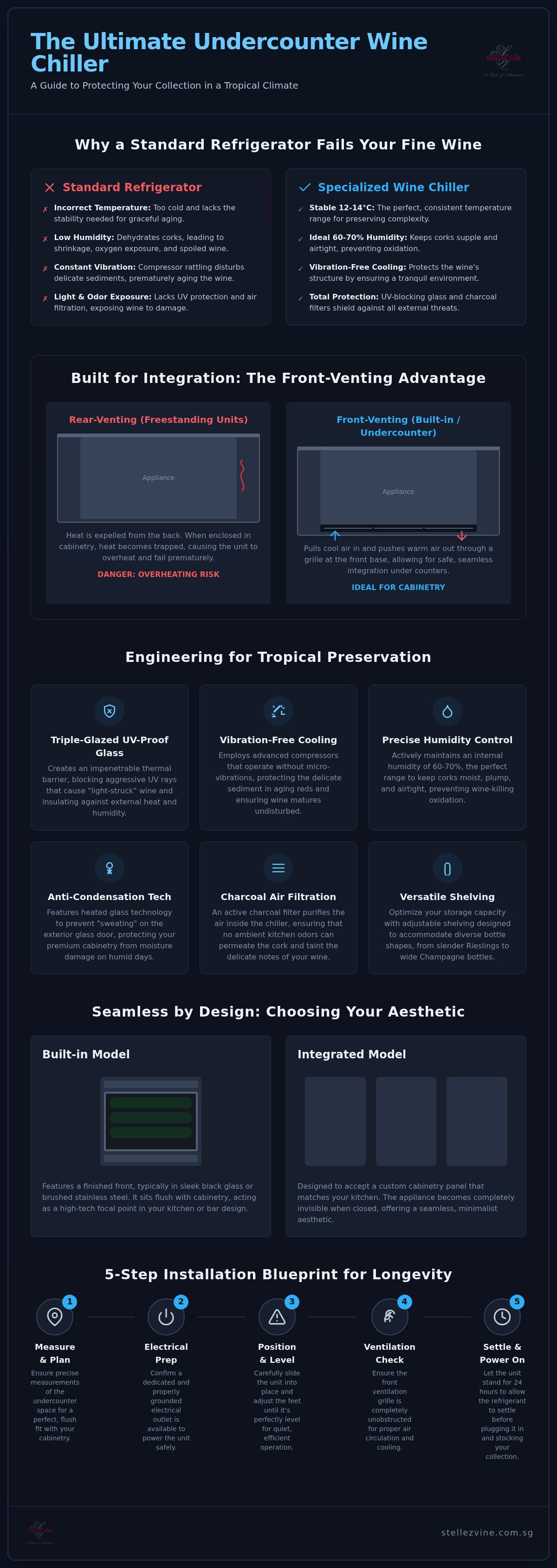
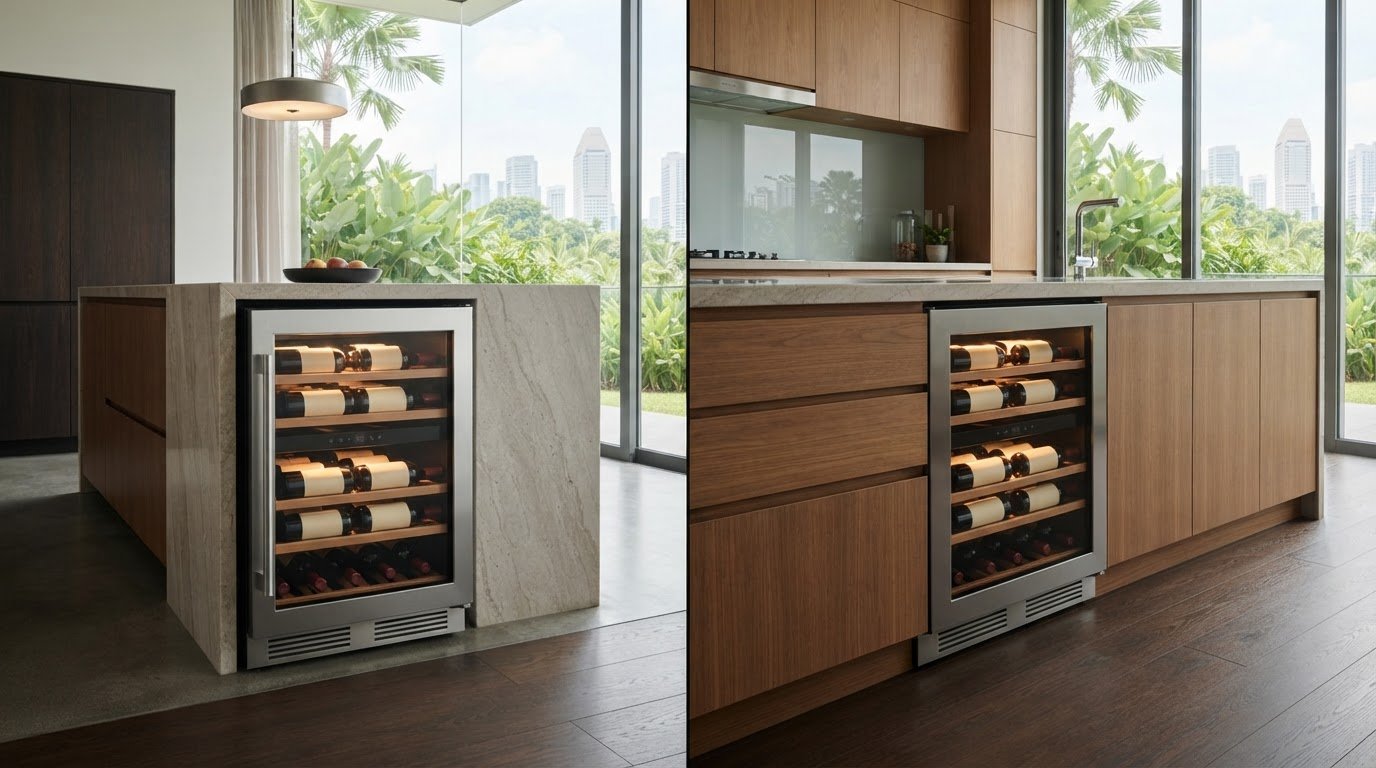
An undercounter wine chiller isn't just a compact fridge; it's a specialized piece of engineering designed to disappear into your kitchen architecture while performing a high-stakes task. Unlike freestanding units that require open space on all sides, these built-in solutions feature dedicated front-venting systems. This design choice allows them to sit flush against cabinetry, transforming unused space beneath a marble countertop into a high-performance preservation zone. For the modern Singaporean luxury apartment, where square footage is a calculated asset, this format has become the benchmark for blending epicurean passion with interior efficiency.
Don't confuse these units with standard beverage coolers. A beverage cooler is designed for rapid cooling of sodas and beers, often lacking the humidity controls and vibration-dampening technology essential for fine wine. A professional chiller, like those from Eurocave or Kadeka, maintains a steady 12°C to 14°C while managing hygrometry to keep corks supple. It's the difference between a temporary storage locker and a permanent sanctuary for your collection.
The Critical Role of Front-Venting Technology
Standard refrigeration units breathe from the back. When you shove a rear-vented unit into a tight cabinet, heat becomes trapped, forcing the compressor to work double time until it eventually fails. Front-venting technology pulls cool air in and pushes warm air out through a kickplate at the base. This front-breathing mechanism is what protects the sensitive internal components from the humid Singaporean climate. Proper air circulation is the single most important factor determining the technical longevity of any built-in appliance.
Built-in vs. Integrated: Understanding the Aesthetic
Designers often distinguish between built-in and integrated models based on their visual profile. Built-in units usually feature a finished front, often in sleek black glass or brushed stainless steel, that sits slightly forward or flush with the cabinet doors. In contrast, integrated models are designed to accept a custom cabinetry panel, allowing the appliance to become completely invisible when closed. If you prefer the high-tech allure of a professional bar, a black glass Eurocave unit offers a striking focal point. For a minimalist, quiet luxury kitchen, an integrated Liebherr cabinet provides a seamless, uninterrupted wood or lacquer finish. Select a finish that mirrors your existing hardware to create a cohesive, intentional aesthetic that elevates the entire room.
Engineering Excellence: Critical Features for Tropical Preservation
Preserving a fine vintage in a tropical climate requires more than just a cold box; it demands a sophisticated defense system against Singapore’s relentless environmental factors. With average relative humidity levels often exceeding 80%, a standard undercounter wine chiller must work significantly harder than its European counterparts. Without the right engineering, you risk mold growth on labels and, more critically, the gradual degradation of the wine itself. Every component must be optimized for stability, from the glass thickness to the compressor's motor.
Premium units from benchmark brands like Eurocave and Liebherr utilize triple-glazed, UV-protected glass doors to create an impenetrable thermal barrier. UV rays are particularly aggressive, capable of penetrating clear glass and triggering chemical reactions that lead to "light-struck" wine, which tastes flat and metallic. Beyond light, stillness is vital. Modern units employ vibration-free cooling systems. Even the slightest micro-vibrations from a cheap compressor can disturb the delicate sediment in aging reds, prematurely aging the wine and ruining its complexity. To maintain the purity of the environment, active charcoal filters are integrated to purify the air, ensuring that no kitchen odors permeate the cork and taint the liquid gold inside.
Anti-Condensation and Humidity Control
High humidity often leads to "sweating" on the exterior glass, which looks unsightly and can damage surrounding premium cabinetry. Sophisticated chillers feature heated glass technology to prevent condensation from forming, even on the most humid days. Internally, these units manage a precise humidity range of 60% to 70%. This specific level is essential to keep corks supple and airtight, preventing oxidation. Understanding these nuances is a core part of mastering long term wine storage Singapore collectors must prioritize to safeguard their assets.
Thermal Stability and Inverter Compressors
While traditional compressors cycle on and off abruptly, inverter technology allows the motor to run at varying speeds, maintaining a constant temperature with surgical precision. This eliminates the thermal spikes that can stress a wine’s structure over time. For 24/7 operation in a tropical setting, this technology also provides unmatched energy efficiency, reducing the workload on the appliance and extending its lifespan. If you are looking to upgrade your setup, you can discover our curated selection of high-performance chillers designed specifically for these demanding conditions.
Capacity and Configuration: Selecting the Optimal Model
Choosing the right undercounter wine chiller requires more than just counting your current collection; it involves anticipating your future tastes. Most residential models offer capacities between 18 and 54 bottles. While a 54-bottle unit sounds generous, remember that manufacturers calculate these numbers using standard 750ml Bordeaux bottles. If your collection leans toward the wider silhouettes of Burgundy or the heavy glass of Champagne, your actual capacity might drop by 20% or more. Balancing sheer volume with the physical reality of your bottles is the first step toward a functional home bar.
Evaluate your collection's diversity before committing to a specific layout. A high-density configuration might maximize bottle count, but it often sacrifices the ease of movement required to organize a growing cellar. Prioritize models that offer a mix of storage styles, ensuring you have the vertical clearance for non-standard shapes without forcing bottles into tight spaces where labels might be damaged.
Single Zone vs. Dual Zone: Which Suits Your Palate?
Decide how you intend to interact with your wine. A single-zone chiller maintains a uniform temperature throughout the cabinet, making it the superior choice for serious collectors focused on long-term aging. Setting a single zone to 12-14°C provides the perfect sanctuary for maturing complex reds. If your collection features diverse regions, perhaps a deep selection of South African wine known for its aging potential, the stability of a single zone is unmatched.
Conversely, a dual-zone model offers lifestyle flexibility. It allows you to cellar reds in one compartment while keeping whites or sparkling wines at a crisp 7°C in the other. This configuration turns your appliance into a high-performance serving station, ensuring every bottle is poured at its absolute peak. Assess your habits: do you buy to hold, or do you buy to host?
Shelf Design and Bottle Versatility
Look beyond the door and examine the shelving architecture. Fixed shelves often lead to label scuffing and restricted access, which is why premium units prioritize telescopic shelving. These smooth-gliding racks allow you to view your entire inventory without clashing bottles or straining your wrist. Kadeka is particularly renowned for its versatile shelf configurations, offering adjustable wooden racks that accommodate diverse bottle shapes with ease.
Protective wooden shelves also serve a dual purpose. They act as natural shock absorbers, further dampening any residual micro-vibrations that could disturb the wine’s development. When selecting your model, prioritize units that offer at least 10-12cm of clearance between shelves if you plan on storing larger formats. Quality storage isn't about how many bottles you can cram inside; it's about how safely and elegantly you can access them.
Integration and Installation: Designing Your Dream Home Bar
Successful integration is where your technical investment becomes a permanent part of your home's architectural DNA. An undercounter wine chiller shouldn't just fit into a gap; it should look as though the kitchen was built around it. Achieving this level of seamlessness requires a shift from general DIY thinking to precision engineering. If you neglect the physical logistics of the niche, even the most expensive Eurocave or Liebherr unit will underperform or disrupt the visual flow of your cabinetry.
Follow this five-step process to ensure a professional-grade installation:
Precision Measurement: Verify the niche dimensions at three points: the front, middle, and back. Standard undercounter heights usually range between 820mm and 870mm, but always allow for a 2-3mm buffer on all sides to prevent cabinet friction.
Socket Strategic Placement: Never place the power outlet directly behind the chiller. This causes "depth creep," where the unit protrudes past the cabinet line. Install the socket in an adjacent cabinet and feed the cable through a side hole.
Floor Leveling: Use a spirit level to check the floor's pitch. Even a minor tilt increases compressor vibration, which generates noise and disturbs the wine’s sediment.
Ventilation Validation: Confirm the front kickplate is entirely unobstructed. Decorative plinths must be notched or replaced with a ventilated grille to maintain the front-breathing cycle.
Countertop Clearance: Ensure the top of the unit doesn't make direct contact with the underside of the stone or wood. A small air gap prevents heat transfer to your expensive surfaces.
Cabinetry Clearances and Ventilation Paths
While we've established that front-venting is essential, the unit still requires "breathing room" to operate efficiently. A common mistake is sealing the unit too tightly within the joinery. You need a clear path for air to move through the base grille. When aligning the kickplate, ensure it sits flush with your existing kitchen plinth. This creates a continuous line that hides the mechanical nature of the appliance. If your countertop features a waterfall edge, pay extra attention to the depth clearances to avoid a clashing aesthetic.
Lighting and Ambiance
Ambiance is the final layer of a sophisticated home bar. Always opt for "cool" LED lighting. Unlike traditional bulbs, LEDs don't emit infrared heat, protecting your collection while casting a refined glow over your labels. A well-lit display serves as a focal point, turning your storage into a conversation piece. Whether you are stocking rare vintages from an online wine shop or showcasing a curated selection of daily drinkers, the psychological impact of a professional display is undeniable. It signals a respect for the craft and a commitment to quality living.
Ready to transform your kitchen into a connoisseur’s sanctuary? You can consult with our specialists today to find the perfect dimensions for your space.
Curating the Collection: Matching Your Chiller to Your Lifestyle
Think of your undercounter wine chiller as the "active" component of your cellar. While a full-sized cabinet or remote storage handles long-term maturation, this unit serves as your primary ready-to-drink station. It's the bridge between a vast inventory and the immediate pleasure of a perfectly poured glass. To maximize this limited real estate, you need a disciplined curation strategy that reflects how you actually live and host. It isn't just about storage; it's about accessibility and the ritual of service.
We recommend a balanced inventory approach: 50% daily drinkers, 30% special occasion bottles, and 20% short-to-medium-term aging. This ensures you always have a crisp white for a Tuesday evening while keeping a few "rising stars" in reserve. For those looking to expand their horizons beyond the traditional, it’s the perfect place to showcase adventurous selections like Matias Riccitelli wine, where the vibrant energy of Argentinian terroir is best preserved at precise, stable temperatures. Ultimately, a chiller is only as good as the liquid it protects; it is the silent guardian of your sensory experiences.
The "Rotation Strategy" for Small Capacities
Managing a 30-bottle limit requires a methodical rotation of stock. If you maintain a larger collection elsewhere, use your undercounter unit for stabilization. Wines that have traveled or been stored in bulk benefit from a few weeks of thermal and vibration-free rest before they're opened. This period of "calming" allows the wine’s structure to settle after any transport stress. A perfectly stabilized bottle, pulled directly from your undercounter wine chiller, transforms a simple gathering into a sophisticated dinner party where every vintage performs at its absolute peak. This rotation ensures your "software" (the wine) is always as refined as your "hardware" (the appliance).
Stellez Vine Singapore: Your Partner in Storage and Selection
At Stellez Vine Singapore, we don't just sell appliances; we curate lifestyles. As authorized retailers for Eurocave, Kadeka, and Liebherr, we understand the technical nuances of tropical preservation. More importantly, we're passionate connoisseurs who understand the wine itself. Buying your storage solution from a partner who also handpicks the bottles ensures a holistic approach to your collection. We invite you to consult with the experts at Stellez Vine Singapore to find a storage solution tailored to your space and a wine selection tailored to your palate. We've done the research so you don't have to.
Elevate your home bar with the confidence that comes from professional-grade engineering and expert curation. Discover our full range of premium wine chillers and fine wines today and begin your journey toward a flawlessly preserved collection.
Secure Your Legacy: The Future of Your Collection
Investing in a premium undercounter wine chiller is a commitment to both architectural elegance and technical precision. Your bottles deserve a sanctuary. By prioritizing front-venting engineering and triple-glazed UV protection, you ensure that Singapore’s humidity never compromises your most prized vintages. A seamless installation, paired with a disciplined rotation strategy, transforms your kitchen into a professional-grade tasting room.
As authorized dealers for Eurocave and Kadeka, we specialize in optimizing storage for the unique demands of the tropical climate. Our team provides more than just hardware. We offer white-glove delivery and installation support to ensure your unit performs flawlessly from day one. Whether you're safeguarding a rare vertical or preparing for your next gala, we bridge the gap between world-class engineering and the fine wine you love.
Elevate your home and protect your liquid assets with a partner who understands the craft as deeply as you do.
Frequently Asked Questions
Does an undercounter wine chiller need a dedicated power outlet?
Yes, you should always provide a dedicated power outlet for your undercounter wine chiller. Sharing a socket with heavy appliances like dishwashers or ovens can lead to power surges or tripped breakers, which puts your compressor at risk. Since wine preservation requires absolute thermal stability, a direct connection ensures that your collection remains undisturbed by external electrical fluctuations. Plan your socket placement in an adjacent cabinet to maintain a flush, integrated finish.
Can I use a freestanding wine fridge under my counter if I leave a gap?
No, you cannot safely use a freestanding unit in an undercounter niche, even with a visible gap. Freestanding models disperse heat through the side or rear panels. When enclosed by cabinetry, this heat becomes trapped, forcing the compressor to overwork until it eventually fails. Always select a front-vented model specifically engineered for built-in use. This choice protects your appliance's longevity and prevents heat damage to your premium kitchen joinery.
How much clearance do I need for a built-in wine chiller?
Precision is vital for a seamless aesthetic. While front-venting units are designed for tight fits, you should leave a 2mm to 3mm gap on either side to prevent the door from rubbing against cabinetry. For the height, aim for a 5mm clearance beneath the countertop to allow for minor floor leveling adjustments. These small buffers ensure that the unit slides into place without damaging your bespoke kitchen panels or restricting the door's swing.
What is the best temperature for a dual-zone undercounter chiller?
Set your "cellar" zone to 12°C for long-term maturation of all wine types. If you utilize the second zone for service, 7°C is the benchmark for crisp whites and Champagne, while 17°C is ideal for bringing full-bodied reds to their peak expression. This configuration allows you to balance the technical needs of preservation with the immediate lifestyle demand for perfectly chilled service. Always monitor the internal hygrometry to ensure corks stay supple.
Why is my wine chiller "sweating" on the outside in Singapore?
Condensation occurs when the high humidity of the Singaporean climate meets the cold surface of the chiller's glass door. If your undercounter wine chiller lacks heated glass or sufficient thermal insulation, "sweating" becomes inevitable. To resolve this, ensure your unit is equipped with triple-glazed, argon-filled glass. You should also check that the front ventilation grille is completely unobstructed, as poor airflow can cause the exterior temperature of the unit to drop significantly.
How often should I change the charcoal filter in my wine cabinet?
Replace your active charcoal filter every 12 months to maintain a pristine internal environment. Over time, these filters lose their ability to neutralize ambient odors from the kitchen, such as spices or cleaning agents. If left unchanged, these scents can permeate the cork and taint the character of your wine. Regular replacement is a simple, proactive step that guarantees your collection remains as pure and expressive as the day it was bottled.
Are undercounter wine chillers noisy in an open-concept kitchen?
Premium chillers are remarkably quiet, typically operating at sound levels below 40 decibels. High-end brands like Eurocave utilize vibration-dampening technology and silent compressors to ensure the appliance doesn't disrupt the flow of an open-concept living area. While you might hear a soft hum during a cooling cycle, it shouldn't interfere with conversation or dining. Proper floor leveling is essential here, as an uneven base can amplify mechanical noise and lead to unwanted rattling.
Do I need a plumber for a wine chiller installation?
No, a plumber isn't required for a standard installation. Unlike ice makers or some refrigerators, a wine chiller is a self-contained system that doesn't need a dedicated water line or drainage. The only requirement is a standard electrical connection. However, if you are incorporating the unit into a new kitchen island, you should coordinate with your electrician and cabinet maker to ensure the niche dimensions and power access are perfectly aligned before the final fit.

Comments