
Mastering the Chill: The Connoisseur’s Guide to Energy Efficient Wine Coolers in Singapore

Did you know that Singapore’s regulated electricity tariffs surged by 17% in the third quarter of 2026? For the dedicated collector, this spike transforms a refined passion into a mounting monthly expense. You likely understand the struggle of finding an energy efficient wine cooler Singapore homes can sustain without watching utility costs spiral. It's a common anxiety; you want to shield your rare vintages from the relentless 85% humidity while maintaining a stable, cost-effective environment.
Discover how to secure your liquid assets with storage solutions tailored specifically for our unique tropical climate. This guide promises to show you how to achieve a rock-solid 12°C storage environment while enjoying whisper-quiet operation and significantly lower overheads. By selecting the right technology, you can elevate your home lifestyle, reduce your carbon footprint, and protect every bottle with absolute confidence.
We'll examine the unmatched efficiency of inverter compressors and the superior UV protection offered by premium brands like Eurocave, Kadeka, and Liebherr. You'll learn to identify the specific features that prevent condensation, stabilize internal temperatures, and ensure your investment matures exactly as the winemaker intended.
Table of Contents
The Economics of Wine Storage in Singapore’s Tropical Climate
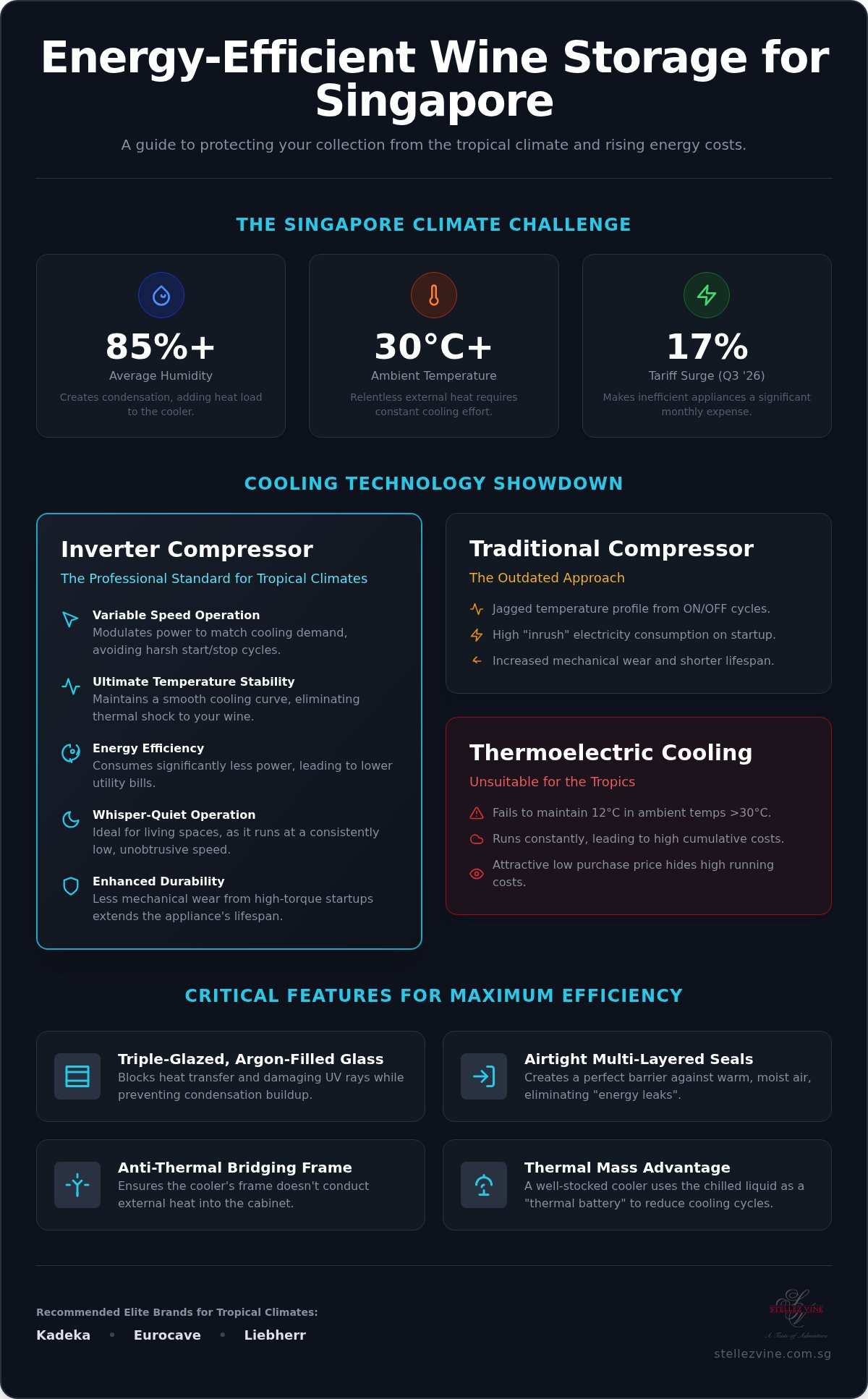
Maintaining a pristine 12°C environment while the outside air swelters at 30°C creates a unique financial challenge known as the "Tropical Tax." In Singapore, your cooling unit doesn't just rest; it fights a relentless battle against ambient heat that wants to seep through every seal. With SP Group’s regulated electricity tariff sitting at 34.78 cents per kWh (including GST) as of late 2026, the choice of an energy efficient wine cooler Singapore collectors can trust is no longer a luxury. It is a fundamental requirement for sustainable ownership.
Efficiency isn't just about the compressor; it's about thermal mass and consistency. A well-stocked fridge actually consumes less energy over time because the chilled liquid in the bottles acts as a thermal battery. This stable mass prevents the temperature from fluctuating wildly every time you open the door, reducing the frequency of energy-intensive cooling cycles. By contrast, an empty or poorly insulated unit will cycle constantly, driving up your monthly bill and shortening the lifespan of the appliance.
Heat Gain and the Battle Against Humidity
Singapore’s high humidity, often exceeding 80%, adds another layer of complexity. When warm, moist air meets a cold surface, condensation forms. This process releases latent heat, which the cooler must then work to remove. Premium units utilize high-quality, multi-layered door seals to create an airtight barrier, ensuring that the "energy leaks" common in cheaper models are eliminated. Thermal bridging is the process where heat travels through conductive materials in the frame or glass, directly undermining the unit's ability to maintain a steady internal temperature without excessive power draw.
Calculating the Real Cost of Ownership
Smart collectors look beyond the initial price tag to evaluate the total cost of ownership over five to ten years. While thermoelectric cooling technology might seem attractive for its low entry price, it often fails to maintain the necessary 12°C when ambient temperatures rise above 30°C, leading to constant operation and higher cumulative costs. Choosing a professional-grade compressor model designed for the tropics ensures your investment pays for itself through lower utility bills and the preservation of your wine's market value. For those serious about their collection, understanding the nuances of long term wine storage Singapore requires balancing these economic realities with technical performance. The cheapest unit to purchase is almost always the most expensive to run, making energy efficiency the ultimate benchmark of quality.
Decoding Efficiency: Inverter Compressors vs. Thermoelectric Cooling
Selecting an energy efficient wine cooler Singapore enthusiasts can trust requires looking beneath the sleek exterior. The relationship between power consumption and wine health is inseparable. High-performance cooling isn't just about reaching a number on a digital display; it's about how the unit arrives there and how it maintains that state. Traditional compressors are the blunt instruments of the appliance world. They operate on a binary cycle, blasting cold air at 100% capacity until the target is reached, then shutting off entirely. This creates a jagged temperature profile and consumes a massive "inrush" of electricity every time the motor restarts.
The Superiority of Inverter Technology
Inverter technology represents a more refined approach to climate control. Instead of the aggressive start-stop cycles of standard motors, an inverter compressor modulates its speed to match the cooling demand. When the internal environment is stable, the motor slows to a whisper, consuming only a fraction of the power required by traditional models. This creates a smooth cooling curve that eliminates the thermal shocks associated with older technology. By maintaining a consistent, low-speed operation rather than a series of high-torque bursts, these units ensure that your vintage remains undisturbed in a perfectly stable environment.
Inverter compressors have a longer lifespan in tropical climates because they avoid the mechanical wear and tear associated with thousands of high-torque start cycles. This durability is essential in a region where the ambient heat forces the cooling system to remain active for longer periods. Additionally, the reduction in mechanical friction makes these units exceptionally quiet. This is a vital feature for collectors living in modern, open-plan apartments where a loud, cycling compressor can disrupt the home's tranquility. While wine fridges are not always subject to Singapore's Energy Label scheme, savvy buyers use these technical benchmarks to judge motor quality and long-term reliability.
Thermoelectric Limitations in the Tropics
While thermoelectric units are often marketed as affordable entry-level options, they are generally unsuitable for the Singaporean climate. These systems rely on the Peltier effect to transfer heat, which is a silent process but one with very limited cooling power. Most thermoelectric coolers can only lower the internal temperature by about 10°C to 15°C relative to the room. In a non-air-conditioned Singaporean home where temperatures often hit 31°C, a thermoelectric unit will struggle to reach the necessary 12°C for long-term storage.
Running a Peltier chip at maximum capacity 24 hours a day is incredibly inefficient. Because these units lack the cooling "muscle" of a compressor, they often run constantly without ever reaching the desired set point. This leads to higher electricity bills and a frustrated collector. Thermoelectric models only make sense in Singapore if they are kept in a room that is air-conditioned around the clock, which itself adds to the total energy footprint of your collection.
Energy-efficient storage also focuses on the finer details that protect your investment. Premium models utilize LED lighting, which emits virtually no heat, and UV-protected glass to block harmful rays without compromising thermal insulation. These features, combined with high-precision motors, significantly reduce micro-vibrations that can disturb delicate sediment in older wines. Discover the perfect balance of performance and protection by browsing our curated selection of climate-ready storage.
Performance Benchmarks: Comparing Kadeka, Eurocave, and Liebherr
When selecting an energy efficient wine cooler Singapore collectors must weigh technical specifications against real-world performance in our harsh humidity. While many brands claim efficiency, only a few have engineered their systems to thrive when the external environment consistently hits 30°C. We've curated a comparison of the three industry leaders that define the benchmark for thermal stability and low power consumption in the tropical context.
Kadeka: The Pioneer of Inverter Storage
Kadeka has long been the preferred choice for Singaporean households seeking a balance between sophisticated design and practical reliability. Their Signature Series was among the first to introduce inverter technology to the local market, specifically addressing the need for variable-speed cooling. By modulating the compressor speed, Kadeka units avoid the massive energy spikes associated with traditional on-off cycles. This results in a significantly lower annual electricity draw compared to standard budget models. For a deeper look at their specific technical advantages, consult our Kadeka wine fridge guide to understand how they maintain optimal conditions in HDB and condo environments alike.
Eurocave and Liebherr: The Premium Efficiency Leaders
Eurocave represents the "Gold Standard" of thermal retention. Their engineering philosophy centers on the "Cellar" concept, utilizing exceptionally thick insulation that mimics the natural temperature-dampening properties of a limestone cave. This heavy-duty insulation means the compressor runs less frequently, even when the ambient air is sweltering. Their units are designed with low-wattage precision, ensuring that the standby energy draw is kept to an absolute minimum. When you invest in a Eurocave, you aren't just buying a fridge; you're buying a high-performance thermal envelope that shields your wine from the "Tropical Tax" mentioned earlier.
Liebherr brings German engineering to the forefront with a focus on airflow efficiency and climate-class ratings. They utilize high-performance vacuum insulation panels that provide superior thermal resistance without the bulk of traditional foam. This allows for a larger internal capacity while maintaining a slim external profile. Liebherr units are particularly adept at managing Singapore’s 85% humidity. They use advanced sensors to ensure that moisture is recycled to maintain cork health rather than being allowed to condense on the glass or walls, which would force the unit to work harder. Each brand approaches the challenge differently:
Kadeka: Focuses on inverter-driven mechanical efficiency and value.
Eurocave: Prioritizes passive thermal retention and thick-walled insulation.
Liebherr: Employs vacuum technology and precision airflow management.
Choosing between these leaders depends on your specific collection size and where the unit will be placed. Regardless of the choice, moving away from entry-level appliances toward these benchmarked brands ensures your collection matures perfectly while your utility bills remain manageable.
Critical Features for Maximising Thermal Retention
While the compressor acts as the heart of your storage system, the cabinet's physical construction serves as its shield. In a climate where humidity frequently reaches 85%, the structural integrity of your unit determines how often that "heart" needs to beat. Superior thermal retention isn't just a matter of keeping heat out; it's about creating a perfectly sealed micro-environment that requires minimal energy to maintain. Every design choice, from the gas between the glass panes to the material of the shelves, contributes to the overall performance of an energy efficient wine cooler Singapore collectors can trust for decades.
Glass Technology and UV Protection
Triple-glazed glass is a non-negotiable requirement for any serious collector in the tropics. These three layers of tempered glass create two insulating chambers that drastically reduce heat transfer. To further enhance this barrier, premium manufacturers like Eurocave and Kadeka inject Argon gas into these chambers. Argon is denser than air and provides an invisible shield that blocks the conduction of heat, ensuring the external tropical air doesn't compromise the internal 12°C sanctuary. This advanced layering is also the primary defense against external condensation, a common nuisance in Singapore that occurs when cold glass meets warm, moist air.
For units placed in bright living rooms or near windows, "Low-E" (Low-Emissivity) glass is essential. This specialized coating reflects infrared and ultraviolet light away from your collection. UV protection doesn't just prevent the "light-struck" effect that ruins a wine's delicate chemistry; it also prevents the internal temperature from rising due to solar gain. By blocking these rays, the unit doesn't have to compensate for external light energy, leading to a more stable and efficient cooling cycle. Digital thermostats provide the final layer of precision, allowing for 0.1°C adjustments that prevent the energy waste caused by over-cooling or frequent temperature swings.
Internal Airflow and Shelving Design
Uniformity is the key to efficiency. Fan-assisted cooling systems ensure that air circulates evenly throughout the cabinet, preventing "hot spots" that would otherwise force the compressor to run longer. This gentle airflow works in tandem with active charcoal filters, which purify the air and remove odors that could permeate the cork. By maintaining high internal air quality, you won't need to open the door frequently to "air out" the unit, keeping the chilled air exactly where it belongs.
Shelving materials also play a subtle but vital role in thermal stability. While metal shelves are common in budget units, handpicked wooden shelves provide better vibration dampening and act as a thermal buffer. Wood retains its temperature better than thin metal, contributing to the overall thermal mass of the unit. When loading your cooler, ensure you leave small gaps between bottles to allow for unobstructed air circulation. A crowded unit with poor airflow forces the fans and compressor to work twice as hard to reach the same result. Explore our exclusive range of professional storage solutions to find a model that masters these technical details with elegance.
Elevating Your Collection with Stellez Vine Singapore’s Energy-Efficient Solutions
At Stellez Vine Singapore, we act as the authoritative gatekeeper for your collection. We don't just supply appliances; we curate a protective environment for your most valued liquid assets. Every brand in our portfolio must survive the rigorous "Singapore test," a benchmark where only the most resilient systems from Eurocave, Kadeka, and Liebherr are selected for their ability to thrive in our local humidity. We understand that an energy efficient wine cooler Singapore homes require must do more than just reach a temperature. It must maintain absolute thermal integrity without a punishing draw on your utility bill.
Curated Storage for Curated Vintages
Investing in a world-class Matias Riccitelli wine is a commitment to quality that deserves an equally committed storage solution. These vibrant, expressive labels, much like our handpicked South African and French selections, are highly sensitive to the thermal fluctuations and energy spikes discussed earlier. Choosing the right capacity is a strategic decision. We assist you in calculating your storage needs based on your current inventory and long-term acquisition goals, ensuring your unit remains efficient as your collection grows. Relying on a specialized online wine shop with technical expertise ensures you receive advice from connoisseurs who understand the synergy between a fine vintage and its environment.
Your Next Steps to Premium Storage
Securing your investment follows a clear, methodical path designed for the modern minimalist. We value your time and prioritize a seamless transition from selection to cellar. Our process follows a refined three-step journey:
Tailored Consultation: Speak with our experts to match a Kadeka or Eurocave model to your specific spatial constraints and bottle count.
Professional Logistics: Experience dependable, localized delivery that respects the delicate nature of high-end cooling equipment.
Seamless Integration: Enjoy a comprehensive setup where we ensure your unit is positioned for optimal airflow and peak energy efficiency.
Don't let the "Tropical Tax" of rising electricity costs compromise the quality of your lifestyle. Whether you're housing a few choice bottles of Savage wines or an extensive collection of French classics, we provide the benchmark storage solutions that define living well in Singapore. Savor the confidence that comes with professional-grade protection. Protect your passion, reduce your overheads, and elevate your home experience by choosing a storage solution that is as refined as the wine it holds.
Secure Your Legacy with Sustainable Storage
Mastering the tropical climate is the ultimate challenge for any serious collector. We've explored how superior insulation and inverter technology don't just lower your monthly utility bills; they provide the rock-solid thermal stability your finest vintages demand. By choosing an energy efficient wine cooler Singapore enthusiasts can rely on, you're investing in the longevity of your collection and the sophisticated tranquility of your home environment. The combination of triple-glazed glass and precision engineering ensures that every bottle, from South African gems to French icons, matures exactly as the winemaker intended.
As an authorized distributor for Eurocave and Kadeka, Stellez Vine Singapore serves as your specialized partner in tropical storage. Our experts are ready to help you navigate technical benchmarks and find a solution that fits your specific space and collection goals. Benefit from our fast national delivery and the peace of mind that comes with professional curation and localized attentiveness. It's time to elevate your storage standards and protect the heritage of your cellar.
Explore Our Energy-Efficient Wine Cooler Range at Stellez Vine Singapore and discover a world where craftsmanship meets climate control. Savor every glass knowing your investment is shielded by the very best in modern cooling technology.
Expert Answers for Smart Wine Storage
How much electricity does a wine fridge use in Singapore annually?
A standard compressor-based model typically costs between S$3.40 and S$3.80 per month to operate, totaling approximately S$40 to S$46 annually based on 2026 electricity tariffs. These figures assume the unit is kept in a well-ventilated area. High-performance models from Eurocave or Kadeka leverage superior insulation to stay at the lower end of this range. Actual consumption varies based on how often the door is opened and the ambient temperature of your home.
What is the best temperature setting for energy efficiency and wine health?
Setting your unit to 12°C provides the perfect equilibrium between maturing your vintages and maintaining energy efficiency. While some collectors prefer cooler serving temperatures for whites, a constant 12°C ensures the compressor doesn't overwork. Drastic temperature drops force the motor into high-torque cycles that consume significantly more power. Keeping a consistent set point prevents the thermal shocks that can prematurely age delicate wines while keeping your utility bills predictable and manageable.
Is an inverter wine cooler really worth the extra cost in Singapore?
An inverter-driven system is absolutely worth the investment for any collector seeking an energy efficient wine cooler Singapore weather won't overwhelm. Unlike traditional motors that spike in power every time they restart, inverters modulate their speed to maintain a steady climate. This results in lower electricity draw, whisper-quiet operation, and reduced mechanical wear. Over a five-year period, the savings on utility bills and the lack of repairs often exceed the initial price premium.
Can I put my wine cooler in a kitchen without air conditioning?
You can place a compressor-based cooler in a non-air-conditioned kitchen, provided there is adequate ventilation around the unit. Avoid placing the appliance next to ovens or in direct sunlight, as external heat sources force the cooling system to run longer. For these warmer spaces, prioritize models with Climate Class ratings designed for tropical environments. Ensure at least a 5cm gap around the sides and back to allow heat to dissipate effectively from the condenser.
How does humidity affect the energy consumption of my wine chiller?
High humidity levels in Singapore force your chiller to work harder because moisture carries latent heat. When you open the door, humid air enters and condenses on the cold internal surfaces, requiring the system to remove that extra heat. Premium units use multi-layered door seals and advanced airflow management to minimize this exchange. Maintaining a tight seal is the most effective way to prevent humidity from driving up your energy consumption and causing internal frost.
Are thermoelectric wine coolers good for Singaporean weather?
Thermoelectric units are generally unsuitable for the Singaporean climate unless they are kept in a room with 24/7 air conditioning. These systems struggle to maintain the necessary 12°C when ambient temperatures exceed 25°C, often running at maximum capacity without ever reaching the target. This constant operation leads to high energy waste and unstable storage conditions. For reliable performance in our tropical heat, a compressor-based model remains the only practical choice for serious collectors in Singapore.
How often should I service my wine cooler to maintain its efficiency?
Schedule a basic maintenance check every twelve months to ensure your unit remains at peak efficiency. The most critical task is cleaning the condenser coils, as dust buildup prevents heat from escaping, forcing the compressor to work harder. You should also inspect the door seals for any cracks or energy leaks that allow cool air to escape. A well-maintained unit uses up to 25% less energy than one neglected and choked by household dust.
Does the number of bottles inside affect how much energy the cooler uses?
A full cooler is actually more energy-efficient than a half-empty one due to the principle of thermal mass. Once your bottles reach the target temperature, the chilled liquid helps maintain the internal climate, acting like a battery that resists temperature changes. Every time you open the door, the cold bottles prevent the internal air from warming up too quickly. This reduces the frequency of cooling cycles, allowing the compressor to rest for longer periods.

Comments