
Investment Wine Storage at Home: Collector Guide (2026)

Updated: Oct 5
A standard domestic beverage cooler is quietly compromising your most valuable bottles. Fine wine isn't mere pantry stock; it's a delicate, living asset that rapidly deteriorates under continuous micro-vibrations, ambient light exposure, and erratic temperature shifts. Establishing authentic investment grade wine storage at home demands a decisive shift away from decorative kitchen chilling and toward uncompromising climate engineering.
You already know the quiet anxiety of exposing rare allocations to thermal shock, dried corks, or tainted labels in Singapore's punishing tropical warmth. Safeguarding physical provenance shouldn't mean surrendering immediate physical access to your collection. Discover how to engineer museum-grade aging conditions within your private residence to safeguard bottle condition, aromatic complexity, and long-term financial appreciation. Ahead, we evaluate the exact environmental benchmarks required to protect fine vintages, accompanied by an authoritative selection guide covering premier preservation cabinets from Eurocave, Liebherr, and Kadeka to keep your liquid assets auction-ready.
Table of Contents
What Defines Investment Grade Wine Storage at Home?
The Chemistry of Maturation: Why Fine Wine Demands Precision
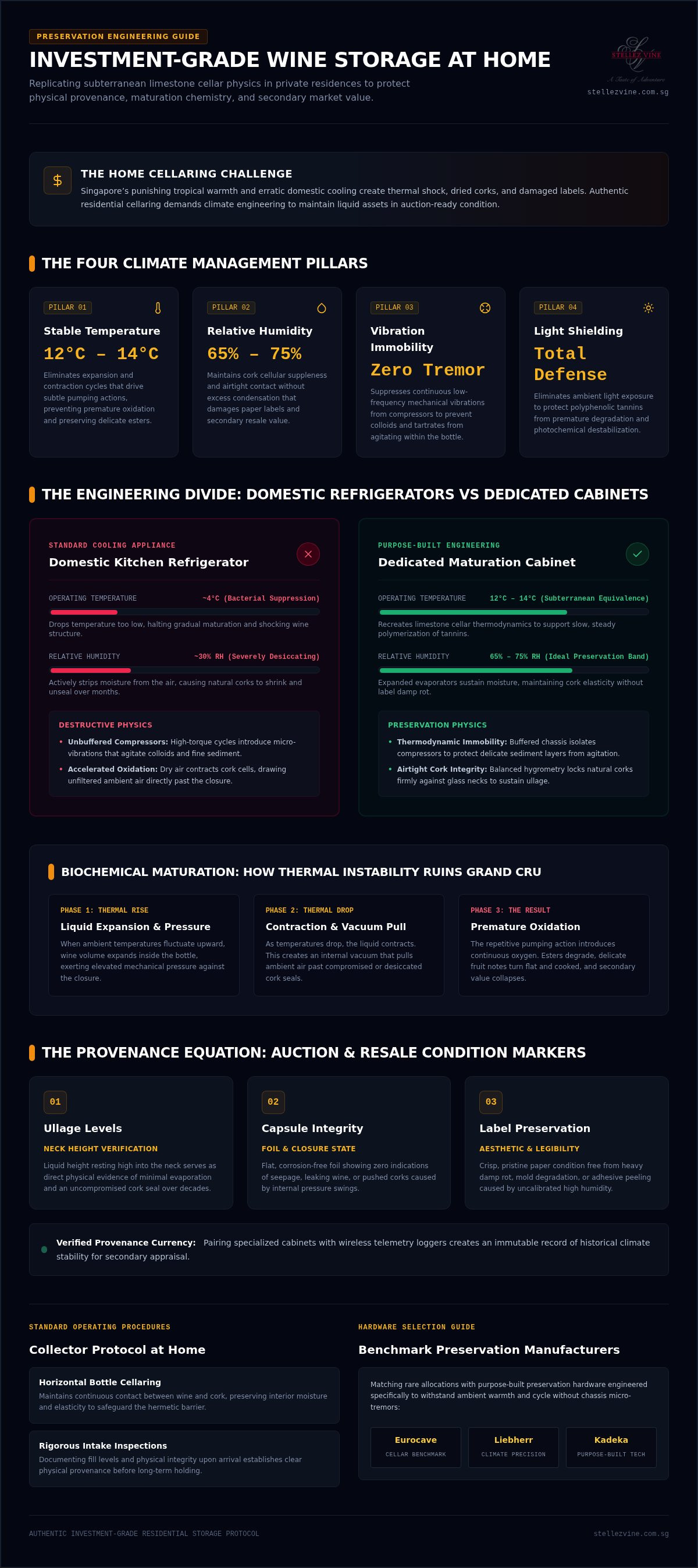
Fine wine matures through gradual, highly sensitive biochemical reactions. Over decades, delicate esters develop, acidity integrates, and polyphenolic tannins slowly polymerize to build tertiary aromatic complexity. Thermal instability disrupts this evolution. When ambient temperatures rise, wine expands inside the glass, increasing internal pressure against the closure. As temperatures drop, the liquid contracts, pulling ambient air past the seal.
The Provenance Equation: Protecting Resale and Auction Value
Secondary market appraisers and auction specialists inspect physical condition markers as direct evidence of historical cellaring quality. When evaluating residential lots, inspection teams focus on specific physical indicators:
Ullage levels: Liquid height resting high into the neck, proving minimal evaporation over time.
Capsule integrity: Flat, corrosion-free foil showing zero signs of leaking or pushed corks.
Label preservation: Crisp paper condition free from heavy damp rot or peeling adhesive.
Pairing specialized storage cabinets with wireless telemetry loggers creates an immutable record of historical performance. Documented continuous climate logs turn residential cellaring into verified provenance currency. Read our guide on long term wine storage in Singapore to explore how specialized preservation hardware overcomes equatorial ambient heat to protect asset condition and future secondary value.
Standard Refrigerators vs Dedicated Cabinets: The Engineering Divide
Many novice collectors assume an undercounter drink fridge or spare kitchen refrigerator provides adequate preservation. In reality, everyday domestic appliances operate on thermal principles directly opposed to the delicate requirements of investment grade wine storage at home. Domestic refrigerators are engineered to suppress bacterial growth on perishable food by dropping temperatures near four degrees Celsius while stripping ambient moisture out of the air. Wine cabinets operate as self-contained maturation ecosystems designed to sustain life rather than freeze it in time.
Humidity Dynamics: Why Dry Air Destroys Natural Corks
Kitchen refrigerators routinely force interior relative humidity down to roughly thirty percent. This dry environment desiccates natural cork closures over several months. Once a cork loses internal moisture, it loses mechanical elasticity and begins to shrink away from the glass neck. Unfiltered air seeps inside, precipitating rapid oxidation that irreversibly ruins prized vintages.
Dedicated wine maturation cabinets reverse this risk. By managing refrigeration cycles across expanded evaporator surfaces, benchmark preservation cabinets sustain a steady sixty-five to seventy-five percent relative humidity. This ideal hygrometric band keeps cork cells supple and airtight, ensuring the interior ullage remains intact without creating excessive condensation that deteriorates collectible labels.
Vibration and Light: The Invisible Threats to Aged Tannins
Standard cooling units cycle on and off using unbuffered, high-torque compressors. Every mechanical cycle introduces low-frequency micro-vibrations across the internal chassis:
Sediment agitation: Constant micro-tremors prevent fine colloids and tartrates from naturally settling, clouding clarity.
Molecular disruption: Kinetic friction artificially accelerates chemical energy, blunting tertiary bouquet development.
Structural fatigue: Physical agitation wears down the structural grip between glass and cork seals.
Purpose-built cabinets decouple their cooling circuits using silent variable-speed compressors, rubberized chassis mounts, and vibration-damped wooden shelving. They also combat photochemical decay. Sunlight and indoor fluorescent tubes emit ultraviolet rays that excite riboflavin and amino acids in wine, producing foul sulphur compounds known as lightstrike. Dedicated units block these wavelengths using solid insulated doors or argon-charged, triple-pane Low-E glass.
If you want to secure high-value allocations against mechanical stress, explore specialized cabinets through authorized preservation specialists who pair fine international allocations with engineering built specifically for long-term cellaring.
The Four Pillars of Residential Wine Climate Management
Thermal Stability and Airflow Optimization
Targeting an operational baseline between twelve and fourteen degrees Celsius is the gold standard for long-term maturation. Stability matters far more than minor baseline differences. A gradual swing of one degree across seasons causes little harm, but erratic daily swings create rapid expansion cycles that degrade wine structure.
True precision requires understanding the difference between cabinet air temperature and core liquid temperature. Air responds swiftly to opening doors, while dense liquid shifts slowly. Superior preservation cabinets leverage thermal inertia through dense internal walls and uniform convective airflow. This circulation prevents stagnant pockets or cold spots near the cooling elements. Serious collectors insert telemetry probes into sacrificial liquid bottles rather than measuring ambient air, capturing true liquid conditions and ensuring temporary electrical interruptions never trigger thermal panic.
Hygrometry and Odor Filtration Safeguards
Maintaining relative humidity between sixty-five and seventy-five percent protects natural cork elasticity without encouraging mould. When relative humidity dips below this threshold, corks dry out and contract. When it climbs above eighty percent, label paper rots and dissolves, destroying crucial auction provenance. Sophisticated home cabinets regulate hygrometry passively through internal condensation cycles, maintaining natural equilibrium without messy water reservoirs.
Air quality represents an equally critical safeguard. Natural cork breathes microscopically across years of rest. Unfiltered ambient environments introduce lingering household aromas, cooking oils, and cleaning solvents straight into the bottle. Dedicated cabinets employ continuous slow-cycle ventilation driven by replaceable activated charcoal filters. These filters scrub incoming air clean of volatile organic compounds before they reach the closure.
Cabinet architecture completes this protection. Shelving crafted from untreated beechwood absorbs ambient moisture without warping, dampening vibrations while emitting zero synthetic lacquer fumes. Read our breakdown on whether is a wine fridge worth it to evaluate how specialized hardware protects rare labels against intense tropical ambient conditions.
Collector Protocol: Maintaining Home Provenance and Integrity
Secondary market buyers often discount privately cellared collections because residential custody introduces uncertainty. Overcoming that assumption requires disciplined operational habits. Successfully executing investment grade wine storage at home means acting as your own cellar master, establishing auditable protocols that verify pristine condition from day one.
Receiving, Auditing, and Logging New Acquisitions
Every allocation entering your residence should pass through a systematic intake routine before resting in your cabinet:
Visual baseline photography: Capture high-resolution, macro images of the capsule top, vintage label, back label, and the fill level against a backlit grid.
Document archival: Digitise physical merchant invoices, unbroken cold chain delivery receipts, and customs clearances into a dedicated cellar database.
Hardware onboarding: Install cloud-enabled wireless sensors inside each shelf zone. Set automated push alerts to flag temperature deviations beyond ±1°C or humidity dips below sixty-five percent.
Power safeguards: Connect your preservation cabinet to an uninterruptible power supply (UPS) to smooth out voltage spikes and protect compressor electronics during building maintenance outages.
Provenance begins with original acquisition. Sourcing rare allocations through an established online wine shop guarantees pristine cold chain transit from European estates directly to your door, giving you verified source documents that auction houses demand.
Rack Management and Bottle Handling Etiquette
Unnecessary physical agitation disrupts the natural cohesion of aged wines. Every time you roll or tilt a mature bottle, settled tartrates and colloidal colour compounds disperse back into the liquid, interrupting the delicate equilibrium achieved across years of rest.
Always rack bottles horizontally. This posture ensures the liquid continuously coats the inner face of the cork, preventing desiccation while minimizing the air surface area exposed inside the headspace. Map your cabinet layout deliberately: place trophy bottles and decades-long library holdings in the lower, thermally stable zones, reserving upper tiers for earlier drinking windows. Choose cabinets fitted with smooth-glide, telescopic beechwood shelves so you can inspect an individual bottle without disturbing the resting inventory around it.
Ready to upgrade your residential cellar strategy? Explore authorized wine preservation cabinets to protect your investment with benchmark hardware engineered for serious private collectors.
Selecting Premium Wine Cabinets for Serious Home Cellaring
Investing in preservation hardware is asset insurance for your private cellar. Generic wine chillers fluctuate whenever ambient living room temperatures rise, but benchmark manufacturers design their units to hold rock-solid parameters under demanding household conditions. Executing authentic investment grade wine storage at home relies on proven engineering that protects your bottles against heat, light, dry air, and vibration.
Brand Evaluation: Eurocave, Liebherr, and Kadeka Compared
Three manufacturers represent the gold standard in residential wine preservation, each bringing distinct engineering strengths to private cellars:
Eurocave: Widely regarded as the pioneer of residential aging cabinets, Eurocave designs single-temperature models specifically engineered to recreate the physics of natural French limestone caves. Features like individual bottle cradles decouple shelf contact to completely eliminate external vibrations.
Liebherr: Built on precision German engineering, Liebherr specializes in silent, energy-efficient inverter compressors and multi-zone versatility. Their cabinets offer ultra-precise digital control panels and multi-layer UV-filtering glass doors that shield fragile tannins without obscuring your view.
Kadeka: Renowned for seamless integration in modern residences, Kadeka pairs robust thermal insulation with versatile multi-zone configurations. Their systems handle long-term maturation alongside immediate service temperatures, making them practical for dynamic collections.
Matching Cabinet Capacity to Long-Term Collecting Goals
Always acquire more capacity than your current inventory demands. A disciplined collecting routine quickly outpaces storage space. When sizing a cabinet, calculate your annual purchase rate against expected holding horizons, factoring in that Grand Cru allocations often sleep for ten to twenty years before opening.
Bottle geometry also dictates your actual capacity. Manufacturer bottle ratings assume traditional slender Bordeaux formats. If your portfolio features wider Burgundy shapes, vintage Champagne flutes, or oversized New World bottles, effective shelf capacity drops by twenty to thirty percent. Look for modular, height-adjustable shelving with generous spacing so bottle labels never rub against the rack above. Connect with the specialists at Stellez Vine Singapore for expert guidance on pairing authorized preservation cabinets with fine international wine allocations tailored to your home.
Secure Your Collection With Proven Residential Cellaring
Transforming your residence into a sanctuary for rare allocations requires moving decisively beyond standard chilling. Authentic investment grade wine storage at home unifies precise thermal regulation, sixty-five to seventy-five percent relative humidity, and meticulous intake logging. When you eliminate damaging micro-vibrations and volatile temperature shifts, your bottles mature gracefully while retaining pristine secondary market provenance.
Fine wine deserves hardware that matches its craftsmanship. As an authorized distributor of benchmark preservation cabinets from Eurocave, Liebherr, and Kadeka, Stellez Vine pairs world-class storage engineering with exceptional bottle curation. From sourcing storied estates like Chateau Canon Chaigneau to executing unbroken, climate-controlled cold chain delivery nationwide, we protect every stage of your collecting journey. Discover professional wine cabinets at Stellez Vine today and curate your home cellar with absolute confidence.
Frequently Asked Questions
Can I safely store investment grade wine in a regular beverage chiller at home?
No, standard beverage chillers lack the climate engineering required for investment grade wine storage at home. Typical domestic chillers operate with high-amplitude compressor cycles that transmit continuous micro-vibrations, disturbing settled sediment. They also feature aggressive cooling cycles that strip ambient humidity below forty percent. This rapid dehumidification dries out natural cork closures within months, allowing oxygen ingress to ruin fine bottles.
What is the exact ideal temperature for long term fine wine aging?
The benchmark temperature for long-term wine maturation is twelve degrees Celsius, with an acceptable steady range between twelve and fourteen degrees Celsius. Thermal stability is far more critical than an exact fractional figure. Maintaining this baseline without rapid daily swings prevents liquid expansion against the cork, ensuring delicate tannins, anthocyanins, and aromatic esters develop at a natural pace over decades.
How does ambient tropical humidity impact home wine storage cabinets?
Tropical ambient humidity creates exterior condensation and label decay risks if cabinet door frames aren't properly engineered. While excessively dry air shrinks corks, ambient humidity above eighty percent breeds mildew that destroys valuable vintage labels. Dedicated preservation cabinets utilize heated perimeter seals and multi-pane insulated glass to prevent exterior sweating, while internal regulation keeps relative humidity balanced between sixty-five and seventy-five percent.
Why do investment grade bottles require horizontal storage rather than upright positioning?
Horizontal racking ensures that wine remains in continuous physical contact with the interior face of the natural cork. This constant contact keeps the cellular structure of the cork supple, expanded, and hermetically sealed against outside air. Storing collectible bottles upright causes the cork to dry out and shrink over time, allowing unwanted oxygen ingress that leads to irreversible, premature oxidation.
What happens to rare wine during an unexpected home power outage?
High-end wine cabinets feature dense polyurethane insulation and heavy thermal mass that keep interior liquid temperatures stable for twelve to twenty-four hours during outages. Provided the cabinet door remains sealed, the core liquid temperature changes by less than a single degree. Serious collectors often pair their cabinets with an uninterruptible power supply to prevent sudden electrical surges when residential power resumes.
How do fine wine auction houses evaluate the provenance of home stored collections?
Auction houses inspect physical condition markers alongside digital environmental logs when assessing investment grade wine storage at home. Specialists examine fill levels resting high into the neck, inspect capsules for corrosion, and verify pristine labels. Providing continuous cloud telemetry records that prove unbroken temperature and humidity history counters the standard private-cellar valuation discount, validating museum-grade custody.
What is the functional difference between single temperature and multi zone wine cabinets?
Single-temperature cabinets maintain a uniform twelve to fourteen degrees throughout the entire interior, engineered specifically for long-term aging and cellaring. Multi-zone cabinets feature separate thermal chambers operating at distinct temperatures, allowing you to age long-term reds at cellar temperature while holding whites and Champagne at immediate service temperatures. Collectors prioritizing multi-decade maturation over immediate entertaining typically select dedicated single-temperature models.

Comments