
How to Organize a Wine Fridge: A Collector's Guide

Did you know that a collection rich in Champagne and Burgundy bottles can reduce your fridge’s stated capacity by as much as 40 percent? It’s a common frustration for serious collectors in Singapore. You invest in a premium Eurocave or Kadeka unit, yet find yourself struggling with cramped shelves and scuffed labels. It’s easy to lose track of which South African Syrah is ready to pour and which Bordeaux needs another decade of quiet aging.
We believe your collection deserves a home that honors its craftsmanship. This guide teaches you exactly how to organize a wine fridge to maximize your storage, safeguard your labels, and elevate your entire tasting experience. You’ll discover how to master the art of wine fridge organization to protect your investment and ensure every bottle is enjoyed at its absolute peak. We will explore professional spatial mapping, the benefits of digital inventory management, and the specific layout secrets used by top sommeliers to keep every bottle accessible and perfectly preserved.
Table of Contents
The Architecture of Aging: Understanding Your Wine Fridge
Think of your wine chiller not as a static cold box, but as a living, breathing environment. Unlike a standard kitchen refrigerator designed to strip moisture and drop temperatures rapidly, a dedicated wine cabinet acts as a guardian. It preserves the delicate chemical evolution of your collection. Understanding this internal architecture is the first step in learning how to organize a wine fridge effectively. When you treat the space as a curated ecosystem, you ensure that a bottle of South African Pinotage or a refined Bordeaux develops the complexity its winemaker intended.
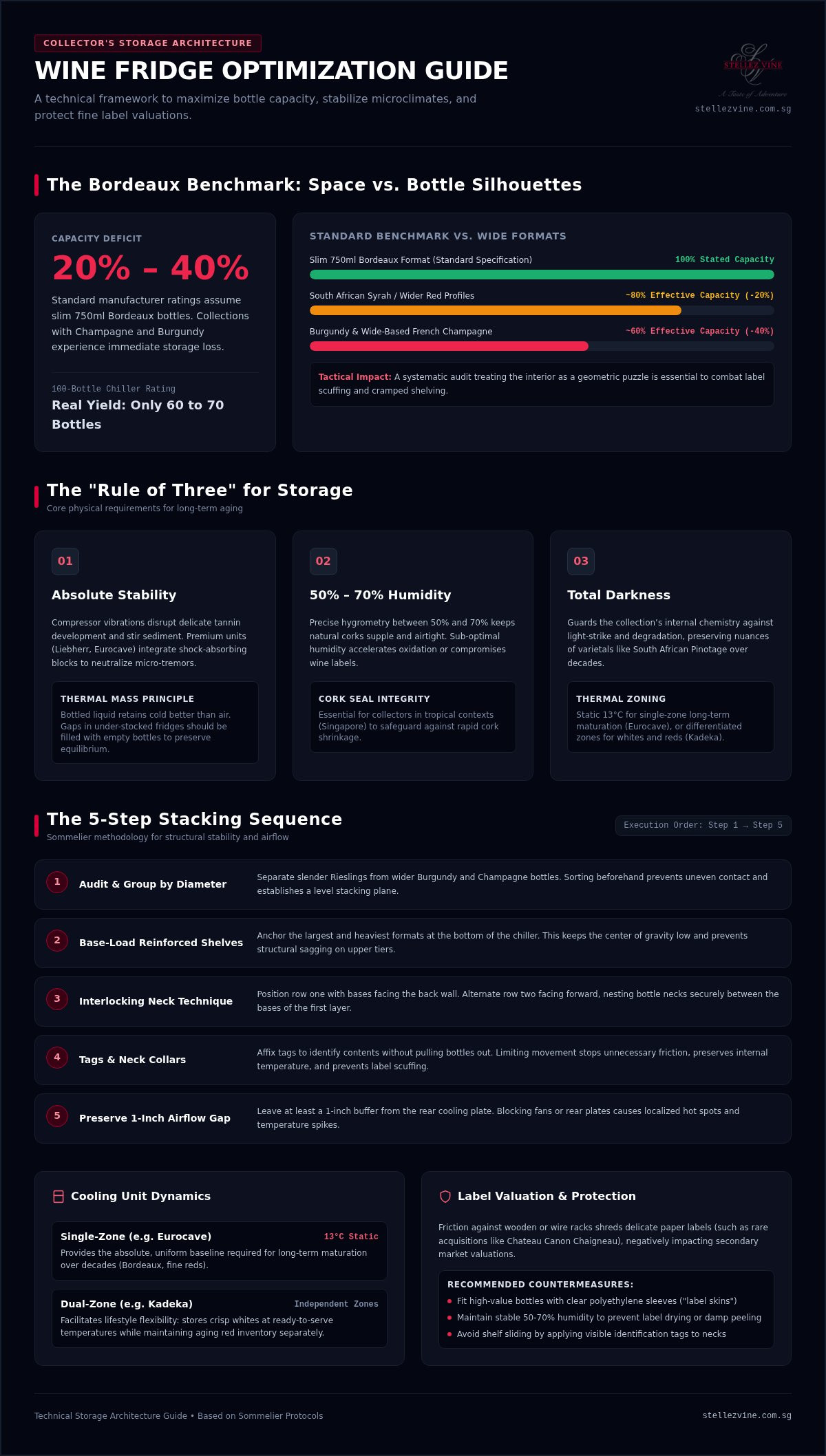
Efficiency in these units relies heavily on the concept of thermal mass. A common mistake is leaving too much empty space, which forces the cooling system to work harder every time the door opens. A well-stocked fridge maintains a more consistent temperature because the liquid in the bottles holds cold energy better than the air around them. This stability is the bedrock of long-term preservation. If your collection is currently small, filling the gaps with empty bottles can help maintain this thermal equilibrium.
Dual-Zone vs. Single-Zone Dynamics
Your choice between a single or dual-zone unit depends on your primary objective: aging or service. If you prioritize long-term maturation, a single-zone Eurocave set to a static 13°C provides the unmatched stability required for fine wines to evolve over decades. In contrast, dual-zone Kadeka units facilitate modern lifestyle efficiency. They allow you to keep crisp whites at a lower serving temperature in one section while maintaining reds in another. To master the environment, always follow the 'Rule of Three' for storage: prioritize absolute stability, consistent humidity, and total darkness.
Airflow and Vibration Management
Air must circulate freely to prevent localized hot spots. Crowding bottles against the back wall or blocking internal fans disrupts this flow, leading to temperature fluctuations that can age wine prematurely. Vibration is another silent enemy of quality. Premium cabinets from Liebherr or Eurocave use shock-absorbing blocks to neutralize compressor micro-vibrations. This is vital for fine reds, as even tiny tremors can stir up sediment and disrupt natural tannin development. Hygrometry is the critical 50-70% humidity range for wine storage; it keeps natural corks supple and airtight while protecting the integrity of your labels.
Strategic Stacking: Maximizing Space and Protecting Labels
Most collectors encounter a rude awakening when their "100-bottle" chiller refuses to accept more than 70. This discrepancy stems from the 'Bordeaux Benchmark.' Manufacturers standardize capacity ratings using slim 750ml Bordeaux bottles. If your passion leans toward robust South African Syrah or wide-based French Champagne, your actual capacity will drop by 20% to 40%. Mastering how to organize a wine fridge requires a tactical approach to these diverse silhouettes. You must treat the interior like a high-stakes puzzle where every millimeter counts toward preserving your investment.
The 5-Step Stacking Sequence
Efficiency begins with a systematic audit of your inventory. Follow this sequence to maximize every square inch of your cabinet:
Step 1: Group bottles by diameter. Separate slim Rieslings from wider Burgundy and Champagne formats to ensure a level base for stacking.
Step 2: Place your heaviest and largest bottles on the bottom reinforced shelves. This provides structural stability and keeps the center of gravity low.
Step 3: Implement the interlocking neck method. Lay the first row with bases toward the back; the second row should face forward, with necks resting securely between the bases of the first.
Step 4: Affix shelf tags or neck collars. This simple habit prevents you from pulling bottles out to check labels, which preserves both temperature and label integrity.
Step 5: Leave a 1-inch gap from the cooling plate. This ensures the airflow remains unobstructed and prevents temperature spikes.
Protecting Your Investment: Label Care
Friction is the silent enemy of a pristine collection. Constant sliding on wooden or wire racks can shred the paper labels of rare acquisitions like Chateau Canon Chaigneau, significantly impacting their future valuation. For high-value bottles, consider using clear polyethylene sleeves or "label skins." This is especially vital in the high-humidity environments maintained by Eurocave and Kadeka units. If you are curating a diverse selection of South African wines, use a 'label-forward' philosophy for your top-tier sliding shelves. This allows you to identify daily drinkers at a glance without disturbing the deeper, ageworthy layers of your cellar. Balancing accessibility with a 'Deep Cellar' stack ensures that your most precious bottles remain undisturbed until their peak drinking window arrives.
Curate by Character: Organizing by Varietal and Region
A well-managed collection tells a story through its layout. Beyond the physical mechanics of stacking, mastering how to organize a wine fridge involves creating a logical flow that respects both the varietal's needs and your own drinking habits. Even the most advanced compressor-based units exhibit subtle temperature gradients. Cold air is denser and settles at the base; therefore, you should always place sparkling wines and crisp rosés on the lowest shelves. Heavier reds, which benefit from slightly warmer service temperatures, should occupy the upper tiers. This stratification ensures every bottle is pulled at its ideal temperature without the need for aggressive decanting or chilling.
The 'Drinking Window' strategy is perhaps the most overlooked organizational principle. Many collectors treat their fridge as a static vault, yet 90% of wine is intended for consumption within two years. To avoid "losing" a bottle past its peak, designate specific shelves based on maturity. Group your everyday South African Chenin Blancs and approachable Pinotages in a high-turnover zone. Reserve the prime, most stable middle shelves for your serious French reds and ageworthy South African Pinotage. These middle racks offer the least amount of thermal fluctuation and vibration, making them the safest sanctuary for investment-grade bottles.
Regional Zoning for the Global Collector
Transform your fridge into an educational journey by zoning by geography. Create a 'New World' sector for your vibrant South African and Argentinian discoveries. Separate these from 'Old World' classics like Bordeaux and Italian reds. This systematic approach isn't just for aesthetics; it maps directly to the core tenets of long term wine storage Singapore collectors must follow. By grouping regions, you can better monitor the specific humidity needs and aging trajectories of different terroir-driven styles.
Accessibility vs. Maturation
Strategic placement saves time and protects your delicate corks. Implement an 'Everyday Shelf' at eye level. This zone should house accessible wines that don't require long-term cellaring, allowing you to grab a bottle for dinner without disturbing the rest of the unit. Conversely, the 'Do Not Disturb' zone should be located at the very bottom or the deepest part of the racks. This is where your long-term aging projects live. By isolating these bottles, you minimize the physical agitation and light exposure that can compromise a wine's character over time. This balance between daily convenience and disciplined maturation is the hallmark of a professional-grade cellar.
Inventory and Intelligence: Managing Your Collection Like a Pro
Opening your wine fridge should be an act of selection, not a search mission. If you have ever spent five minutes with the door open hunting for a specific bottle, you have already compromised the internal climate and forced the compressor to work overtime. Learning how to organize a wine fridge involves more than just physical stacking; it requires a robust management system. A physical collection without a digital twin is essentially a black box. By integrating intelligence into your storage, you transform a simple cooling appliance into a professional-grade cellar.
Digital Tools for the Modern Cellar
Serious collectors in Singapore increasingly rely on platforms like CellarTracker or InVintory to build a virtual representation of their fridge. These apps allow you to log every acquisition, from a rare Bordeaux to a contemporary bottle of Savage Wine, and track market valuations in real time. Drinking Windows are the most important metric in an inventory app as they provide a clear roadmap for when each bottle will reach its peak aromatic and structural complexity. For smaller collections, a simple spreadsheet or a QR code system affixed to the door can suffice, provided you maintain the discipline to update it with every pour.
Physical Tagging Systems
Digital logs are only as effective as your physical identification system. To maintain temperature stability, you must minimize door-open time. Implement the 'Rule of Three' for inventory: Log every new arrival, Tag it immediately, and Track its movement. Color-coded neck tags are the gold standard for quick identification. Use Red for 'Ready to Drink', Yellow for 'Wait/Aging', and Green for 'Daily Drinkers'. This visual shorthand allows you to scan your shelves without disturbing the bottles or the climate. Shelf-mapping ensures you know exactly where a specific bottle of Matias Riccitelli is located, even if it is buried behind a front-row stack.
Perform a quarterly audit to ensure your digital records match the physical reality. This practice prevents "forgotten" bottles from slipping past their prime and allows you to reorganize based on changing drinking windows. It also provides an opportunity to inspect labels for any signs of humidity-related wear. If your collection has grown beyond your current tracking capabilities, it is time to upgrade to a professional wine management solution and secure the future of your investment.
Elevate Your Experience: Professional-Grade Solutions
The journey of a collector often begins with a single shelf and matures into a curated library of fine vintages. As you refine your understanding of how to organize a wine fridge, you may find that your current unit no longer meets the technical demands of your growing inventory. Common signs that an upgrade is necessary include persistent over-stacking that blocks airflow or a noticeable struggle to maintain humidity levels in Singapore's tropical climate. At this stage, transitioning to a professional-grade solution is not just about capacity; it is about absolute climate control and long-term peace of mind.
Eurocave remains the undisputed gold standard for serious aging. These units replicate the precise conditions of a natural limestone cellar, offering unmatched thermal stability and sophisticated hygrometry. For collectors who value a blend of modern aesthetics and technical precision, Kadeka and Liebherr provide exceptional alternatives. These cabinets integrate seamlessly into contemporary Singaporean homes while offering features like UV-protected glass and active charcoal filters to maintain air purity. Stellez Vine Singapore serves as your trusted partner in this transition, providing the expertise to help you select a wallbox that acts as a true guardian for your collection, whether you are cellaring a delicate Pinot Noir or a robust Syrah.
Choosing Your Next Cabinet
When selecting a new unit, you must balance bottle capacity against the physical footprint, especially within the context of urban apartment living. A larger unit offers better thermal mass, yet it must fit logically within your lifestyle space. Local support and a comprehensive warranty are non-negotiable for premium appliances; you need a partner who understands the local electrical and climate conditions. For a detailed breakdown of the investment involved, consult our guide on is a wine fridge worth it Singapore to see how professional storage pays dividends in wine preservation.
Curation Meets Storage
A perfectly organized fridge is only as good as the liquid it holds. Once your storage environment is optimized, you can focus on filling it with the best South African wine Singapore has to offer, from allocated Chenin Blancs to powerful Stellenbosch reds. The experience is further elevated when you pair these wines with premium glassware designed to capture every aromatic nuance. Professional storage and high-quality service tools work in synergy to transform a simple glass of wine into a sensory event. To begin your next chapter in collecting, discover our curated collection of wines and fridges today and secure a legacy for your cellar.
Secure Your Legacy: The Art of the Organized Cellar
Mastering the nuances of how to organize a wine fridge transforms a simple appliance into a professional sanctuary for your finest acquisitions. By moving beyond basic storage and embracing strategic stacking alongside digital inventory management, you ensure that every bottle of South African Pinotage or French Grand Cru evolves exactly as the winemaker intended. You now possess the technical tools to maximize your cabinet's capacity while safeguarding the delicate labels and complex chemistry of your collection.
As your passion grows, your storage must evolve with it. Stellez Vine stands as your reliable partner in Singapore, serving as an authorized distributor for Eurocave and Kadeka cabinets. We combine technical expertise in tropical climate storage with expert national delivery to ensure your investment is protected from the moment of purchase. Our curated selection of fine wines and professional-grade chillers provides the perfect foundation for any serious collector.
Explore the 2026 Collection of Professional Wine Fridges at Stellez Vine and elevate your home tasting experience today. Your collection is a narrative of your personal journey; treat it with the precision and care it deserves.
Frequently Asked Questions
How many bottles can I actually fit in my wine fridge?
Stated capacity is almost always based on standard 750ml Bordeaux bottles. If your collection includes wider South African Syrah or French Champagne, expect a capacity reduction of 20% to 40%. When learning how to organize a wine fridge, always account for these "Shape Struggles." Premium units from Kadeka or Eurocave offer adjustable shelving to mitigate this, but a full cabinet of mixed varietals rarely hits the manufacturer's maximum bottle count.
Should I remove the shelves to fit larger Champagne or Magnum bottles?
You should only remove shelves if your unit lacks the specific height clearance for oversized bottles. Removing shelves reduces your total capacity and disrupts the "Bordeaux Benchmark" efficiency. Instead, utilize the bottom bulk storage bins found in many Liebherr or Eurocave models for Magnums and Champagne. If you must remove a shelf, ensure the remaining bottles are securely interlocked to prevent rolling or vibration damage during the compressor cycle.
Is it better to organize wine by type or by region?
Organizing by region is superior for the global collector seeking an educational journey. Grouping your South African Pinotage separately from French Bordeaux makes selection intuitive and sophisticated. However, if you use a dual-zone Kadeka unit for service, you must first prioritize temperature zones. Place sparkling and whites in the colder zone while grouping your reds in the warmer section, then sub-divide those groups by their specific regional origin.
How do I prevent wine labels from peeling or getting damaged in the fridge?
Maintain a stable hygrometry range between 50% and 70% to prevent corks from drying while protecting labels. In Singapore's humid climate, paper labels can soften or develop mold over time. Protect your high-value acquisitions by using clear polyethylene sleeves or food-grade plastic wraps. This "Label-Forward" philosophy ensures your rare French reds remain in auction-grade condition while allowing you to scan your inventory without physically touching the bottles.
Do I need a dual-zone fridge if I only drink red wine?
A dual-zone fridge is not strictly necessary if your primary goal is long-term aging. Both red and white wines age perfectly at a static 13°C. However, a dual-zone unit is essential if you intend to serve your wines directly from the cabinet. This allows you to keep your everyday reds at a supple 16°C while maintaining a separate section for ageworthy bottles that require the "Architecture of Aging" stability.
How often should I reorganize or audit my wine fridge inventory?
Audit your inventory quarterly to ensure your digital twin matches your physical stock. This practice prevents "forgotten" bottles from aging past their peak drinking window. Use the "Rule of Three" during these audits: Log new arrivals, Tag them with color-coded neck collars, and Track their movement within the racks. Regular audits also provide a chance to check your Kadeka or Eurocave filters and ensure airflow remains unobstructed by shifting bottles.
What is the best temperature to set for a single-zone wine fridge?
Set your single-zone wine chiller to a constant 13°C (55°F) for the ideal balance of preservation and evolution. This temperature is the universal benchmark for all varietals, from crisp Thai whites to heavy Argentinian reds. Avoid the temptation to fluctuate the temperature for specific service needs. Stability is the most critical factor in how to organize a wine fridge; even minor daily shifts can compromise the natural cork and accelerate oxidation.
Can I store other beverages like craft beer or soda in my wine fridge?
Storing soda or craft beer in a wine fridge is generally discouraged due to the specialized climate settings. Wine cabinets maintain higher temperatures and humidity levels than standard beverage chillers, which can leave beer under-chilled and soda carbonation less crisp. Kadeka and Liebherr units are precision-engineered for the delicate chemistry of wine. If you must share space, limit non-wine items to the coldest bottom shelf to avoid disrupting the thermal mass of your vintages.

Comments