
When to Replace Your Wine Fridge in Singapore
- Stellez Vine

- Aug 4
- 12 min read
Imagine returning from a weekend at the coast to find your prized Matias Riccitelli labels peeling and the internal display blinking a frantic 28 degrees. In Singapore's relentless heat and humidity, a failing wine chiller isn't just a minor technical glitch; it is a quiet catastrophe for your liquid investment. You understand that fine wine requires a precise, stable environment to evolve, yet even the most premium cabinets eventually succumb to the tropical workload. Determining exactly when to replace wine fridge Singapore systems is the difference between savoring a benchmark vintage and pouring a ruined bottle down the sink.
We recognize the anxiety that comes with unpredictable temperature swings and the fear of a compressor failing while you are away. You deserve the confidence that your collection is aging in optimal, cellar-like conditions without the constant threat of condensation or rising energy bills. This guide provides the expert criteria you need to decide between a costly repair and a strategic upgrade. You will discover the critical signs of mechanical fatigue, learn how to weigh modern efficiency against rising electricity tariffs, and find the perfect moment to elevate your storage standards with a refined, high-performance unit.
Table of Contents
The Tropical Toll: Why Singapore’s Climate Shortens Fridge Lifespan
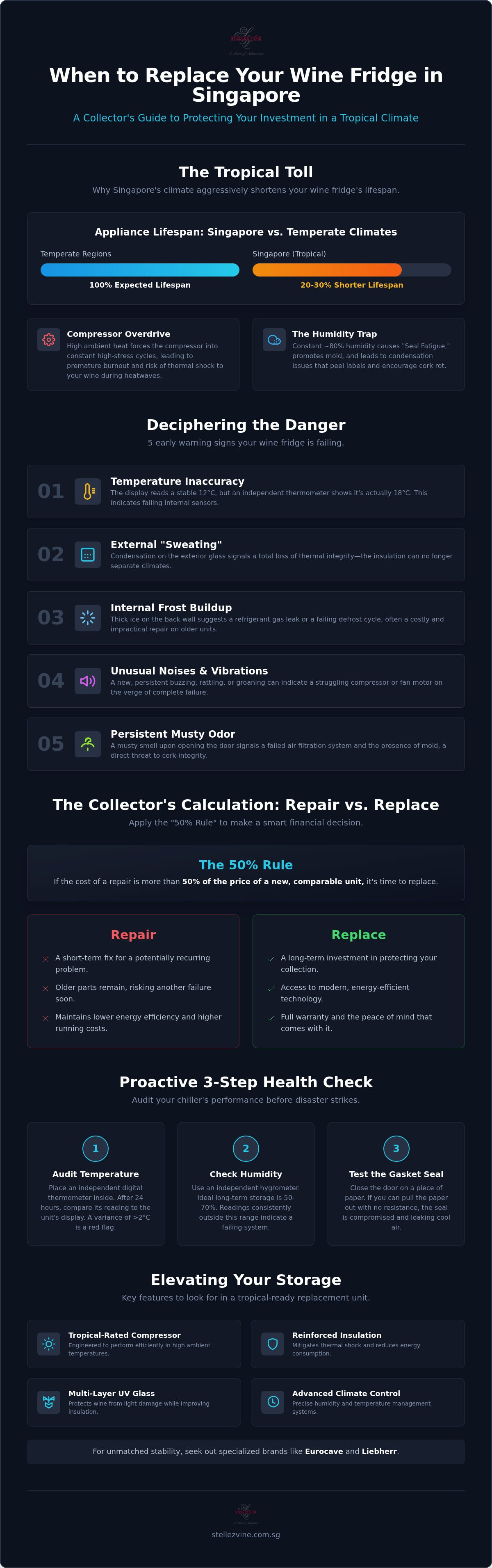
In the temperate climates of Europe, a high-quality wine cabinet might hum along effortlessly for decades. In the heart of the Lion City, the reality is far more demanding. Singapore’s relentless heat and saturating humidity create a "Tropical Lifecycle" for appliances, where internal components often retire 20 to 30 percent earlier than they would in cooler regions. Understanding when to replace wine fridge Singapore systems requires a clear-eyed look at how our environment aggressively degrades even the most robust machinery. When the ambient temperature outside your unit consistently hovers near 30°C, the margin for error vanishes.
The primary antagonist is our constant 80 percent humidity. This moisture does more than just strain the cooling engine; it facilitates "Seal Fatigue." Tropical mold thrives in the damp crevices of door gaskets, slowly eating away at the rubber’s elasticity until the airtight seal fails. Once the seal is compromised, warm air seeps in, forcing the unit to work twice as hard to maintain the delicate long term wine storage Singapore collectors require. This cycle of overwork and environmental assault eventually leads to a catastrophic failure that can jeopardize your entire collection.
Compressor Stress and Thermal Shock
A wine chiller’s compressor is its beating heart. In Singapore, that heart is often in a state of permanent tachycardia. While standard appliances are designed for occasional cooling cycles, our high ambient heat forces compressors into a state of "overdrive" to protect the wine storage conditions within. This constant cycling leads to mechanical burnout, where the motor simply lacks the torque to recover after a power surge or a particularly hot afternoon. If an aging unit fails during a heatwave, your wine faces the threat of thermal shock. This rapid temperature spike can expand the liquid, push the cork, and oxidize a vintage in hours. While entry-level units often buckle under this pressure, tropical-rated premium chillers from brands like Eurocave or Liebherr are engineered with reinforced insulation to mitigate these risks.
The Humidity Trap: Condensation and Cork Health
Precision humidity control is a hallmark of a healthy fridge, but as units age, their drainage systems often become the source of internal "flooding." When a chiller can no longer manage the moisture it pulls from the Singapore air, condensation pools at the base or drips down the back wall. This excessive moisture is a silent predator. It destroys the aesthetic value of your collection by peeling labels and, more dangerously, promotes cork rot and mold growth. If you notice a persistent musty odor when opening the door, it is a definitive signal that the air filtration system has failed. At this stage, your fridge is no longer a sanctuary; it is a liability that risks the structural integrity of your bottles.
Deciphering the Danger: 5 Signs Your Wine Fridge is Failing
Identifying a failing appliance requires more than just noticing a lack of chill. It demands a keen eye for the subtle shifts in performance that precede a total breakdown. When the digital display claims a steady 12°C but your handheld thermometer reads 18°C, the internal sensors are likely failing. This misalignment is often the first warning sign of when to replace wine fridge Singapore collectors should heed. If your unit is "sweating" on the exterior glass, it indicates a total loss of thermal integrity. Singapore's high ambient moisture makes this particularly evident; it shows the insulation can no longer separate the tropical air from the internal microclimate. You can learn more about how heat and humidity affect wine fridges to see why these environmental stressors are so damaging.
Frost buildup on the rear internal wall is another red flag. While a tiny amount of moisture is normal, thick ice suggests a refrigerant gas leak or a failing defrost cycle. These issues are rarely worth fixing in aging units, as the labor costs for recharging refrigerant often rival the price of a more efficient, modern cabinet. Similarly, keep an ear out for unusual mechanical rhythms. Loud humming or metallic clicking sounds often signal that the compressor's internal valves are failing. These sounds are the final protests of a machine under too much stress, usually occurring just before the unit ceases to function entirely.
Vibration: The Invisible Threat to Fine Wine
Vibration is a silent predator. It accelerates the chemical reactions within the bottle, prematurely aging the wine and disturbing the delicate sediment of older vintages. While a new Eurocave utilizes sophisticated vibration-dampening technology, an aging motor often begins to rattle. If you can feel a distinct tremor when placing your hand on the shelf, it is a terminal sign. This mechanical instability is a primary replacement trigger, especially if you are storing a delicate Matias Riccitelli wine Singapore collection that deserves absolute stillness to evolve correctly.
The 'Constant Run' Syndrome
Listen to the rhythm of your kitchen or cellar. A healthy fridge cycles on and off to maintain its set point. If yours runs continuously without stopping, it is trapped in a "run-flat" state. This puts immense strain on the internal fans and compressor, leading to a total system blackout within weeks. Beyond the mechanical risk, a unit that never rests is a massive energy drain. With Singapore’s regulated electricity tariff at 34.78 cents/kWh (including GST) for the third quarter of 2026, an inefficient unit significantly inflates your utility bills. Replacing a "constant runner" with a modern, energy-efficient model is often the most financially sound decision for the long term.
If your current storage is showing these symptoms, consider browsing our curated selection of Kadeka and Liebherr chillers to find a more reliable home for your collection.
Repair vs. Replace: Calculating the ROI for Collectors
Deciding when to replace wine fridge Singapore units often feels like a gamble between a quick fix and a fresh start. However, the decision becomes clearer when you apply the "50% Rule." If a repair bill for a failing thermostat begins at S$400, or a major compressor overhaul reaches S$800, you have crossed a critical threshold. For a compact chiller originally priced around S$1,500, these repairs represent more than half the value of a new, warrantied model. Investing in a repair for an aging unit is often a case of "throwing good money after bad," especially when that unit no longer offers the energy efficiency of modern standards.
Consider the impact on your utility bills. With Singapore’s regulated electricity tariff currently at 34.78 cents/kWh (including GST), an old, struggling motor is a hidden tax on your collection. Modern inverter compressors are engineered to maintain precision temperatures with significantly lower power consumption. Over three to four years, the energy savings from a new unit can offset a substantial portion of its purchase price. Beyond the financial tally, a new unit provides the structural certainty and manufacturer warranty that an aging, repaired unit simply cannot match. This peace of mind is why many serious collectors partner with a trusted online wine shop Singapore experts recommend, ensuring every bottle is protected by current, reliable technology.
The Cost of a Spoiled Vintage
Quantifying the risk is essential for any serious collector. Imagine the heartbreak of losing a single case of premium French Bordeaux or a curated vertical of South African gems due to a midnight mechanical failure. The market value of those bottles likely dwarfs the cost of a mid-range Kadeka or even a premium Liebherr cabinet. Viewed through this lens, a new fridge isn't merely an appliance; it's a "palate insurance policy" that guarantees your liquid investment survives the tropical heat. Don't risk a S$10,000 collection on a S$500 patch-up job for a ten-year-old machine.
Technological Leap: Why 2026 Models Beat 2016 Units
The storage landscape has shifted dramatically over the last decade. 2026 models feature advanced humidity management systems and triple-glazed, UV-resistant glass designed specifically for high-exposure luxury interiors in Singapore. Smart alarms and IoT connectivity now provide real-time alerts directly to your smartphone, preventing catastrophic failures while you are traveling or at work. These aesthetic and functional upgrades ensure your storage matches the sophistication of your home while providing a level of security that older units simply lack.
The Singapore Wine Fridge Health Check: A 3-Step Protocol
Maintaining a premium collection requires more than just a high-end chiller; it demands a proactive diagnostic routine. While modern units are robust, the tropical environment necessitates a regular "health check" to catch mechanical fatigue before it turns into a disaster. By following a structured 3-step protocol, you can determine with certainty when to replace wine fridge Singapore units that have passed their prime. This methodical approach removes the guesswork and protects your liquid assets from the invisible creep of mechanical failure.
Performing the Paper Test
The integrity of your door gasket is your first line of defense against Singapore's 80 percent humidity. To perform the "paper test," simply take a standard sheet of paper or a S$10 note and close the chiller door on it. Try to pull the paper out. If it slides out with zero resistance, your seal has lost its vacuum. Repeat this process at multiple points around the door. Look closely for "pitting" or brittleness in the rubber. While you can sometimes revive a stiff seal by cleaning it with warm, soapy water to remove tropical mold, a brittle or cracked gasket is a terminal sign. A compromised seal forces the compressor to run indefinitely, accelerating the mechanical burnout discussed earlier.
Audit Your Internal Sensors
Never trust a ten-year-old digital display implicitly. Over time, internal sensors can drift, providing a reading that doesn't reflect the actual temperature of your bottles. Use an independent, professional-grade hygrometer or digital thermometer to audit your cabinet. Place the tool on different shelves for 24 hours at a time to check for "hot spots." In a tropical environment, a variance of even 2 degrees from your set point is significant. It suggests that the internal fans are no longer circulating air effectively or that the cooling element is failing. If your independent audit consistently contradicts the fridge's display, the internal brain of the unit is malfunctioning.
The final step in your protocol should be a thorough coil and drainage inspection. Dust is a powerful insulator. If the condenser coils at the rear of your unit are caked in grime, the heat exchange process fails. Similarly, check the drainage hole for blockages. In Singapore's damp air, these holes can become clogged with "bio-slime," leading to internal flooding. Finally, record how often your unit "cycles" during the hottest part of the day, typically between 1 PM and 4 PM. If the motor is active for more than 70 percent of that window, the unit is struggling to keep up with ambient conditions.
If your current unit fails this health check, it is time to invest in a premium storage solution from Stellez Vine Singapore to ensure your collection receives the protection it deserves.
Elevating Your Storage: Choosing a Tropical-Ready Replacement
Selecting a replacement is a strategic investment in your collection’s future. In Singapore, you cannot afford to compromise on thermal stability or humidity management. Moving from a failing unit to a benchmark brand ensures that your vintages are protected by engineering designed to withstand our equatorial climate. When you understand when to replace wine fridge Singapore cabinets, you also realize that the right partner provides more than just a cooling box; they provide a stable sanctuary for your liquid assets. Avoid the temptation of unverified imports and prioritize authorized retailers who offer dedicated local support and authentic spare parts.
The Eurocave Advantage: Humidity Mastery
Eurocave remains the undisputed gold standard for those who view wine as a liquid legacy. Their unique "breathing" system utilizes natural air circulation to mimic the humid, steady environment of a French limestone cave. This meticulous attention to detail is why Eurocave is the only choice for Chateau Canon Chaigneau Singapore collectors who demand that their Lalande-de-Pomerol matures with absolute precision. By choosing this benchmark brand, you gain access to expert local servicing and a machine built to endure the specific stresses of our local power grid. It is a proactive choice for the connoisseur who values heritage and unmatched craftsmanship.
Liebherr and Kadeka: Precision and Performance
For collectors seeking versatility, Liebherr offers precision German engineering adapted specifically for high-humidity environments. Their dual-zone cabinets allow you to store delicate whites and robust reds at their respective optimal temperatures within a single, sleek frame. These units utilize advanced sensors to prevent the "hot spots" common in aging, entry-level chillers. If energy efficiency and space optimization are your primary drivers, Kadeka’s latest inverter technology represents the best-in-class value for modern Singaporean apartments. These units modulate their cooling power rather than simply switching on and off, leading to a smoother mechanical rhythm and significantly lower monthly electricity bills.
Ultimately, your storage solution should be as refined as the wine it holds. Invest in a system that offers peace of mind, technological superiority, and a clear path to long term preservation. Follow these three steps to secure your collection: assess your current unit's failure points, select a brand with tropical-rated insulation, and purchase from a specialist with a proven track record in Singapore. Savor your wine, don't stress its storage. Protect your collection with premium storage from Stellez Vine.
Secure Your Legacy: The Path to Precision Preservation
Your collection represents more than just a series of bottles; it is a curated liquid legacy that deserves an uncompromising sanctuary. In Singapore's unforgiving humidity, identifying when to replace wine fridge Singapore cabinets is a vital strategic move to prevent the heartbreak of a spoiled vintage. By prioritizing the 50% Rule and recognizing the early warning signs of mechanical fatigue, you ensure your investment continues to evolve exactly as the winemaker intended. Don't let an aging unit become a silent killer for your prized labels or an unnecessary drain on your energy bills.
Stellez Vine has served as Singapore's fine wine specialists since 2009, acting as a trusted gatekeeper for collectors who value excellence. As an authorized retailer for benchmark brands like Eurocave and Liebherr, we provide the expert local delivery and technical support necessary to navigate unique tropical storage challenges. Protect your collection with premium storage from Stellez Vine and regain the confidence that every bottle is aging in optimal, cellar-like conditions. Elevate your storage standards today and savor the peace of mind that comes with professional grade protection.
Frequently Asked Questions
How often should I service my wine fridge in Singapore?
You should schedule a professional service for your wine chiller at least once every 12 months. In our dusty, humid environment, condenser coils accumulate grime quickly, which forces the motor to overwork. Annual maintenance includes cleaning the drainage systems and verifying sensor accuracy. This proactive habit is the best way to delay the moment when to replace wine fridge Singapore units, extending the life of your investment through consistent care.
Why is there condensation on the outside of my wine chiller door?
External condensation, or "sweating," typically occurs when the airtight seal of your door gasket has failed. When the cold internal air meets the warm, humid Singaporean atmosphere through a leak, moisture forms on the glass. While it can sometimes be a result of extreme weather, persistent sweating indicates that your unit's thermal insulation is compromised. This inefficiency leads to higher energy bills and unstable internal temperatures for your collection.
Is a wine fridge worth it in Singapore if I only have 20 bottles?
A dedicated wine chiller is absolutely essential in Singapore, even for a modest 20-bottle collection. Standard ambient temperatures in local apartments often exceed 30°C, a level that can cause permanent heat damage to fine wine within weeks. A compact, entry-level unit like a Kadeka provides the stable 12°C environment necessary to protect your bottles from "cooking," ensuring every glass you pour remains fresh and vibrant.
What is the ideal humidity level for a wine fridge in a tropical climate?
The ideal humidity level for wine storage in a tropical climate is between 60% and 70%. This range is specifically designed to keep corks supple and airtight without encouraging the growth of tropical mold on your labels. Premium brands like Eurocave utilize advanced humidity management systems to maintain this delicate balance, which is vital for long-term aging where cork integrity is the only barrier against oxidation.
Can I use a normal refrigerator repairman for my Eurocave or Liebherr?
You should always use an authorized specialist rather than a general appliance repairman for premium units like Eurocave or Liebherr. These high-end systems require specific technical knowledge and authentic spare parts that generalists cannot access. Using an unauthorized technician can void your warranty and lead to improper calibration, which risks the safety of your collection. Authorized partners ensure your unit is restored to its original manufacturer specifications.
How long does a wine fridge typically last in Singapore?
A high-quality wine fridge in Singapore typically lasts between 8 and 12 years. This "Tropical Lifecycle" is roughly 20% shorter than in temperate regions because the compressor must work harder to combat the constant 30°C ambient heat. While budget models might fail sooner, investing in a tropical-rated cabinet ensures you maximize this lifespan. Regular maintenance is the key to reaching the decade mark without a catastrophic mechanical failure.
Why is my wine fridge making a loud humming noise suddenly?
A sudden, loud humming noise usually indicates that the compressor is under extreme mechanical stress or that an internal fan is obstructed. If the sound is accompanied by a metallic clicking, it often signals that the compressor's internal valves are failing. These auditory warnings are critical indicators of when to replace wine fridge Singapore systems, as a failing motor will soon cease to maintain the stable temperatures your wine requires.
Do I really need to change the carbon filter every year in a humid city?
Changing your active carbon filter every year is a non-negotiable requirement in a humid city. These filters are responsible for purifying the air that enters the cabinet, removing odors and mold spores that thrive in Singapore's damp climate. A saturated filter loses its ability to protect your collection, potentially leading to "cork taint" where external smells penetrate the bottle and ruin the delicate profile of your wine.


Comments