
Tropical Wine Storage: Common Mistakes and Collector Solutions

Updated: Sep 5
In the relentless heat of the tropics, a single afternoon of high temperatures can age a fine vintage by a decade in a matter of hours. You've likely felt that nagging fear of "cooking" an expensive bottle or discovered the heartbreak of a mold-ruined label after a humid season. It is a common struggle for collectors who want to savor the craftsmanship of a handpicked South African Savage or a refined French vintage without the environment intervening. Identifying common wine storage mistakes in the tropics is the first step toward securing your liquid assets against chemical acceleration.
Discover how to protect your fine wine collection from the unique environmental hazards of a tropical climate through active, climate-controlled stability. We'll guide you through the physics of heat and humidity, explain why a standard food fridge is a silent killer of corks, and define the criteria for choosing premium cabinets from brands like Eurocave and Liebherr. You'll gain a clear understanding of how to preserve bottle value and a practical plan to ensure every pour reaches its benchmark potential. Let's transform your storage from a source of stress into a sanctuary for your most exceptional bottles.
Table of Contents
The Tropical Threat: Why Ordinary Storage Fails Fine Wine
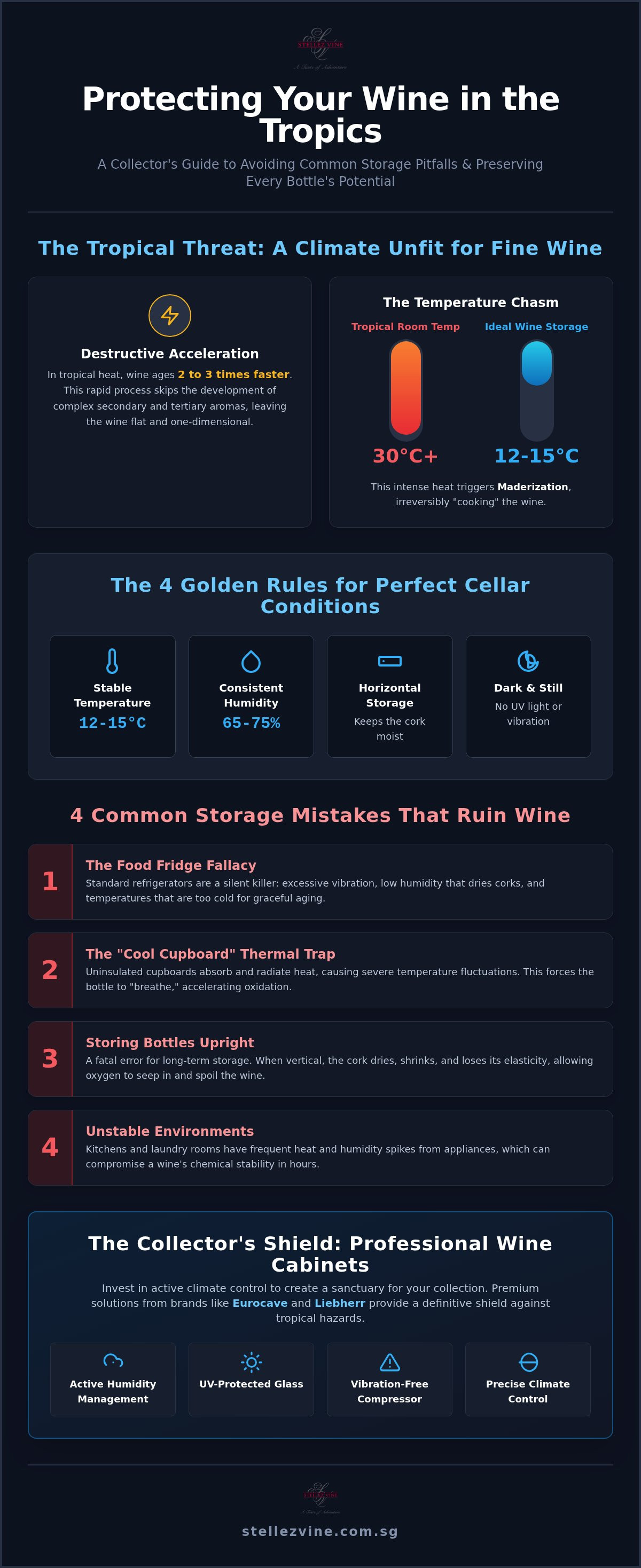
Tropical heat is a relentless adversary for the serious collector. While a bottle of handpicked South African Savage or a refined French vintage represents years of careful craftsmanship, it can be undone in weeks by a harsh climate. One of the most common wine storage mistakes in the tropics is assuming that "room temperature" is a safe baseline for your collection. In temperate regions, this might mean a steady 18°C; in Singapore, it frequently exceeds 30°C. This intense heat triggers aggressive chemical reactions that disrupt phenolic development, leading to a flat, uninspired profile that lacks the complexity the winemaker intended.
Many enthusiasts rely on the myth of the "cool, dark cupboard" or a basement corner. Without professional insulation, these spaces are thermal traps that absorb and radiate the day's heat long into the night. To protect your investment and ensure every bottle reaches its benchmark potential, you must maintain the ideal wine storage conditions of 12°C to 15°C with a stable humidity level of 65-75%. Anything less is a gamble with your heritage bottles.
Thermal Instability and the Expansion Trap
Temperature fluctuations are often more damaging than a steady, slightly warm environment. When the mercury rises, the liquid inside your bottle expands, exerting physical pressure on the cork. As the ambient air cools, the wine contracts, creating a vacuum that pulls oxygen into the bottle through the seal. This "breathing" bottle effect accelerates oxidation and destroys the wine's structural integrity over time. Maderization is the irreversible heat-damage of wine compounds. This process leaves your wine tasting like stewed fruit or burnt nuts, effectively stripping away the elegance and nuance you paid for.
The Acceleration of Aging
In a tropical environment, wine ages two to three times faster than it would in a temperate climate without intervention. While rapid aging might sound appealing to the impatient, it's actually a destructive process. High temperatures force the wine to skip the slow, graceful evolution of secondary and tertiary aromas. Instead of discovering notes of leather, truffle, or dried spices, you're left with a beverage that has lost its vibrancy and acidity. Securing long term wine storage in Singapore isn't just about luxury; it's a necessary defense against the climate's inherent volatility. Stop settling for passive storage and embrace active climate management to savor your wines as they were meant to be.
Thermal Traps and Humidity Hazards: Common Pitfalls Decoded
Storing a bottle upright might seem space-efficient, but it's a fatal error for long-term aging. When wine stands vertically, the cork loses contact with the liquid, causing it to dry out and lose its essential elasticity. In a tropical climate, this dehydration happens at an accelerated rate. A brittle cork allows ambient air to seep into the bottle, leading to rapid oxidation and a ruined profile. Lay your bottles flat to keep the cork moist, secure the seal, and protect the wine's structural integrity. This simple adjustment is the first line of defense against common wine storage mistakes in the tropics.
Identifying common wine storage mistakes in the tropics often starts with location. Avoid placing your collection in the kitchen or laundry room. These areas are prone to sudden heat spikes and humidity surges from ovens, dishwashers, or dryers. Even a few hours near a hot appliance can compromise the chemical stability of your finest vintages. Seek out a stable, neutral environment where the conditions remain constant throughout the day and night to ensure your wine reaches its benchmark potential.
Hygrometry: The Silent Collector’s Challenge
Maintaining a 70% humidity level is the "Golden Mean" for any serious tropical collector. While many believe that standard air conditioning solves all climate issues, these units actually strip moisture from the air, causing corks to shrink and crack over time. Conversely, the natural ambient humidity in Southeast Asia can often exceed 80%, creating a breeding ground for mold. This excess moisture doesn't just threaten the cork; it leads to label rot, which can significantly decrease the resale value and aesthetic appeal of a rare bottle. There is scientific proof that stable humidity is just as vital as temperature for preventing premature aging. Achieve this delicate balance by using professional-grade cabinets that actively manage moisture levels.
Lightstrike and the UV Perimeter
Sunlight is a silent predator for wine. When UV rays penetrate a bottle, they trigger a riboflavin reaction that produces unpleasant sulfur compounds, often described as smelling like wet wool or cabbage. This "lightstrike" can ruin a delicate white or rosé in a matter of hours. Never treat your collection as a window display. Even dark glass offers limited protection against the intense tropical sun. Professional wine cabinets utilize specialized UV-filtered glass doors to provide a secure perimeter for your bottles. Protecting your investment requires more than just a cool spot; it demands a shielded environment. To ensure your collection remains pristine, explore our curated storage solutions designed for the modern connoisseur.
The Food Fridge Fallacy: Why Kitchen Appliances Are a Risk
One of the most pervasive common wine storage mistakes in the tropics is the "food fridge fallacy." Many collectors believe that moving a bottle from the 32°C heat into a standard kitchen refrigerator is a safe compromise. It isn't. While a household fridge is excellent for preserving perishables, its mechanical design is fundamentally hostile to the evolution of fine wine. These appliances are engineered to strip moisture from the air to prevent food spoilage, creating a desert-dry environment that rapidly dehydrates corks. A brittle, shrunken cork is a failed seal, inviting oxygen to destroy your liquid assets.
Beyond the humidity crisis, your kitchen fridge is a reservoir of volatile aromas. Natural cork is a porous membrane that "breathes" over time. If your wine shares a shelf with onions, garlic, or pungent leftovers, those scents will eventually permeate the bottle. You risk transforming a handpicked Argentinian Malbec or a refined Italian vintage into a muddled, off-flavor disappointment. True curation requires an environment free from the domestic chaos of a shared kitchen appliance.
Vibration: The Invisible Flavor Killer
Fine wines, especially aged reds, require absolute stillness to reach their benchmark potential. Standard refrigerators rely on high-output compressors that generate constant micro-vibrations. These tremors act as a kinetic agitator, disturbing the sediment and preventing the natural polymerization of tannins. This chemical disruption leaves the wine feeling gritty and structurally unbalanced. Premium brands like Eurocave and Liebherr utilize specialized, dampened compressors and vibration-absorbing shelving to ensure your collection remains in a state of perfect repose. Without this mechanical isolation, the delicate chemical dance within the bottle is cut short by constant kinetic energy.
Temperature vs. Climate Control
A standard fridge typically operates at 3°C to 4°C, which is far too cold for long-term storage. At these temperatures, the aging process doesn't just slow down; it becomes "stunted," preventing the development of complex bouquets and secondary aromas. Domestic appliances also lack thermal inertia. Their thin-walled construction means that every time the door opens for a snack, the internal temperature spikes, forcing the wine through the expansion and contraction cycles that compromise the cork seal. If you are questioning is a wine fridge worth it in Singapore, consider the cost of losing a single case of premium vintage to these avoidable mechanical risks. Investing in a dedicated cabinet from Kadeka or Liebherr is the only way to move beyond simple cooling and into true climate curation.
Curating Your Climate: A Collector’s Blueprint for Success
Moving beyond the common wine storage mistakes in the tropics requires a shift from passive storage to active curation. A professional collector doesn't just "store" wine; they manage a living inventory. Implement a "Zone Strategy" within your cabinet to optimize accessibility and aging. By categorizing your collection into "Ready to Savor" and "Long-Term Sanctuary" zones, you ensure that no bottle is opened before it reaches its benchmark potential. Pair this with a "First-In, First-Out" (FIFO) system. This organizational discipline prevents rare vintages from being forgotten in the dark recesses of a shelf, ensuring you capture every bottle at its peak maturity.
Stagnant air is a hidden enemy in humid climates. Without proper ventilation, moisture can settle, leading to musty smells and label degradation. High-end cabinets utilize active airflow systems and replaceable charcoal filters to maintain a neutral, fresh environment. When it's time to enjoy your wine, remember that the transition from a 13°C cabinet to a 30°C tropical dining room is a significant thermal shock. Temper your wine gradually by bringing it out shortly before service, allowing it to acclimate without the condensation that ruins labels. Implementing these systems ensures you don't fall victim to the common wine storage mistakes in the tropics that often plague unorganized collections.
Strategic Positioning Within the Home
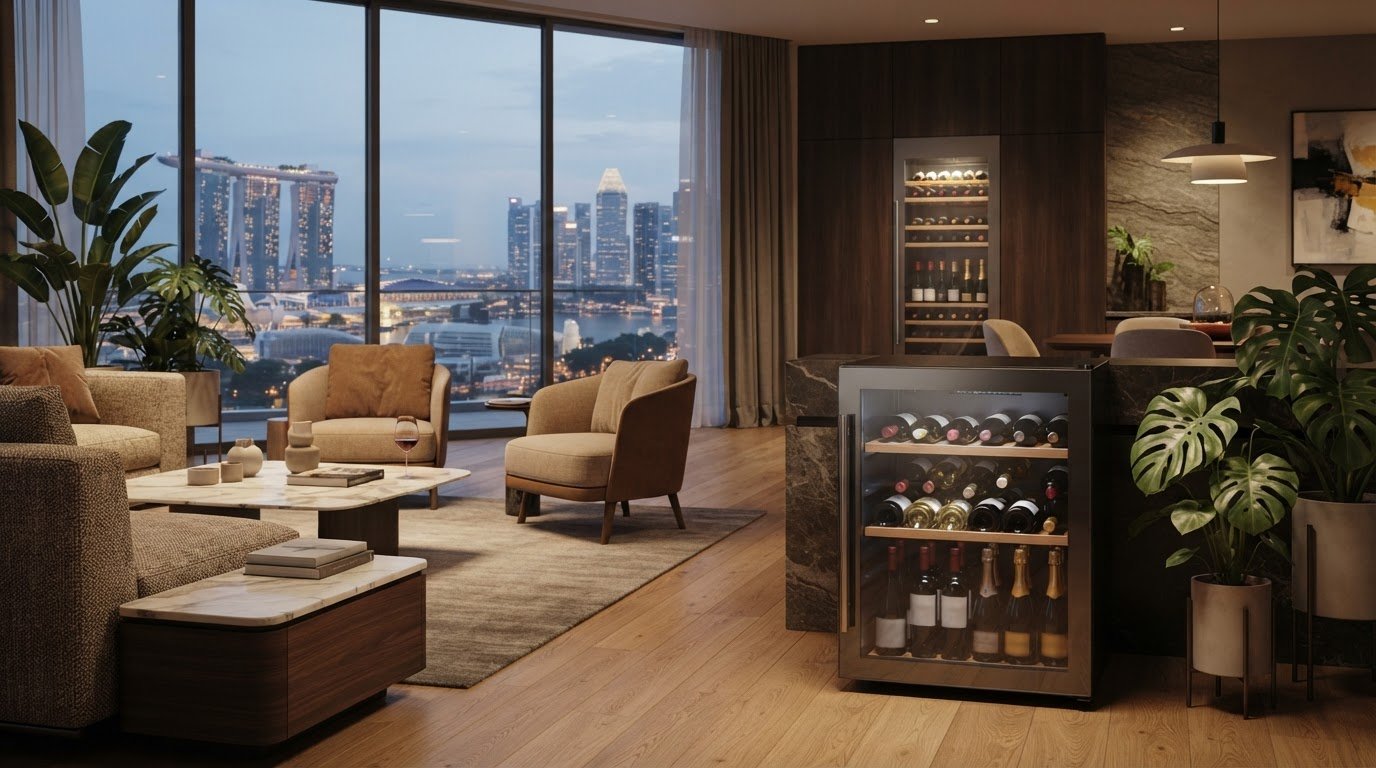
The location of your wine cabinet is as critical as its internal settings. Identify the "Thermal Core" of your residence, which is typically a central area away from external walls that bake in the afternoon sun. Avoid proximity to heat-generating appliances like ovens, dishwashers, or even heavy-duty electronics. In custom wine rooms, professional insulation and vapor barriers are non-negotiable. They act as a definitive shield, reducing the workload on your cooling unit and ensuring consistent temperatures even during a tropical heatwave. A central, stable location provides the foundation for long-term preservation.
Maintenance and Monitoring
Proactive maintenance is the hallmark of a serious collector. While professional cabinets have internal sensors, utilizing independent external thermometers and hygrometers provides essential peace of mind. Check these readings weekly to verify that your hardware is performing at its peak. Maintain your door seals by cleaning them with a damp cloth to prevent dust buildup, which can cause thermal leakage and force the compressor to overwork. Ensure that your bottles are spaced to allow for consistent airflow across all shelves. This methodical approach guarantees that every bottle in your sanctuary is protected by an unmatched standard of care. Browse our collection of professional wine cabinets to begin building your sanctuary today.
Investing in Longevity: Professional Solutions for Collectors
View your storage hardware not as a simple appliance, but as a premium insurance policy for your liquid heritage. Every handpicked bottle represents a significant investment of both capital and time. Falling prey to common wine storage mistakes in the tropics, such as relying on passive cooling or improper humidity levels, can lead to irreversible financial and sensory loss. Professional wine cabinets provide a definitive shield against the climate. They ensure that your collection remains a source of pride rather than a liability by maintaining a sanctuary of absolute stability.
The Eurocave Benchmark
This commitment to quality and safety often extends to other areas of a collector's life, from fine art to professional personal services. For those who value specialized expertise, you can find out more about Stellar Malaysia's professional approach to hygienic jewelry and ear piercing services.
Eurocave remains the undisputed gold standard for collectors who demand uncompromising precision and long-term aging capability. Their revolutionary "Main du Sommelier" shelving system is more than a storage rack; it's a sophisticated cradle that mimics the human hand to absorb kinetic energy and eliminate vibration. This level of meticulous care is why serious collectors of rare French vintages, such as the exceptional Chateau Canon Chaigneau, trust Eurocave for their most precious assets. By maintaining a constant, cave-like environment, these cabinets allow the wine to skip the destructive heat of the tropics and evolve at a natural, graceful pace. To discover why seasoned connoisseurs trust these systems, explore our insights on the online wine shop Singapore landscape.
Kadeka and Liebherr: Versatility and Precision
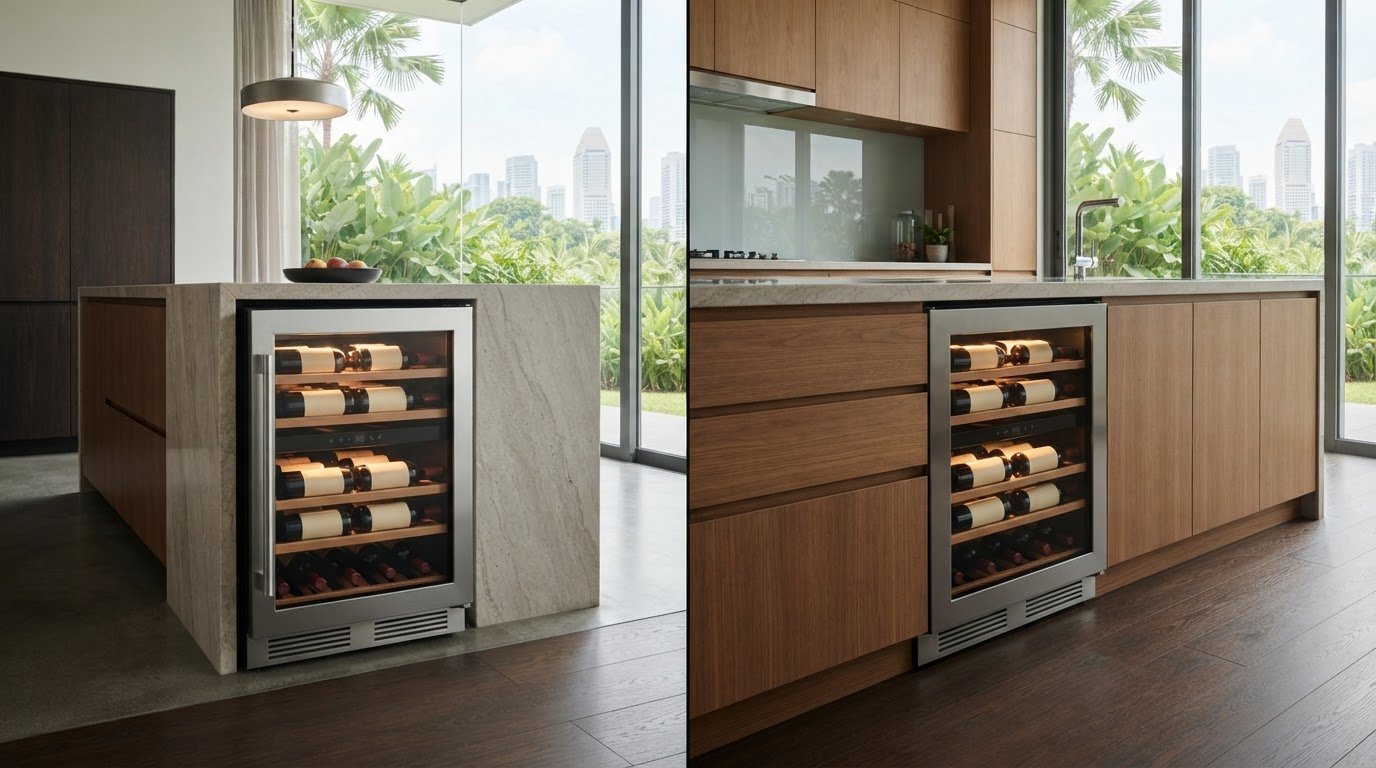
For the modern urban apartment, Kadeka wine chillers offer a sophisticated balance of sleek aesthetics and high-performance cooling. These units are specifically engineered to handle the thermal demands of a tropical climate while maintaining a minimalist footprint. If your collection spans varied styles, from delicate whites to robust South African Savage reds, Liebherr provides the benchmark for German engineering. Their multi-zone cooling technology allows you to set distinct temperatures within a single cabinet, ensuring every varietal is stored and served at its specific peak. This technical superiority eliminates the risk of thermal instability and provides a reliable sanctuary for your bottles.
Don't let the environment dictate the fate of your collection. Move beyond the common wine storage mistakes in the tropics by choosing hardware that honors the craft of the winemaker. Whether you seek the heritage of Eurocave or the precision of Liebherr, our curated selection provides the protection your wines deserve. Elevate your collection with professional storage from Stellez Vine and experience the certainty of benchmark quality in every pour.
Secure Your Sanctuary: Elevate Every Vintage
Protecting a fine wine collection in the heat of the tropics is a journey from simple cooling to deliberate climate curation. You now understand that preserving your investment requires more than a dark corner; it demands an active defense against chemical acceleration, mechanical vibration, and fluctuating humidity. By identifying and correcting the common wine storage mistakes in the tropics, you ensure that every handpicked South African Savage or rare French vintage reaches its full benchmark potential.
True connoisseurship deserves the certainty of professional-grade hardware. As Singapore-based specialists in tropical preservation and authorized distributors for Eurocave, Kadeka, and Liebherr, we provide the technical expertise your collection requires. Combining a curated selection of premium labels with world-class storage solutions allows you to savor the craft exactly as the winemaker intended. Savor the finest vintages with professional storage from Stellez Vine. Start your journey today and discover the peace of mind that comes with a perfectly preserved cellar. Your future self will thank you at the first pour.
Expert Answers for Tropical Collectors
Can I store wine in a regular refrigerator if I plan to drink it within a week?
Yes, for short term consumption under seven days, a regular fridge is an acceptable temporary measure. However, it's not ideal for anything beyond a quick chill. Food fridges are typically too cold and generate constant micro vibrations that can mute a wine's delicate bouquet. While fine for a crisp rosé, avoid using it for premium reds, as the aggressive thermal shock upon removal can disrupt the wine's structural balance.
How does Singapore’s high humidity specifically affect wine corks and labels?
High humidity in the tropics is a double edged sword for collectors. While moisture prevents corks from drying out, levels exceeding 80% encourage the growth of mold and mildew. This leads to label rot, which significantly degrades the aesthetic and resale value of rare bottles. Professional cabinets from brands like Eurocave utilize active moisture management to maintain the "Golden Mean" of 65% to 75% humidity, protecting both the seal and the branding.
What is the ideal temperature for storing a mix of red and white wines?
The universal benchmark for long term aging of all wine styles is 12°C to 15°C. Storing your reds and whites together at this constant temperature ensures stable chemical evolution for every bottle in your sanctuary. While you will serve them at different temperatures, they should age in the same cool environment. Using a multi zone Liebherr cabinet allows you to maintain this aging core while keeping specific bottles at service temperature.
Is it better to store wine bottles horizontally or vertically in the tropics?
Always store your bottles horizontally to ensure the liquid stays in constant contact with the cork. In a tropical climate, dry air from air conditioning can cause vertical corks to shrink rapidly, leading to oxidation. Horizontal positioning keeps the cork moist and expanded, maintaining a definitive seal against the elements. This simple habit prevents one of the most common wine storage mistakes in the tropics and secures your collection's longevity.
How long can a premium red wine last if stored in an air-conditioned room?
A premium red might only stay fresh for a few months in a standard air conditioned room. Air conditioning is designed for human comfort rather than wine preservation; it creates significant temperature fluctuations and strips essential moisture from the air. These cycles cause the wine to expand and contract, eventually compromising the cork. Without the active, stable climate of a dedicated cabinet, your vintage will age prematurely and lose its complexity.
Do wine fridges use a lot of electricity in a tropical climate?
Modern wine cabinets from Kadeka and Liebherr are engineered for high energy efficiency, even in intense heat. While they work harder than they would in temperate zones, their specialized insulation and high performance compressors minimize consumption. They typically consume less power than a standard household refrigerator. Investing in a high quality unit ensures your collection is protected without causing a significant spike in your monthly utility expenses or environmental footprint.
What happens if the power goes out? How long will my wine stay safe?
Most professional wine cabinets, especially thick walled models from Eurocave, possess excellent thermal inertia. If the door remains closed during a power outage, the internal temperature will stay within a safe range for several hours. The insulation acts as a shield against the external tropical heat. For longer outages, the temperature rises slowly and steadily, which is far less damaging to the wine than the rapid spikes found in passive storage.
Why does my wine taste "metallic" or "flat" after being stored in the kitchen?
This flavor degradation is a classic sign of heat damage, often called "cooking." Kitchens are the most volatile rooms in a home, with heat from cooking appliances accelerating destructive chemical reactions inside the bottle. High temperatures strip away vibrant fruit notes and acidity, leaving the wine tasting dull or metallic. This is one of the common wine storage mistakes in the tropics that is easily avoided by moving your collection to a stable environment.
Comments