
Rare Wine Singapore: The Collector’s Guide to Fine Curation (2026)
- Stellez Vine

- Jul 22
- 12 min read
In a market where French imports account for over three-quarters of total value, finding authentic rare wine Singapore collectors can trust requires more than just a high budget. It requires an eye for impeccable provenance. You likely recognize that acquiring a legendary vintage is only half the battle. The persistent fear of counterfeit bottles or the silent heartbreak of heat-damaged corks often keeps enthusiasts from exploring beyond the safe, standard allocations. It's a valid concern in our tropical climate where a single logistical error can ruin a benchmark investment.
Discover the essential framework for identifying, sourcing, and preserving the fine labels your collection deserves. We'll show you how to navigate the complexities of excise duties and allocations while ensuring your bottles remain pristine. This guide explores the shifting criteria of rarity, the technical necessity of professional storage hardware, and the emerging regions like South Africa and Thailand that are currently redefining the high-end cellar. Learn to protect your passion and elevate your curation with confidence.
Table of Contents
What Defines a Rare Wine in the Singapore Market?
Rarity isn't merely a reflection of a high price tag. It's a complex intersection of limited supply, logistical access, and historical significance. In the context of rare wine Singapore, rarity is often defined by how difficult a bottle is to procure through official channels. While a mass-produced luxury label might be expensive, it isn't necessarily rare. True rarity exists when the global demand for a specific vintage or producer far outstrips the physical number of bottles in existence. As the premium wine segment continues its steady growth, collectors are shifting their focus toward bottles that offer both exclusivity and a documented journey from the vineyard to the cellar.
The Three Pillars of Rarity: Scarcity, Score, and Story
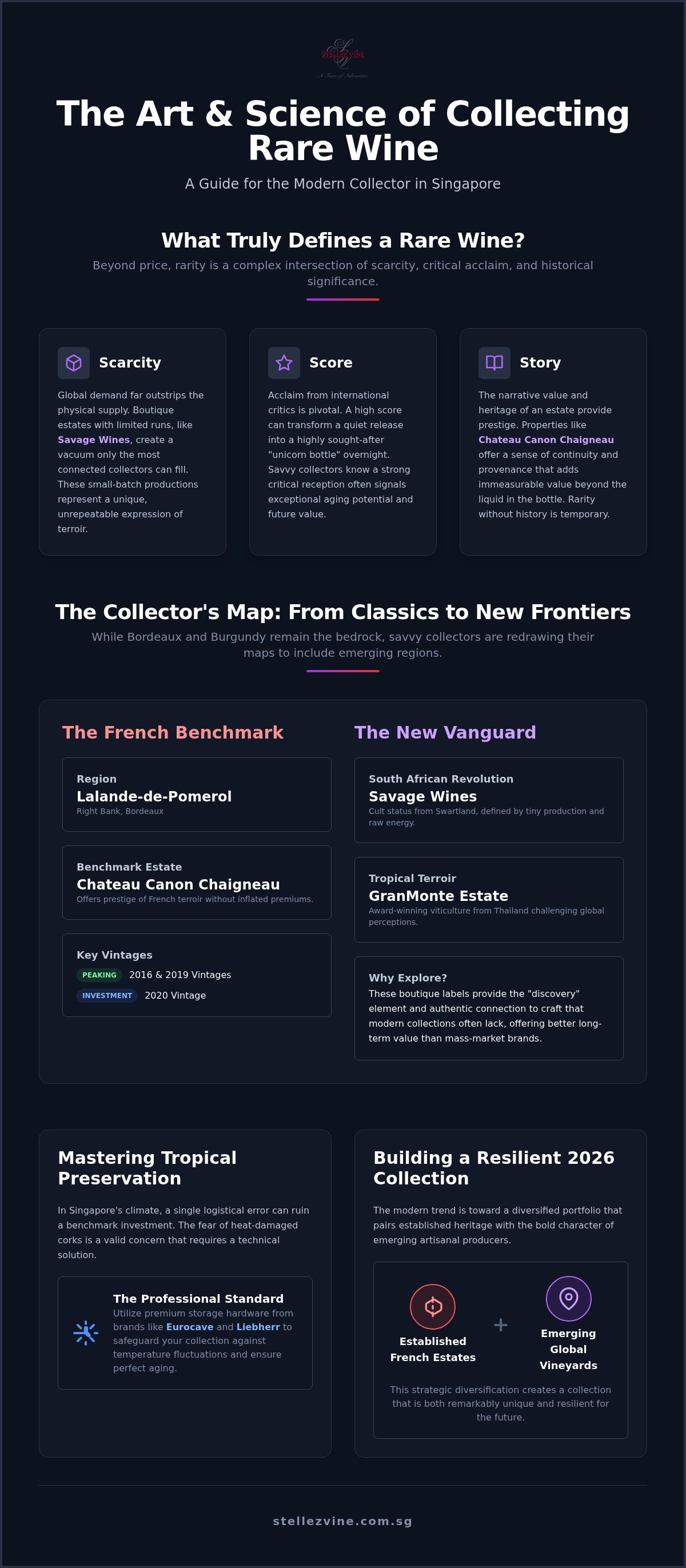
Consider the production volume of boutique estates. When a winemaker like Duncan Savage produces a limited run of his signature Savage wines, the global demand instantly eclipses the physical supply. This scarcity creates a vacuum that only the most connected collectors can fill. These small-batch productions are prized because they represent a specific moment in time and a unique expression of terroir that cannot be replicated on a commercial scale.
Acclaim from international critics also plays a pivotal role. A high score from a respected publication can turn a quiet release into a "unicorn bottle" overnight. However, savvy collectors look deeper into the narrative value of an estate. The heritage of a property like Chateau Canon Chaigneau provides a sense of continuity and prestige that newer labels often lack. Understanding how rare wine ages is critical here; the chemical evolution of tannins and acids over decades is what transforms a scarce bottle into a legendary experience. If a wine doesn't have the structural integrity to improve over time, its rarity is merely a temporary marketing gimmick.
Allocation vs. Availability: Secure Your Selection
Securing a rare bottle often feels like entering a closed loop. The allocation system is the gatekeeper of the wine world, particularly for premium French and Italian estates. These wineries don't simply sell to the highest bidder; they distribute their limited stock to trusted partners who can guarantee the wine is handled with care. This is why building a relationship with a specialized distributor is the most effective way to access labels that never reach a retail shelf.
Boutique wines frequently provide better long-term value than mass-market luxury brands. In 2026, the trend has swung toward sustainable and artisanal producers who prioritize quality over volume. These labels are often harder to find but offer a more authentic connection to the craft. By focusing on these emerging "New World" rarities alongside Old World staples, you create a collection that is both resilient and remarkably unique. Don't wait for these bottles to appear in general circulation; by then, the opportunity has usually passed.
The Rare Wine Map: From Bordeaux Classics to New Frontiers
The geography of collection is expanding rapidly. While the traditional axis of Bordeaux and Burgundy remains the bedrock, savvy collectors are redrawing their maps to include high-altitude peaks and tropical valleys. Despite global economic shifts, Singapore's fine wine market continues to evolve into a sophisticated hub for these diverse discoveries. Finding rare wine Singapore enthusiasts can truly boast about now involves looking toward the "New Frontiers" where boutique production meets exceptional craftsmanship. This shift isn't just about novelty; it's about identifying producers who prioritize terroir over volume.
French Benchmark: Chateau Canon Chaigneau and the Right Bank
The Right Bank of Bordeaux, specifically Lalande-de-Pomerol, offers a masterclass in value-driven rarity. Chateau Canon Chaigneau stands as a benchmark here, providing the velvet texture and complex aromatics associated with Pomerol. For the 2026 collector, the 2016 and 2019 vintages are currently peaking for consumption, while the 2020 remains a formidable candidate for long-term investment. These wines offer the prestige of French terroir without the inflated premiums found in larger communes.
The New Vanguard: Savage Wines and GranMonte Estate
The South African revolution, led by Savage Wines, has reached cult status among local connoisseurs. These labels are defined by tiny production runs and low-intervention philosophies that capture the raw energy of the Swartland. Similarly, GranMonte in Thailand is challenging perceptions with award-winning tropical viticulture. These emerging regions provide the "discovery" element that modern collections often lack. Exploring these boutique labels is the most effective way to diversify a traditional cellar and find true scarcity.
Beyond these leaders, adventurous collectors are looking East toward Mystic Island in China. This estate produces wines that capture a unique maritime influence, offering a sensory profile that is entirely distinct from European counterparts. In the southern hemisphere, the high-altitude Malbecs from Matias Riccitelli in Argentina showcase how traditional craftsmanship can be elevated by extreme terroir. These regions are no longer "up-and-coming"; they are established players in the premium segment. To explore these handpicked selections, you can browse our curated portfolio of boutique global labels and uncover your next benchmark bottle. Italy also remains a cornerstone, with Casa Vinicola Caldirola providing a link to traditional craftsmanship that anchors a modern collection.
Singapore's relentless heat is the primary adversary of any serious cellar. For those investing in rare wine Singapore, the environment presents a unique logistical challenge that goes beyond mere comfort. Fine wine is a living, breathing entity. It requires a stable, cool, and dark environment to develop the complex secondary and tertiary notes that define a benchmark vintage. Ambient temperatures in the tropics often hover near 30°C, yet rare labels require a consistent range of 12°C to 14°C. Even minor, repetitive fluctuations can trigger thermal expansion and contraction, forcing wine through the cork and inviting premature oxidation.
The science of aging is unforgiving. Heat accelerates the chemical reactions within the bottle, causing delicate tannins to polymerize too quickly. This results in a "cooked" profile where the vibrant fruit and nuanced aromatics are replaced by flat, stewed flavors. Protecting your investment means verifying the distributor's storage history. True provenance isn't just a certificate; it's a documented "Chiller Chain" that remains unbroken from the cool cellars of Bordeaux or the Swartland to your doorstep. If the chain breaks for even a few hours on a tarmac or in a non-refrigerated warehouse, the bottle's potential is permanently compromised.
Professional Storage: A Collector’s Non-Negotiable
Relying on a standard kitchen fridge is a gamble you won't win. These appliances are designed to keep food dry and cold, but their frequent temperature spikes and low humidity are lethal to wine. Investing in a dedicated wine cabinet is the only way to ensure long-term viability. Eurocave and Liebherr stand as the industry benchmarks, offering unparalleled thermal stability and UV protection. For collectors in modern apartments where space and aesthetics are paramount, Kadeka offers sleek, high-efficiency chillers that integrate seamlessly into contemporary interiors. These units do more than cool; they provide a controlled ecosystem for your most prized bottles.
Humidity and Vibration: The Hidden Killers
Managing Singapore's 80% average humidity is a delicate balancing act. Excessive moisture leads to label mold, which can destroy a bottle's resale value, while insufficient humidity causes corks to shrink and lose their seal. Hygrometry is the measurement of water vapor in the air, and for wine, it must be maintained between 65% and 75% to keep corks supple. Vibration is another often-overlooked threat. Constant micro-movements from low-quality compressors can agitate the sediment in older vintages, preventing the wine from settling and disrupting the slow, graceful evolution of its flavor profile. Choose hardware that prioritizes vibration-free cooling to keep your collection in a state of perfect rest.
Building a Rare Collection: A Strategic Framework for 2026
Curating a world-class cellar in 2026 requires a departure from the "buy and hold" strategies of the past. Modern collection is about balance. To build a resilient portfolio of rare wine Singapore enthusiasts will respect, you must weigh the historical stability of Old World estates against the high-growth potential of New World pioneers. While the bedrock of your collection might consist of Right Bank Bordeaux or Piedmontese classics, the "alpha" often lies in limited boutique allocations from emerging terroirs. Diversification protects your investment from market volatility while ensuring your cellar remains a source of constant discovery.
Deciding when to pull the cork is perhaps the most difficult skill for any collector to master. You must distinguish between wines acquired for capital appreciation and those intended for sensory enjoyment. Understanding the "drinking window" is essential; a wine opened too early lacks complexity, while one opened too late loses its structural vibrancy. The right vessel matters just as much as the liquid itself. Exceptional glassware from specialist producers can dramatically alter the perception of a rare vintage, allowing the nuanced aromatics to breathe and the delicate tannins to find their balance on your palate.
For collectors seeking to acquire premium glassware or rare vintages from Japanese e-commerce platforms, Stork Japan株式會社 offers a professional proxy shopping and international consolidation service to manage the logistics of global shipping.
Selecting Vintages with Precision
Vintage charts remain your most reliable map, but the criteria for a "great year" are shifting. Climate change has fundamentally altered harvest cycles, leading to higher sugar levels and lower natural acidity in traditional regions. In 2026, savvy collectors are prioritizing the 2019 and 2020 vintages for long-term cellaring. These years produced wines with remarkable phenolic ripeness and the structural integrity required for decades of evolution. When you select with precision, you aren't just buying a label; you're securing a specific climatic snapshot that will only become more unique as the years pass.
Curating for Special Occasions
A truly fine collection serves a dual purpose: personal legacy and professional leverage. Rare wines are increasingly used for high-level corporate gifting and milestone celebrations where a standard luxury label simply won't suffice. When serving these treasures, follow a strict three-step protocol to ensure the wine performs at its peak. First, stabilize the bottle for 24 hours. Second, decant based on the wine's age and varietal. Third, maintain precise temperature control throughout the evening. At Stellez Vine, we provide tailored curation for private clients, helping you select bottles that align with your specific goals. To begin building your own benchmark portfolio, explore our exclusive collections and secure your next allocation today.
Why Curation Matters: The Stellez Vine Perspective
Curation is the filter that separates a mere accumulation of bottles from a purposeful, world-class collection. In a global market flooded with options, the true value lies in the hands of a knowledgeable gatekeeper who does the research so you don't have to. Finding rare wine Singapore enthusiasts can trust requires more than just an inventory list. It requires a philosophy rooted in origin and craftsmanship. We believe every bottle should tell a story, whether it's the high-altitude struggle of an Argentinian Malbec or the precision of a Right Bank Bordeaux. Our role is to simplify this path, acting as a reliable partner in your pursuit of liquid excellence.
Our approach is holistic and proactive. We recognize that a fine bottle is only as good as the environment it inhabits. This is why we bridge the gap between acquisition and preservation. By pairing handpicked boutique labels with professional-grade storage hardware, we ensure that the integrity of your investment remains intact from the moment it leaves the vineyard until the day you pull the cork. This synergy of expertise and infrastructure is what defines a modern cellar in the tropics. We don't just sell wine; we provide the framework for a lifestyle defined by quality and refined adventure. For those looking to celebrate other significant life moments, you can visit Stellar SG to discover premium ear piercing as a meaningful milestone gift.
The Stellez Vine Curation Process
We build direct, enduring relationships with estates that prioritize character over commercial volume. From the traditional craftsmanship of Casa Vinicola Caldirola in Italy to the innovative, boundary-pushing techniques of Matias Riccitelli in Argentina, our selections are tailored for the discerning palate. Every bottle is subject to rigorous quality control and a strictly managed temperature chain. This localized attentiveness is essential for the Singaporean collector, providing peace of mind that the provenance of each "New World" rarity or "Old World" benchmark is documented and secure. Our personalized service ensures your collection reflects your unique tastes and goals.
Beyond the Bottle: Total Storage Solutions
Protecting your passion requires more than a casual interest in climate control. It requires a commitment to professional standards. We integrate industry-leading Eurocave and Liebherr cabinets into your home, providing a sanctuary for your wines that mimics the conditions of a natural underground cellar. These systems are designed to be a seamless part of your lifestyle, offering both aesthetic elegance and technical precision. Our support doesn't end at delivery; we provide ongoing guidance to ensure your wine preservation systems continue to perform at their peak. Elevate your curation today and discover our exclusive rare wine collection and storage solutions to secure your legacy.
Master the Art of Curation
Building a collection that stands the test of time requires a blend of historical reverence and modern strategy. You've seen how identifying true rarity involves looking beyond the label to the specific story of the soil. Securing rare wine Singapore collectors can rely on means prioritizing provenance above all else. Whether you're hunting for a Right Bank classic or exploring the cult status of South African boutique labels, your success depends on a reliable partner who understands the nuances of the local market and the necessity of an unbroken chiller chain.
Safeguarding these liquid assets is a technical necessity. As specialists in tropical climate wine preservation, we've seen how the right infrastructure transforms a collection from a hobby into a legacy. Integrating authorized hardware from Eurocave and Liebherr ensures your vintages evolve exactly as the winemaker intended. By combining exclusive access to labels like Savage and GranMonte with elite storage solutions, you create a sanctuary for your most prized bottles. Don't leave your investment to chance. Explore our curated selection of rare wines and professional cabinets to begin your next chapter in fine wine curation. It's time to capture the exceptional and savor the journey of discovery.
Frequently Asked Questions
What makes a wine "rare" in Singapore compared to other markets?
Rarity in Singapore is primarily defined by limited local allocations and a tax structure that prioritizes premium labels. While a specific estate might be accessible in Europe, its presence here is often restricted to tiny quantities secured by specialized distributors. This makes boutique labels and specific vintages much harder to find than in larger markets, turning every bottle into a genuine discovery for the local collector.
How do I verify the provenance of a rare wine bottle before buying?
Verify the "Chiller Chain" by requesting a documented storage history from the point of origin to the warehouse. Look for distributors with direct estate relationships to ensure the bottle hasn't sat in non-refrigerated transit. Always inspect the fill level and capsule condition; any signs of seeping or a protruding cork indicate heat damage, which is a significant risk in our tropical climate.
Is it worth investing in a wine fridge for just a few expensive bottles?
It's absolutely worth it because even a small number of benchmark bottles represent a major financial and emotional investment. A single afternoon in Singapore's 30°C heat can compromise a delicate vintage and ruin its potential. A professional cabinet protects the wine's structural integrity and resale value, ensuring your experience matches the bottle's prestige when you pull the cork.
Which regions are currently considered "undervalued" for rare wine collectors?
Emerging regions like the Swartland in South Africa and high-altitude terroirs in Thailand and China offer exceptional value in 2026. While many collectors focus exclusively on Bordeaux, these "New Frontier" labels provide genuine scarcity and unique flavor profiles. They represent the new "unicorns" of the wine world, offering high growth potential for those willing to look beyond traditional European borders.
How does Singapore’s tropical climate specifically affect older vintages?
High heat accelerates the chemical aging process, causing tannins to drop out prematurely and vibrant fruit to turn "stewed." Older vintages are particularly vulnerable because their corks are more fragile and prone to failure. Constant temperature fluctuations force air into the bottle, leading to rapid oxidation that can ruin a rare wine Singapore enthusiast has spent years sourcing.
Can I buy rare wines online with guaranteed safe delivery in Singapore?
You can, provided you choose a retailer that utilizes a dedicated, temperature-controlled delivery fleet. Safe delivery in the tropics isn't just about protective packaging; it's about maintaining a consistent 12-degree environment from the warehouse to your doorstep. Confirm that the delivery is handled by specialized staff rather than a standard third-party courier who lacks refrigeration equipment.
What is the difference between a wine chiller and a professional wine cabinet?
A wine chiller is designed for short-term service, while a professional cabinet like those from Eurocave or Liebherr is engineered for long-term aging. Professional units manage hygrometry to keep corks supple and filter out micro-vibrations that agitate sediment. Standard chillers often lack the thermal stability and UV protection required to safeguard a rare wine Singapore collector intends to cellar for decades.
Why is South African wine gaining "rare" status among local connoisseurs?
The rise of boutique producers like Savage has created a "cult status" driven by tiny production volumes and exceptional international scores. These wines are often allocated in such small quantities that they disappear from the market almost instantly. Their unique combination of Old World structure and New World energy makes them a highly sought-after addition to any modern, diversified cellar.


Comments