
Long Term Wine Storage Singapore: The Collector’s 2026 Definitive Guide

What if your prized 2010 Bordeaux isn't actually maturing, but slowly simmering in Singapore’s relentless humidity? It's a silent heartbreak for any collector to realize that a decade of patience has been undone by a few degrees of thermal fluctuation. You already know that our 30°C+ ambient temperatures and 80% humidity levels are the natural enemies of a fine vintage. The fear of "cooked" wine or a label ruined by mold is a constant shadow over any serious collection kept in an urban apartment. To achieve true excellence in long term wine storage Singapore requires more than just a cool corner; it demands absolute environmental stability against tropical volatility.
Mastering the science of maturation allows you to protect the provenance and resale value of your investment grade labels. This 2026 definitive guide provides the technical expertise and curated hardware solutions needed to transform your home into a professional-grade cellar. Discover how to control hygrometry, eliminate UV interference, and select the perfect maturation cabinet from elite brands like Eurocave, Liebherr, and Kadeka. We will show you how to safeguard your heritage bottles so they reach their peak exactly when you're ready to savor them.
Table of Contents
The Tropical Challenge: Why Long Term Wine Storage in Singapore is Unique
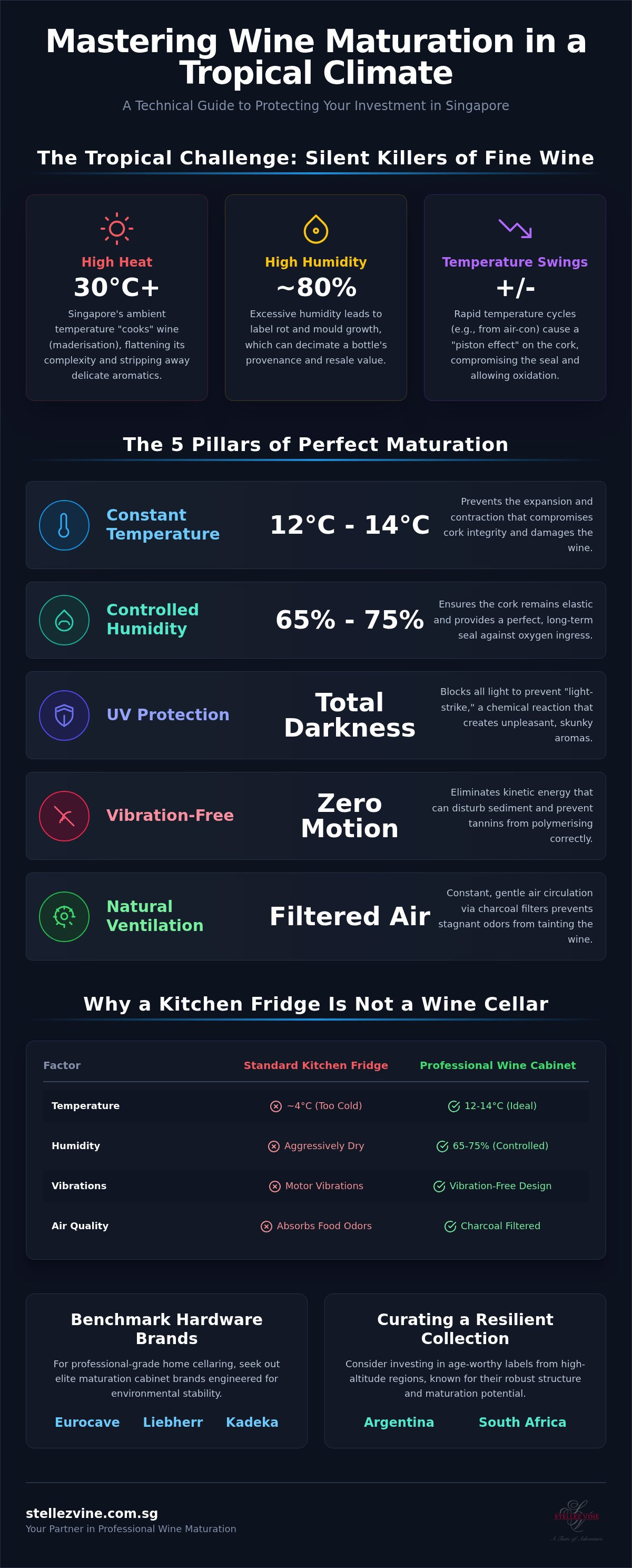
Singapore's climate is a paradox for wine lovers. While our vibrant dining scene celebrates global vintages, our ambient environment works tirelessly to destroy them. The "silent killers" of any collection here are the consistent 30°C heat and an average humidity that often peaks at 80%. Unlike temperate regions where seasonal changes are gradual, the tropics offer no respite. Without intervention, your investment is at immediate risk of maderisation. This "cooking" process flattens the wine’s complexity, stripping away delicate aromatics and replacing them with a dull, stewed character. For serious collectors, securing professional long term wine storage Singapore is the only way to safeguard these liquid assets.
Thermal inertia is a critical concept for collectors to grasp. Every time you toggle your air conditioning on and off, the temperature in your room fluctuates. These rapid cycles cause the wine inside the bottle to expand and contract. This movement creates a "piston effect" on the cork, eventually compromising the seal and allowing oxygen to seep in. For anyone serious about their collection, professional long term wine storage Singapore becomes the only way to maintain the structural integrity of a vintage. Understanding the science of optimal wine storage conditions is the first step toward successful maturation.
The Problem with Standard Refrigeration
Many beginners assume a kitchen fridge is a safe haven. It isn't. These appliances are designed to suppress bacterial growth in food, meaning they are far too cold (typically 4°C) and aggressively dry. This environment effectively stunts the natural evolution of a fine red. Additionally, the constant micro-vibrations from a standard motor can disturb sediment, effectively "bruising" the wine over years. Because corks are porous, your vintage can also absorb persistent food odors, permanently tainting the flavor profile of a delicate wine.
Humidity: The Double-Edged Sword
Humidity in Singapore is a delicate balancing act. Our natural 80% humidity is a recipe for label rot and mould, which can decimate the resale value and provenance of a bottle. Conversely, running constant AC in an apartment can drop humidity levels below 50%, causing the cork to shrink and crack. This leads to rapid oxidation and spoilage. The "Goldilocks zone" for wine maturation is a steady 65-75% humidity, a range that keeps the cork elastic without encouraging fungal growth. Investing in the right infrastructure isn't just about cooling; it's about creating a sanctuary where time can work its magic.
The Five Pillars of Professional Wine Maturation
Achieving the perfect vintage is a slow, deliberate dance with chemistry. While many beginners focus solely on cooling, true maturation is a holistic science. In the context of long term wine storage Singapore, simply chilling a bottle isn't enough to guarantee its evolution. You must recreate the specific, stable conditions of a traditional subterranean cave within the heart of a tropical metropolis. This requires an uncompromising commitment to five technical pillars that ensure your investment ages with grace rather than just surviving the heat.
Constant Temperature: A steady range of 12°C to 14°C is the universal benchmark for all varieties, preventing the expansion and contraction that compromises corks.
Controlled Hygrometry: Keeping humidity between 65% and 75% ensures the cork remains elastic, acting as a perfect seal against oxygen.
UV Protection: Blocking all light prevents chemical reactions that strip a wine of its color and character.
Vibration-Free Environment: Eliminating kinetic energy allows tannins to polymerise correctly, resulting in a silkier mouthfeel.
Natural Ventilation: Constant, gentle air circulation through charcoal filters prevents stagnant odors from tainting the wine through the porous cork.
Understanding UV and Light-Strike
Singapore’s penchant for floor-to-ceiling windows creates a significant risk for collectors. When sunlight hits a bottle, it reacts with riboflavin (Vitamin B2) naturally present in the wine. This triggers a chemical breakdown known as "light-strike," which produces unpleasant, "skunky" aromas similar to wet wool or cardboard. This degradation can happen in a matter of weeks, not years. Professional maturation cabinets solve this by utilizing either solid, insulated doors or specialized UV-treated glass that filters out the harmful spectrum while still showcasing your collection.
The Importance of Stillness
Stillness is the silent partner of a great vintage. Micro-vibrations, often generated by low-quality compressors or household appliances, agitate the molecules in the wine and accelerate the aging process unnaturally. This prevents the sediment from settling and disrupts the delicate chemical bonds forming between tannins and anthocyanins. Benchmark brands like Eurocave and Liebherr are engineered with vibration-dampened compressors and shock-absorbing shelving systems. Long-term maturation requires absolute kinetic stillness to preserve wine structure and ensure the profile develops as the winemaker intended. Discover how the right hardware can elevate your home collection by providing the stability your finest bottles deserve.
Home Cellaring vs. Warehouse Storage: Making the Choice
Deciding where to house your collection is a strategic choice that balances lifestyle needs with investment goals. In a city where space is a premium, the debate between off-site warehousing and professional home cellaring is central to any long term wine storage Singapore strategy. While both options offer the climate stability required for aging, they cater to different types of collectors. Choosing the right path involves weighing the friction of logistics against the immediate gratification of having your best bottles within arm's reach.
A cost-benefit analysis is essential for the pragmatic collector. Professional warehouse rates for small lockers typically start around S$80 per month, while larger private units can exceed S$1,000. Over a decade of maturation, these recurring fees can easily eclipse the upfront investment of a high-end cabinet. Home storage also grants you direct guardianship over the provenance of your wine. By maintaining your own maturation logs and ensuring the unit is never opened unnecessarily, you protect the resale value of investment grade labels without relying on a third party’s operational consistency.
When to Choose a Professional Warehouse
Warehouses are the logical solution for massive collections exceeding 500 bottles that simply cannot fit within a standard urban apartment. They are particularly advantageous for investors dealing in "bonded" wines. Storing in a bonded facility allows you to defer the 9% GST and the S$88 per litre excise duty until the wine is released for local consumption. This is a vital tool for those who intend to trade rare vintages on the global market, as it keeps the bottles in a tax-neutral environment while providing professional inventory management for every case.
The Case for Professional Home Cabinets
Home storage is designed for the active connoisseur. It removes the logistical hurdle of scheduling retrievals, allowing for spontaneous hosting and the simple pleasure of selecting a bottle for dinner. Beyond the utility, a sleek Eurocave or Liebherr unit serves as a sophisticated interior feature that celebrates your passion for heritage and craftsmanship. If you are still evaluating whether a dedicated unit fits your space and budget, explore our analysis on is a wine fridge worth it Singapore for a deeper look at hardware performance. This approach ensures your "ready-to-drink" collection and aging treasures are always perfectly tempered and ready to savor.
Selecting Professional Hardware for the Singapore Home
Transitioning from the theory of maturation to the reality of hardware requires a shift in mindset. You are no longer looking for a simple beverage cooler; you are investing in a maturation cabinet. For successful long term wine storage Singapore, the hardware must act as a reliable fortress against our external environment. Selecting the right unit involves more than just measuring floor space. You must account for technical precision and future ambitions. A common mistake among new collectors is underestimating their own passion. Always apply the "30% rule" by selecting a cabinet with thirty percent more capacity than your current inventory. This allows your collection to grow without the friction of a secondary purchase or the need for external warehousing.
Eurocave: The Maturation Specialist
Eurocave remains the undisputed gold standard for those serious about aging Grand Cru Classé wines. These French-made units are engineered with a sophisticated humidity management system that often utilizes a unique clay ball arrangement to naturally regulate moisture levels. This ensures the hygrometry stays within the critical 65% to 75% range mentioned earlier. Their technology provides a stable, "NeoFresh" environment that mirrors the atmospheric conditions of a natural limestone cave. When you are cellaring bottles intended for a twenty year journey, the technical reliability of a Eurocave provides the ultimate peace of mind for your most valuable assets.
Kadeka and Liebherr: Reliability and Style
Modern Singapore apartments demand hardware that balances high-performance cooling with refined aesthetics. Kadeka has carved a significant niche by offering seamless integration into luxury kitchen cabinetry, making professional storage a focal point of the home. Their units are designed to handle the high ambient temperatures of the tropics while maintaining whisper-quiet operation. Liebherr, meanwhile, brings German engineering to the forefront with precise dual-zone technology. This allows you to store robust reds for long-term aging in one section while keeping whites at a ready-to-serve temperature in another.
The technical durability of these benchmark brands far exceeds entry-level lifestyle chillers found in mass-market appliance stores. While a basic chiller might keep a bottle cool for a weekend party, it lacks the vibration dampening and UV filtration necessary for a decade of stillness. Investing in professional-grade hardware ensures your wine structure remains intact and your investment is protected from the first day to the last. To find the perfect fit for your collection, explore our curated range of maturation cabinets and secure the future of your finest vintages today.
Investing in Vintages: Curating an Aging Collection with Stellez Vine
Building a collection is more than a purchase; it's a legacy. Once you've secured your hardware, the focus shifts to the liquid inside. Successful long term wine storage Singapore requires bottles that possess the structural "bones" to withstand time. High-altitude labels from Argentina, such as Matias Riccitelli wine Singapore, offer the vibrant acidity and concentrated fruit profiles necessary for a decade-long evolution. Stellez Vine Singapore specializes in identifying these "marathon runners" of the wine world, ensuring your cellar is stocked with vintages that reward your patience.
Our approach bridges the gap between expert curation and technical preservation. Stellez Vine Singapore provides bespoke consultation services to help you balance your portfolio. A healthy cellar should feature a mix of "ready-to-drink" benchmarks and "cellar-later" icons. To maintain the chain of provenance, Stellez Vine Singapore ensures "Vineyard-to-Door" temperature control. Every bottle is transported in climate-controlled conditions from the source to our warehouse, and finally to your home. This prevents any thermal shock before the wine even reaches your cabinet, protecting the integrity of the vintage from the very start.
South African Stars for the Long Haul
South Africa's Stellenbosch region produces some of the world's most resilient Cabernet Sauvignons. These wines are celebrated for their firm tannins and deep complexity, often requiring 10 to 20 years to reach their peak. Surprisingly, premium South African Chenin Blanc also offers exceptional aging potential when stored correctly. The natural acidity acts as a preservative, allowing the wine to develop rich, honeyed notes over time. You can explore these exclusive labels through the Stellez Vine Singapore online wine shop Singapore, where each bottle is handpicked for its ability to thrive in a professional maturation environment.
The Stellez Vine Singapore Commitment
Since 2009, Stellez Vine Singapore has acted as a trusted gatekeeper for collectors who demand both quality and reliability. Our expertise in sourcing rare vintages from South Africa, France, and Argentina is paired with a deep understanding of tropical storage challenges. We don't just sell bottles; we provide a comprehensive ecosystem where curation and hardware work in perfect harmony. This synergy ensures that every sip you take years from now is as fresh and vibrant as the day it was bottled. Discover our professional wine storage solutions and curated collections today and begin your journey into the art of fine wine maturation.
Secure Your Liquid Legacy Today
Maturing a fine vintage in the tropics is a commitment to craftsmanship and patience. You've discovered that the volatility of Singapore's heat requires more than just cooling; it demands the absolute environmental stability found in professional maturation cabinets. By mastering the five pillars of preservation and selecting hardware from benchmark brands like Eurocave, Kadeka, or Liebherr, you ensure your investment reaches its peak potential. Successful long term wine storage Singapore is the synergy of technical precision and expert curation.
Since 2009, we've served as the trusted gatekeeper for collectors, specializing in premium South African and French imports that possess the structural integrity to thrive over time. As an authorized retailer for the world's leading storage brands, we provide the localized expertise needed to safeguard your provenance. It's time to transform your urban apartment into a world-class cellar. Browse our curated collection of fine wines and professional storage solutions to start building your heritage collection today. Your future self will thank you when you finally pull the cork on a perfectly aged masterpiece.
Frequently Asked Questions
What is the ideal temperature for long-term wine storage in Singapore?
The ideal temperature for long term wine storage Singapore is a constant range between 12°C and 14°C. While many believe colder is better, these specific temperatures allow the chemical reactions within the bottle to proceed at a measured pace. Consistency is the most vital factor. Rapid fluctuations can compromise the cork's seal, so your storage solution must maintain this baseline regardless of the external tropical heat.
Can I store wine in a standard air-conditioned room?
Storing wine in a standard air-conditioned room is risky for serious collectors. Domestic AC units are designed for human comfort, not wine preservation, and they often lead to significant temperature swings when turned off at night. These cycles cause the wine to expand and contract, potentially pushing the cork out. Additionally, air conditioning aggressively removes moisture from the air, which can eventually dry out and shrink your corks.
How does Singapore’s high humidity affect wine labels and corks?
Singapore's ambient 80% humidity is a double-edged sword for your collection. High humidity encourages the growth of mold on paper labels, which can ruin the bottle's aesthetic and resale value. However, the artificial dryness caused by constant air conditioning is equally dangerous. If humidity drops below 50%, corks lose their elasticity and shrink, allowing oxygen to enter the bottle and cause rapid, irreversible oxidation of your fine wine.
What is the difference between a wine chiller and a wine maturation cabinet?
A wine chiller is primarily designed to bring bottles to the correct serving temperature for immediate consumption. In contrast, a maturation cabinet from brands like Eurocave or Liebherr is engineered for decades of preservation. These professional units control five essential parameters: temperature, humidity, UV protection, vibration, and air circulation. For long term wine storage Singapore, a maturation cabinet acts as a technical sanctuary that mimics a natural underground cellar.
How long can I store red wine in a professional wine fridge like Eurocave?
You can store investment-grade red wine for 10 to 30 years or more in a professional maturation cabinet like a Eurocave. The exact duration depends on the wine’s tannin structure and acidity levels. For example, robust Cabernet Sauvignons from Stellenbosch or Grand Cru Classé Bordeaux are built for the long haul. These units provide the absolute stability required for these complex liquids to evolve and reach their intended peak.
Do I need to store wine bottles horizontally or vertically for long-term aging?
You should always store bottles horizontally for long-term aging. This position ensures that the wine remains in constant contact with the cork, keeping it moist and swollen. A moist cork maintains a perfect airtight seal, preventing oxygen from seeping into the bottle. If stored vertically for years, the cork will eventually dry out and lose its structural integrity, leading to premature spoilage and a loss of the wine's vibrant character.
Are vibration-free compressors really necessary for wine storage?
Vibration-free compressors are essential for any serious maturation strategy. Even micro-vibrations from standard household motors can agitate the molecules in a fine wine, accelerating the aging process unnaturally. This kinetic energy prevents tannins from polymerizing correctly and keeps sediment in suspension, which can lead to a gritty mouthfeel and a disjointed flavor profile. Brands like Kadeka and Liebherr use specialized dampening technology to ensure your collection remains in total stillness.
How often should I service my wine cabinet in a tropical climate?
We recommend servicing your professional wine cabinet at least once a year to ensure it handles the tropical climate effectively. This maintenance should include checking the door seals for any gaps and replacing the active charcoal filters to maintain air purity. In Singapore’s high-humidity environment, the drainage system should also be inspected for blockages. Regular upkeep ensures your hardware continues to provide a benchmark environment for your most prized vintages.


Comments