
Long Term Wine Storage in Singapore: Debunking Myths in a Tropical Climate

Updated: Jul 23
A single afternoon of exposure to Singapore’s 30°C heat can compromise a premier cru faster than a cork taint. Many collectors believe that true long term wine storage Singapore is only possible in a commercial warehouse, fearing that home chillers are mere beverage coolers that fail after a few seasons. If you've ever worried about 'cooking' a rare vintage or watched nervously as humidity levels fluctuated, you aren't alone. It's a common skepticism that keeps many from building the legacy collection they truly desire.
We're here to debunk these myths and prove that you can successfully age world-class bottles for decades in a tropical climate. You'll discover the precise technical requirements for preservation, including humidity control and vibration reduction. We provide a clear framework for selecting the benchmark hardware your collection deserves, whether you're eyeing the unmatched precision of Eurocave, the German engineering of Liebherr, or the reliable versatility of Kadeka. It's time to stop worrying about the heat and start savoring the rewards of a perfectly matured cellar.
Table of Contents
Debunking the 'Impossible' Myth: Why Long Term Wine Storage in Singapore is Achievable
The Science of Maturation: How Singapore’s Heat Accelerates Spoilage
Home Cabinets vs. Regular Refrigerators: A Critical Comparison
Masterclass in Maintenance: Preparing Your Collection for Decades of Aging
Curating Your Legacy: Selecting the Right Storage for Your Singapore Home
Debunking the 'Impossible' Myth: Why Long Term Wine Storage in Singapore is Achievable
Achieving successful long term wine storage Singapore isn't a pipe dream; it's a matter of technical precision and the right hardware. For the serious collector, long-term storage means more than just keeping a bottle drinkable for a few months. It's the dedicated art of aging wine for 5, 10, or even 20 years, allowing the complex chemical transformations within the vintage to reach their peak. While the 30°C tropical heat outside is unforgiving, creating a sanctuary for your bottles within your home is entirely possible with a proactive strategy.
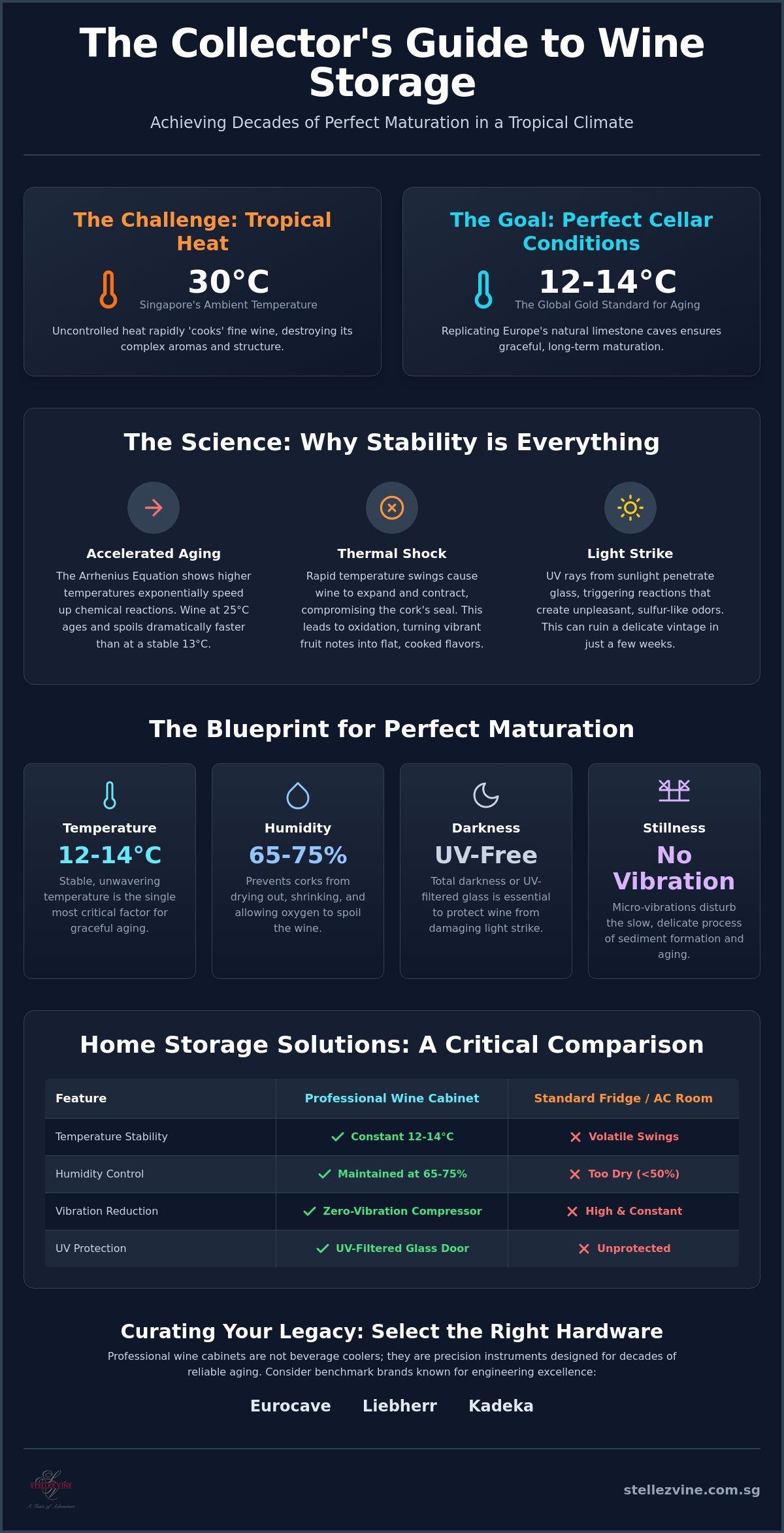
Many enthusiasts confuse 'cooling for service' with 'storing for maturation'. While a white wine might be chilled to 8°C for a crisp finish, true maturation requires a steady, unwavering environment. The global gold standard for aging is 12-14°C, a range that mimics the natural temperature of deep limestone caves in Europe. Understanding The Science of Wine Storage reveals that consistency is far more valuable than a specific number. In Singapore, your goal is to replicate these stable conditions to protect your investment from the volatile climate and ensure every bottle evolves exactly as the winemaker intended.
Myth #1: Tropical Humidity is Always the Enemy
Collectors often fear that Singapore's heavy air will ruin labels with mould. However, low humidity is a far more aggressive threat to the wine itself. If the air drops below 50%, corks begin to shrink and lose their elasticity, allowing oxygen to seep in and spoil the liquid. While you must manage airflow to prevent surface mould, the ambient moisture in a tropical climate is actually a benefit for cork health. The ideal sweet spot for long-term aging is a constant humidity level between 65% and 75%.
Myth #2: Household Air-Conditioning is a Sufficient Solution
Relying on a standard bedroom or living room air-conditioner is a recipe for disaster. Most households cycle their A/C off during the day or at night, creating drastic diurnal temperature swings. These cycles cause the wine to expand and contract, which eventually pushes the cork out or sucks air in. This leads to premature oxidation, stripping the wine of its vibrant fruit notes. Beyond the risk to your bottles, running a whole-room A/C 24/7 is remarkably inefficient. A dedicated cabinet, like those from Eurocave or Liebherr, provides a tailored, insulated environment that uses a fraction of the energy while offering total peace of mind for your long term wine storage Singapore strategy.
The Science of Maturation: How Singapore’s Heat Accelerates Spoilage
Chemistry doesn't wait for a convenient time to spoil your collection. The Arrhenius Equation, a fundamental principle of chemical kinetics, states that reaction rates increase exponentially as temperatures rise. For a bottle intended for long term wine storage Singapore, a typical room temperature of 25°C acts as a relentless accelerator. While wine aged at the classic 13°C develops complex secondary and tertiary aromas over decades, the same bottle kept at tropical ambient temperatures matures significantly faster and far less gracefully.
According to Purdue University's Wine Storage Guidelines, excessive heat causes the organic compounds in wine to break down prematurely. Instead of the slow, elegant evolution of tannins, you get a chaotic race toward spoilage. This heat exposure leads to a "maderized" or "cooked" profile. The wine loses its vibrant acidity and fresh fruit, replaced by flat, burnt sugar notes that no amount of decanting can fix. It's the difference between a deliberate masterpiece and a rushed, blurry sketch.
Light is the silent partner to heat. Singapore’s bright, sun-drenched apartments pose a major risk of "light-strike," where UV rays penetrate glass and trigger reactions in riboflavin. This produces unpleasant, sulfur-like odors that can ruin a delicate vintage in weeks. Professional cabinets with UV-filtered glass doors are essential to maintain the integrity of your investment, ensuring your home remains a sanctuary rather than a hazard for your bottles.
To further protect your collection from ambient light, many collectors integrate advanced glass solutions; for example, Magic Glass Singapore offers technology that can instantly transform clear windows into opaque barriers, shielding your wine from UV damage without sacrificing the room's aesthetics.
The 'Cooked' Wine Phenomenon: Understanding Thermal Shock
Thermal shock occurs when rapid temperature fluctuations cause the liquid inside the bottle to expand and contract. This physical movement compromises the hermetic seal of the cork. As the wine expands under heat, it's forced past the cork's edges. When the temperature drops, a vacuum is created, pulling oxygen-rich air into the bottle. You'll recognize this damage by a brownish hue in red wines or stewed fruit aromas that lack any structural definition. It's a permanent chemical change that strips the wine of its soul.
The Role of Constant Humidity in Cork Integrity
A dried-out cork is a failed gatekeeper. When humidity is inconsistent, the cork loses its moisture and shrinks, leading to "ullage" or significant evaporation. This is why benchmark cabinets like Eurocave utilize specific technologies, such as clay balls or lava rocks, to maintain a precise environment. While you need moisture for the cork, excess humidity can rot labels, which drastically reduces the resale value for serious investors. Protecting these delicate details is why we recommend exploring professional wine cabinets that offer total environmental control for the long haul.
Home Cabinets vs. Regular Refrigerators: A Critical Comparison
Many new collectors in Singapore start their journey by clearing a shelf in their kitchen refrigerator. While this works for a bottle of Sauvignon Blanc intended for Friday's dinner, it is a catastrophic choice for long term wine storage Singapore. A standard household fridge is designed for food preservation, not the delicate stewardship of living liquid. To truly protect an investment, you must understand the fundamental mechanical differences between a kitchen appliance and a professional aging cabinet.
The most immediate conflict is temperature. Research into The Science of Wine Aging demonstrates that extreme cold essentially puts wine into a state of suspended animation. At the 4°C found in a typical fridge, the beneficial chemical reactions that create complexity simply stop. Professional cabinets maintain a steady 12°C to 14°C, allowing the wine to evolve. Additionally, professional units like those from Eurocave or Liebherr feature active charcoal filters. These filters scrub the air of ambient odors, ensuring that your wine's bouquet remains pure and untainted by the environment.
Capacity and intent also play a role. Service chillers are built for quick access and short-term rotation, often lacking the insulation needed for decades of stability. In contrast, aging cabinets are designed with high-density thermal barriers and sophisticated sensors to ensure a "set it and forget it" environment for your most prized vintages.
Why Your Kitchen Fridge is Stunting Your Wine's Growth
A kitchen fridge is a high-traffic zone. Every time the door opens, the internal temperature spikes, forcing the wine to undergo constant thermal stress. This "cycling" prevents the wine from ever reaching a state of equilibrium. Beyond temperature, a shared fridge is a minefield of volatile organic compounds. Pungent aromas from onions, garlic, or leftovers can eventually permeate a porous cork. For a vintage you intend to keep for a decade, this shared environment is simply toxic.
The Vibration Factor: The Silent Killer of Sedimentary Aging
Vibration is the most overlooked threat in long term wine storage Singapore. Standard refrigerator compressors generate constant micro-vibrations that travel through the metal shelving. These movements disturb the natural settling of sediment, which is essential for the graceful development of aged red wines. More critically, these vibrations cause "bruising" by disrupting the slow, delicate formation of complex esters. This is why benchmark brands like Liebherr utilize vibration-dampened compressors and untreated wooden shelves to absorb kinetic energy. Your wine needs absolute stillness to reach its peak potential.
Masterclass in Maintenance: Preparing Your Collection for Decades of Aging
Creating a world-class cellar at home requires more than just purchasing a high-end unit; it demands a disciplined approach to stewardship. When you commit to long term wine storage Singapore, you're essentially becoming the curator of a living history. Successful aging relies on a 'set it and forget it' philosophy, but that stillness must be built upon a foundation of meticulous preparation and smart organization. It's about creating an environment where the wine can rest undisturbed for years.
To launch your home cellar with confidence, follow this three-step process for optimal results:
Select a stable location in your home, ideally away from external walls that absorb tropical heat or appliances that cause vibration.
Stabilize the unit by ensuring it's perfectly level, which prevents unnecessary strain on the compressor and keeps the internal environment quiet.
Stock your collection gradually over a 48-hour period. This allows the internal thermostat to adjust to the thermal mass of the bottles without overworking the cooling system.
Once your hardware is running, digital inventory management becomes your most valuable tool. Utilize specialized apps or software to track peak drinking windows and provenance details. This prevents the tragedy of a forgotten bottle passing its prime. To ensure your system remains a sanctuary for your vintages, perform this yearly maintenance audit:
Vacuum the rear condenser coils to maintain cooling efficiency.
Replace the active charcoal filter to keep the internal air fresh and odorless.
Inspect the magnetic door seals for any cracks or loss of suction.
Clean the interior surfaces with a mild, odorless solution to deter mould spores.
Strategic Organization: Managing Airflow and Accessibility
Air circulation is the lifeblood of temperature consistency. If you stack your bottles too tightly, you create 'hot spots' where air cannot reach, leading to uneven maturation. Position your 'drink now' bottles on accessible sliding shelves at the top. Reserve the bottom and back of the unit for your long-term investment pieces that won't be touched for a decade. Brands like Kadeka offer a versatile mix of sliding and fixed storage shelves, allowing you to tailor the layout to your specific collection needs. For those who need to organize the rest of their cellar or utility room, you can explore boltless rack options that provide heavy-duty support for all your storage requirements.
The Power of Monitoring: Technology for Peace of Mind
Don't rely solely on the cabinet's internal display. Use a secondary, independent hygrometer to verify that your humidity stays within the 65% to 75% range required for long term wine storage Singapore. Premium models now feature integrated alarm systems that trigger if the door is left ajar or if a power failure occurs. In 2026, smart cabinets offer remote temperature alerts directly to your smartphone, providing an extra layer of security for your most valuable assets. To find the perfect hardware to anchor your collection, browse our curated selection of professional wine cabinets and start your legacy today.
Curating Your Legacy: Selecting the Right Storage for Your Singapore Home
Investing in fine wine without a dedicated storage strategy is a gamble against the tropical climate. In the context of long term wine storage Singapore, a professional home cabinet is more than just an appliance; it's a centerpiece of a sophisticated lifestyle. While off-site facilities offer security, they lack the immediate gratification and accessibility of a personal cellar. Having your collection at your fingertips allows for spontaneous hosting and the daily pleasure of seeing your investment mature before your eyes. View your storage as the essential insurance policy for your liquid assets.
Since 2009, Stellez Vine Singapore has acted as a trusted gatekeeper for collectors across the island. We don't just sell hardware; we provide a tailored consultation to match your collection's scale with the right preservation technology. Our expert-led, white-glove delivery process ensures your unit is positioned and calibrated perfectly. This methodical approach removes the stress of logistics, allowing you to focus on the refined adventure of building your legacy.
Eurocave and Liebherr: The Benchmarks of Professional Preservation
Choosing the right hardware depends on your specific collection goals. We curate the world's most trusted brands to ensure your vintages are protected by benchmark technology:
Eurocave represents the pinnacle of heritage, known globally as the original inventor of the wine cabinet designed specifically for maturation.
Liebherr brings world-renowned German engineering to your home, offering precise multi-temperature zones for collectors who store both reds and whites at service and aging temperatures.
Kadeka provides a high-performance, accessible entry point for modern Singaporean apartments where space and style are equally prioritized.
Elevating the Experience: From Storage to Lifestyle
Elevate your evening rituals by transforming storage into an experience. There is an unmatched sense of satisfaction in opening a perfectly aged bottle of Chateau Canon Chaigneau, knowing its secondary notes were developed in a sanctuary you created. A well-lit, glass-door cabinet serves as a sensory testament to your passion for craftsmanship and heritage. It's time to stop treating your wine like a grocery item and start treating it like the investment it is. Discover our curated selection of professional wine cabinets at Stellez Vine Singapore and secure the future of your collection today.
Secure Your Legacy with Precision Preservation
Building a world-class collection in the tropics is a journey of refined adventure. By understanding the chemical kinetics of maturation and the mechanical superiority of professional cabinets, you've moved beyond common myths into the realm of expert stewardship. Achieving long term wine storage Singapore is no longer a logistical hurdle; it's a strategic investment in the sensory rewards of perfectly aged vintages. Your bottles don't just need cooling; they deserve a sanctuary that respects their heritage and potential.
As an authorized retailer for Eurocave, Liebherr, and Kadeka, Stellez Vine Singapore provides the technical expertise and hardware required to replicate a French cellar in your living room. We pair this specialized climate-control advice with a handpicked selection of exceptional South African and French wines, ensuring your cellar is stocked with quality from the start. It's time to stop worrying about the heat and start savoring the evolution of your investment. Every bottle tells a story, and with the right hardware, you ensure that story concludes with a perfect pour.
Elevate your collection with a professional wine cabinet from Stellez Vine Singapore and begin your curation journey today.
Frequently Asked Questions
Is it better to rent a wine cellar or buy a wine fridge in Singapore?
Buying a professional wine cabinet is generally the superior choice for accessibility and long-term cost-efficiency. While wine lockers in Singapore cost approximately S$80 to S$200 per month, a home cabinet is a one-time investment that places your collection at your fingertips. For serious collectors, the convenience of spontaneous hosting and the elimination of recurring rental fees make home hardware the most practical strategy for long term wine storage Singapore.
What is the ideal temperature for long term wine storage in a tropical climate?
The ideal temperature is a constant 12°C to 14°C, regardless of the 30°C heat outside. This range replicates the natural conditions of traditional European caves, allowing for slow and graceful maturation. Consistency is more important than the specific degree; rapid fluctuations cause the wine to expand and contract, which compromises the cork. Professional cabinets are engineered to maintain this narrow window even in a tropical environment.
Can I store red and white wine together in the same cabinet for aging?
Yes, you can store red and white wines together at the same temperature if your primary goal is aging. Both styles mature optimally at 12°C. While white wines are served colder and reds warmer, the maturation process requires a single, stable cellar temperature. Multi-zone cabinets like those from Liebherr allow you to maintain a dedicated aging zone alongside a separate service zone for immediate consumption.
How much does it cost to run a wine fridge 24/7 in Singapore?
Running a modern, energy-efficient wine cabinet in Singapore is surprisingly affordable, often costing less than a standard kitchen appliance. High-end models from Eurocave or Liebherr utilize advanced insulation and high-efficiency compressors to minimize power consumption. These units are designed to maintain internal stability with minimal energy draw, making them a sustainable and cost-effective choice for protecting your fine wine investment over several decades.
Do wine fridges help with humidity control in Singapore?
Professional wine cabinets are specifically designed to manage humidity, maintaining the 65% to 75% range required for cork health. Unlike regular fridges that strip moisture from the air, wine cabinets use specialized technology to keep corks supple. This is crucial for long term wine storage Singapore, as it prevents cork shrinkage and oxidation while also managing tropical moisture levels to protect your labels from mould.
How long can I store wine in a regular refrigerator before it spoils?
You should not store fine wine in a regular refrigerator for more than a few weeks. The standard setting of 4°C is too cold for maturation and will eventually stun the wine, preventing complex flavor development. Additionally, the motor vibrations and constant door openings create a volatile environment. The lack of humidity control in a food fridge will also dry out the cork, leading to premature spoilage.
What happens if there is a power outage in Singapore and my wine cabinet shuts off?
High-quality wine cabinets are built with thick thermal insulation that maintains safe temperatures for several hours during a power outage. If the door remains closed, the internal temperature rises very slowly. Most professional models from Eurocave or Kadeka also feature integrated alarms and memory functions that restore your precise settings as soon as power returns, ensuring your collection remains protected during rare utility disruptions.
Why is vibration such a big deal for aging fine wine?
Vibration is a silent threat that disrupts the delicate chemical balance and sediment settling required for graceful aging. Constant movement creates kinetic energy that can bruise the wine, leading to a permanent loss of aromatic complexity. This is why benchmark brands utilize vibration-dampened compressors and untreated wooden shelves. Absolute stillness is a non-negotiable requirement for any bottle intended to rest for a decade or more.


Comments