
Large Capacity Wine Fridge: 2026 Collector's Guide

In Singapore’s relentless 80% humidity, your rare vintage isn't just aging; it's fighting for its life. If you've reached the point where your current storage feels like a cluttered afterthought, it's time to upgrade to a professional-grade large capacity wine fridge. This isn't merely about finding extra shelf space for a growing collection. It's about creating a stable, controlled environment that mirrors the ancient limestone cellars of France, right in the heart of the tropics.
You deserve the peace of mind that comes with a "set and forget" storage solution that protects your investment while complementing your home’s refined aesthetic. This 2026 collector’s guide empowers you to select, install, and optimize a high-performance vault for your liquid assets. We will analyze the latest inverter technologies from brands like Eurocave and Kadeka, examine energy-efficient cooling strategies, and provide a roadmap to ensure your rare bottles age to perfection. Discover how to transform your passion into a legacy with the right technical foundation and expert curation.
Table of Contents
Why Capacity Matters: Scaling Your Collection in Singapore
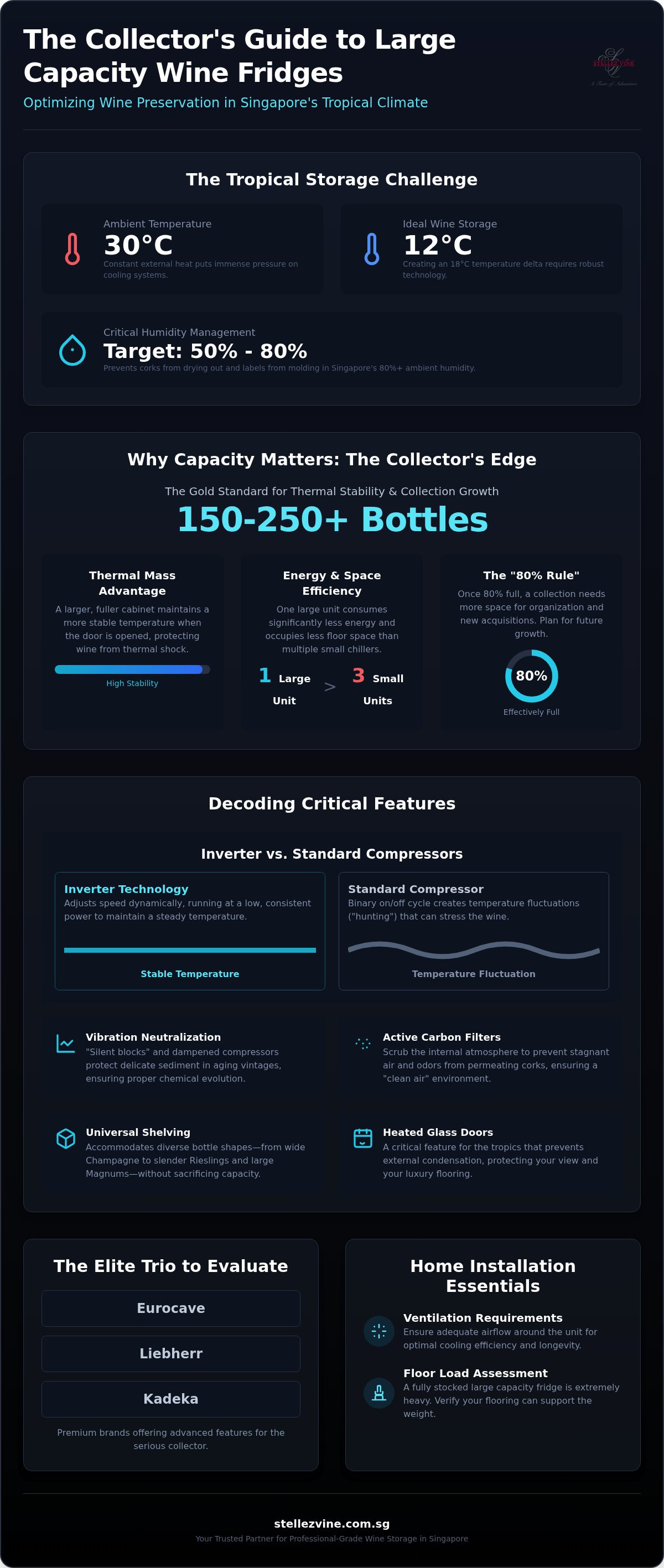
A serious collector understands that a large capacity wine fridge is more than a storage bin; it's a strategic asset. While entry-level chillers might suffice for a dozen bottles, the industry benchmark for a true collection starts at the 150 to 250+ bottle range. This scale allows for a diverse portfolio, balancing ready-to-drink daily selections with investment-grade vintages that require decades of rest. Beyond sheer volume, larger units offer the "thermal mass" advantage. A cabinet filled with liquid remains more temperature-stable than a half-empty one. When you open the door, the sheer volume of chilled wine prevents the internal air temperature from spiking, ensuring your collection remains undisturbed by the heat.
The Psychology of the Growing Collection
Most collectors fall victim to the "80% rule." Once your storage reaches 80% capacity, you've effectively run out of space. You need room to organize by region, vintage, or drinking window without playing a game of Tetris every time you buy a new case. Future-proofing is essential for long term wine storage Singapore. By choosing a larger unit now, you avoid the logistical headache of upgrading in two years when your passion for South African Chenin Blanc or French Bordeaux inevitably expands. It allows you to curate with confidence, knowing you have the "lay down" space for rare finds.
The Tropical Storage Challenge
Singapore presents a unique set of obstacles. You're fighting a 30°C ambient temperature to maintain a precise 12°C internal environment. This 18-degree delta puts immense pressure on any cooling system. Adhering to the essential principles of wine storage requires more than just cold air. You must manage humidity between 50% and 80% to prevent corks from drying out or labels from molding. Premium large-scale units often feature heated glass doors; a critical addition in the tropics that prevents external condensation from clouding your view or damaging your luxury flooring. These specialized features ensure that even in the height of a heatwave, your vintages remain in a pristine, cellar-like state.
Decoding Large Capacity Features: Beyond Bottle Counts
Selecting a large capacity wine fridge requires a shift in perspective. You aren't simply buying a larger box; you're investing in a complex climate-control system designed to manage significant thermal mass. When a cabinet houses 200 bottles, the internal dynamics change. Air circulation becomes more challenging, and the consequences of mechanical failure are far more costly. High-performance units distinguish themselves through engineering that prioritizes stability over mere space.
Vibration is a silent thief of quality. In a professional-grade unit, vibration neutralization is achieved through "silent blocks" and dampened compressors. These features ensure that the delicate sediment in your aging reds remains undisturbed, allowing the wine's chemistry to evolve as intended. Similarly, airflow is managed through active carbon filters. In a high-density environment, stagnant air can develop odors that eventually permeate the cork. These filters scrub the internal atmosphere, ensuring a "clean air" environment for every bottle in your collection.
Shelving versatility is another hallmark of premium design. Standard fridges often struggle with non-Bordeaux shapes, but a large capacity wine fridge should feature universal shelving. This allows you to store wide-bottomed Champagne bottles, slender Rieslings, and 1.5L Magnums on the same rack without sacrificing bottle count or risking structural integrity.
Inverter vs. Standard Compressors
Traditional compressors operate on a binary cycle; they're either running at full power or completely off. This creates "temperature hunting," where the internal environment fluctuates as the machine struggles to catch up. Inverter technology, a standard in 2026 models from brands like Kadeka, adjusts its speed dynamically. It runs at a low, consistent power level to maintain a steady state. This reduces mechanical wear, eliminates the loud "clunk" of startup cycles, and provides unmatched energy efficiency for units running 24/7 in our tropical heat.
Advanced Humidity and UV Management
Precision monitoring is mandatory for serious aging. Modern units feature digital hygrometry displays that allow you to track water vapor levels in real-time. To maintain the 50-80% humidity sweet spot, interior walls are often crafted from embossed aluminum, which helps distribute moisture evenly across the cabinet. Because many Singaporean residences feature expansive windows, triple-pane glass with integrated UV-filtering is essential. It blocks harmful light rays that cause "light strike," a chemical reaction that can ruin a vintage in weeks. If you're ready to see these features in action, explore our curated selection of premium wine storage solutions to find the perfect fit for your home.
The Elite Trio: Eurocave, Liebherr, and Kadeka Compared
Choosing the right large capacity wine fridge often comes down to a choice between heritage, precision, and modern innovation. In Singapore’s high-stakes storage market, three brands stand as benchmarks of quality. Each approaches the challenge of protecting a 200-bottle collection through a different lens of engineering. Understanding these brand philosophies ensures your storage solution aligns with your long-term collecting goals and your home’s architectural style.
Eurocave remains the undisputed "Gold Standard," focused on replicating the conditions of a natural French limestone cellar. Liebherr represents the peak of German modularity and precision. Kadeka, a homegrown favorite, leads the region in value-driven performance. While all three offer high-capacity cabinets, their internal architectures cater to different types of collectors.
Eurocave: The Connoisseur’s Choice
For those curating investment-grade portfolios, Eurocave is the definitive choice. Their Revelation and Pure series are engineered specifically for high-capacity needs, offering unmatched stability for aging. The hallmark of Eurocave is the "Main du Sommelier" shelving system. These individual bottle cradles combine a rigid structure with a soft elastomer "hand" that protects each bottle from vibration and ensures optimal airflow. This level of meticulous care is why Eurocave is the preferred choice for safeguarding iconic labels like Matias Riccitelli wine Singapore. When you're laying down high-altitude Argentinian Malbecs or delicate French Pinots, the French craftsmanship of Eurocave provides the ultimate security.
Kadeka and Liebherr: Engineering and Value
Liebherr’s GrandCru range is a masterclass in precision. These cabinets often feature multiple temperature zones, making them ideal for mixed collections where you need separate environments for long-term aging and immediate service. Their modular shelving allows you to reconfigure the interior as your collection evolves, a vital feature for the experimental collector.
Kadeka has earned its reputation as a "Singapore Favorite" by designing specifically for our tropical climate. Their 2026 Signature Series utilizes advanced inverter technology to maintain rock-solid temperatures while minimizing energy consumption. When comparing shelf load capacities, Kadeka units are built to handle the immense weight of a high-density, 150+ bottle environment without bowing. This makes them an exceptional choice for collectors who prioritize modern aesthetics and energy efficiency without compromising on the technical requirements of large-scale storage. Whether you choose the heritage of France, the precision of Germany, or the localized innovation of Singapore, your large capacity wine fridge should be a proactive partner in your wine journey.
Planning Your Space: Installation and Airflow Essentials
Installing a large capacity wine fridge in a Singaporean home requires more than just a free corner and a power outlet. Because these units are precision-engineered to manage significant weight and heat, your preparation must be meticulous. A standard 200-bottle cabinet, when fully loaded, can easily exceed 400kg. Each bottle weighs approximately 1.5kg; adding that to the 100kg mass of a premium Eurocave or Liebherr unit creates a substantial footprint. Before delivery, verify that your flooring, whether marble, parquet, or tile, can support this concentrated load without cracking or shifting over time.
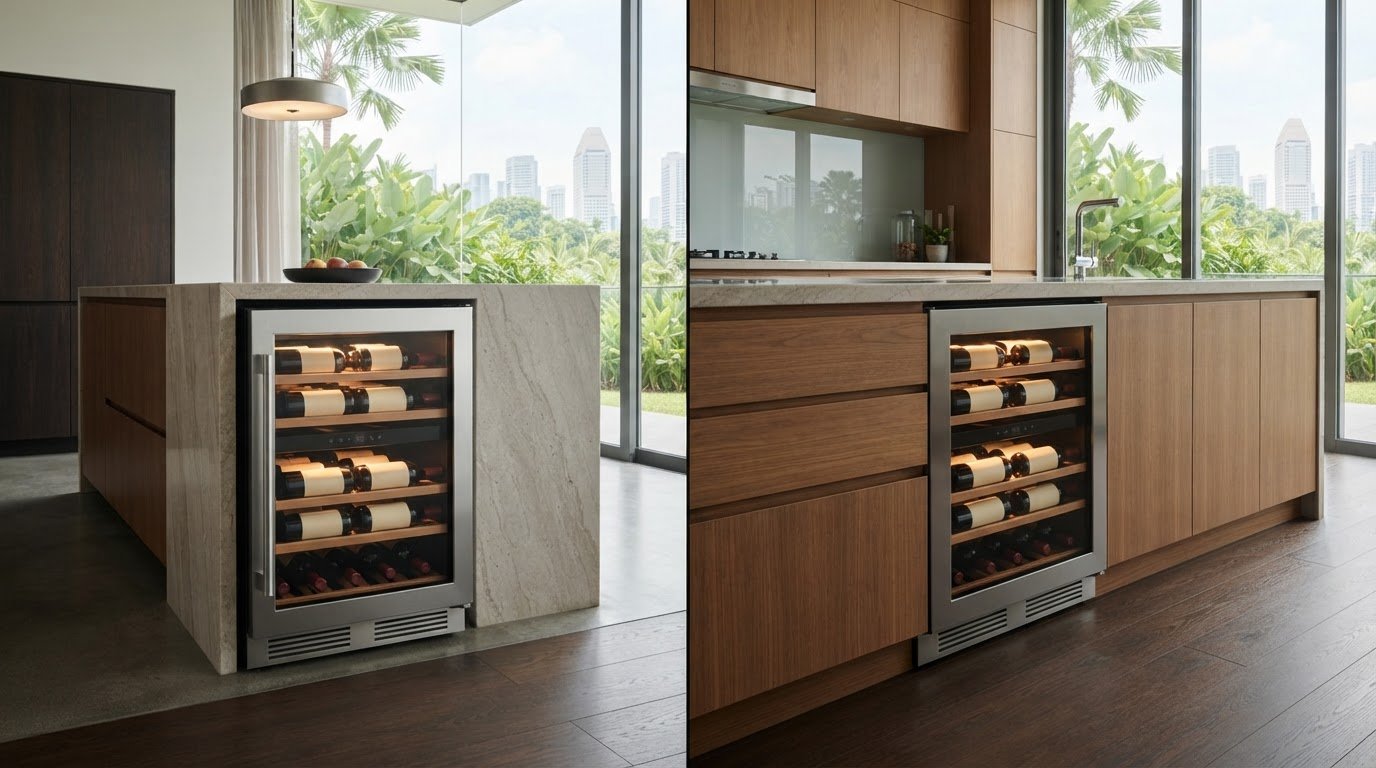
Ventilation is the second pillar of a successful installation. In our tropical climate, ambient temperatures often hover above 30°C, forcing the compressor to work harder to maintain a 12°C core. Without adequate "breathing room," heat builds up behind the unit, leading to compressor burnout and ruined vintages. For freestanding models, maintain at least 5cm to 10cm of clearance on all sides. If you prefer a built-in aesthetic for a luxury kitchen, ensure you select a model specifically designed with front-venting technology to prevent trapped hot air from compromising the system's efficiency.
The Logistics of Large Units
The journey from the delivery truck to your dining room is often where challenges arise. Measure your door frames, lift dimensions, and corridor turns twice. Large units are bulky and unforgiving in tight Singaporean apartment layouts. Once the unit is in place, use a spirit level to ensure it's perfectly flat. Even a 1-degree tilt can cause the door seal to fail over time, allowing humid air to seep in and cause frost buildup. Finally, observe the "24-hour rule." Let the unit sit unplugged for a full day to allow the refrigerant oils to settle after the vibrations of transport. For professional guidance on choosing a model that fits your specific floor plan, consult with our installation experts at Stellez Vine.
Optimizing Internal Airflow
A common mistake among new collectors is over-packing. While it's tempting to maximize every square inch of your large capacity wine fridge, you must never block the internal fans or vents. Air must circulate freely to maintain a uniform temperature throughout the cabinet. Organize your collection logically; place white wines and Champagnes toward the bottom where the air is naturally cooler, and reserve the upper shelves for reds. Because managing 200+ bottles can be daunting, we recommend using a digital inventory app or physical shelf tags. This proactive approach ensures you can locate a specific bottle without leaving the door open for extended periods, preserving the internal climate and your wine's integrity.
Investing in Your Passion: Why Stellez Vine Singapore is the Collector’s Choice
A true collection is a living, breathing portfolio that deserves more than a generic storage solution. It requires a partner who understands the intricate relationship between the vessel and the vintage. At Stellez Vine Singapore, we bridge the gap between technical engineering and sensory enjoyment. By selecting a large capacity wine fridge through our curated platform, you aren't just buying an appliance; you're securing a future for your most prized labels. We provide the expertise to ensure your storage environment is as exceptional as the wines you choose to inhabit it.
Our localized knowledge is particularly vital for collectors navigating the unique environmental pressures of the region. We don't just deliver a box; we provide a comprehensive ecosystem of support. From initial floor load assessments to long-term maintenance, our team ensures your investment remains a "set and forget" masterpiece. This holistic approach allows you to focus on the joy of discovery while we handle the complexities of climate control, vibration neutralization, and structural logistics.
A One-Stop Shop for Wine Lovers
The beauty of our service lies in seamless integration. Imagine your new Eurocave or Kadeka arriving alongside a handpicked selection of the best South African wine Singapore has to offer. We analyze your preferences and order history from our online wine shop Singapore to recommend a fridge that matches your specific drinking and aging habits. Whether you're securing rare vintages like Chateau Canon Chaigneau or building a diverse cellar of Argentinian Malbecs, we ensure your large capacity wine fridge is tailored to your lifestyle. We offer specific advice for those balancing the spatial constraints of urban apartment living with the desire for a professional-grade cellar.
The Stellez Vine Singapore Commitment
Our reputation is built on trust and authorized expertise. As a certified dealer for Eurocave, Liebherr, and Kadeka, Stellez Vine Singapore offers a level of reliability that third-party marketplaces cannot match. Our commitment to your collection involves a clear, three-step process: expert consultation, professional installation, and dedicated after-sales care. We believe that quality is a standard for living well, and we act as a knowledgeable filter to bring you only the benchmark storage solutions available in 2026. Elevate your home, protect your liquid assets, and savor every pour with the confidence that only a specialized partner can provide. We invite you to begin this refined adventure with us, where every bottle is treated with the respect it deserves.
Secure Your Legacy: The Next Step for Your Collection
Selecting a large capacity wine fridge is a definitive commitment to the longevity of your collection. It represents a shift from casual storage to professional-grade curation, where thermal mass and precision humidity control become your primary defenses against the tropical heat. By prioritizing advanced inverter technology and structural integrity, you transform your living space into a sanctuary for every rare vintage you've worked hard to acquire. It's a proactive investment that ensures your bottles evolve exactly as the winemaker intended.
As an authorized premium brand retailer, Stellez Vine Singapore offers more than just hardware; we provide specialized Singapore climate expertise tailored to the unique demands of our region. Our role is to act as your reliable partner, combining elite storage solutions with a curated global fine wine selection. This holistic approach ensures your bottles are not only stored correctly but are also part of a wider, refined adventure in taste and heritage. Elevate your lifestyle and protect your liquid assets with a storage strategy that reflects your passion. Your future self will thank you when the first cork is pulled from a perfectly aged bottle.
Explore Our Curated Collection of Large Capacity Wine Fridges
Frequently Asked Questions
What bottle count qualifies as a large capacity wine fridge?
A large capacity wine fridge is typically defined as any unit capable of housing between 150 and 250+ standard Bordeaux bottles. While smaller chillers focus on immediate consumption, these high-volume cabinets are engineered for serious collectors who prioritize long-term aging and thermal stability. This scale allows you to maintain a diverse portfolio of vintages while ensuring the internal environment remains consistent, even when new cases are added to the racks.
Can a large wine fridge be built into kitchen cabinetry?
Yes, provided you select a model specifically engineered for built-in installation. These units feature front-venting systems that pull air in and push heat out through a bottom plinth. Without this specialized ventilation, a large capacity wine fridge trapped behind cabinetry will overheat, leading to compressor failure. Always verify the clearance requirements with your interior designer to ensure the unit has the necessary "breathing room" to operate efficiently in our heat.
How much power does a 200-bottle wine fridge consume in Singapore?
Power consumption varies by technology, but modern 200-bottle units with inverter compressors are remarkably efficient. In Singapore's tropical climate, an inverter-equipped cabinet might consume approximately 150 to 180 kWh per year. This is significantly lower than older, non-inverter models that cycle on and off at full power. Choosing a high-efficiency unit ensures that your collection remains perfectly chilled 24/7 without causing a substantial spike in your monthly utility bills.
What is the difference between single, dual, and multi-zone large fridges?
Single-zone fridges maintain one consistent temperature, making them the gold standard for long-term aging at 12°C. Dual-zone units offer two distinct compartments, typically used for keeping reds at cellar temperature and whites at service temperature. Multi-zone cabinets provide three or more regions, allowing you to age investment bottles, chill whites for immediate pouring, and bring reds to the perfect room-temperature service state simultaneously. Your choice depends on whether you value aging or lifestyle entertaining.
Do I need a special floor reinforced for a large wine cabinet?
Most modern Singaporean residential floors, including HDB and condo structures, are designed to handle the weight of a full 200-bottle cabinet. However, you must consider that a loaded unit can weigh over 400kg. While structural reinforcement is rarely necessary, it's wise to place the cabinet on a solid, level surface like marble or reinforced tile. Avoid placing high-capacity units on thin laminate or older parquet floors that might compress or warp under the concentrated load.
Why are Eurocave fridges significantly more expensive than standard chillers?
Eurocave units are precision instruments crafted in France, designed to replicate the exact conditions of a natural limestone cellar. Unlike standard chillers that only focus on temperature, Eurocave integrates advanced hygrometry systems for humidity control and patented "Main du Sommelier" shelving for vibration neutralization. You're investing in a heritage-grade vault that protects the chemical evolution of your wine, ensuring that rare vintages age to their full potential rather than simply staying cold.
How often should I change the carbon filter in a large capacity unit?
You should replace the active carbon filter once every 12 months to maintain optimal air quality. In a high-density storage environment, stagnant air can develop odors that might eventually seep through the cork and taint the wine. An annual filter change ensures that the internal atmosphere remains clean and free of volatile organic compounds. Most premium brands include a digital reminder on the control panel to help you stay proactive with this essential maintenance task.
Is a large wine fridge noisy?
Modern high-capacity units are designed for urban living and are surprisingly quiet. Models featuring inverter technology typically operate at noise levels between 37 and 40 decibels, which is roughly equivalent to a soft whisper or a library environment. Because the compressor runs at a low, consistent speed rather than cycling loudly on and off, the sound is a gentle, unobtrusive hum. This makes them suitable for placement in dining rooms or open-concept living areas without disrupting your home's ambiance.
Comments