
How to Store Wine in Singapore: A Collector's Guide
- Stellez Vine

- Aug 8
- 11 min read
Is your prized Bordeaux quietly cooking in the back of your kitchen cabinet? In a city where the mercury rarely dips and humidity frequently climbs above 80%, the stakes for your collection are incredibly high. You've likely felt that pang of worry when the air conditioning cuts out or noticed a damp, peeling label on a bottle you were saving for a special occasion. Learning how to store wine Singapore style isn't just about luxury; it's a necessary defense against a climate that actively works to spoil your investment.
We understand that a fine wine is more than just a drink. It's a captured moment of heritage and craftsmanship that deserves absolute protection. This guide will show you exactly how to shield your bottles from the relentless tropical heat while maximizing the limited space of a modern urban apartment. We'll explore the critical risks of tropical storage, provide actionable steps for setting up a professional-grade home solution, and give you the confidence to let your finest vintages age to perfection. Discover how to transform your home into a sanctuary for every bottle you savor.
Table of Contents
Navigating the Heat: Why Singapore's Climate is a Wine's Worst Enemy
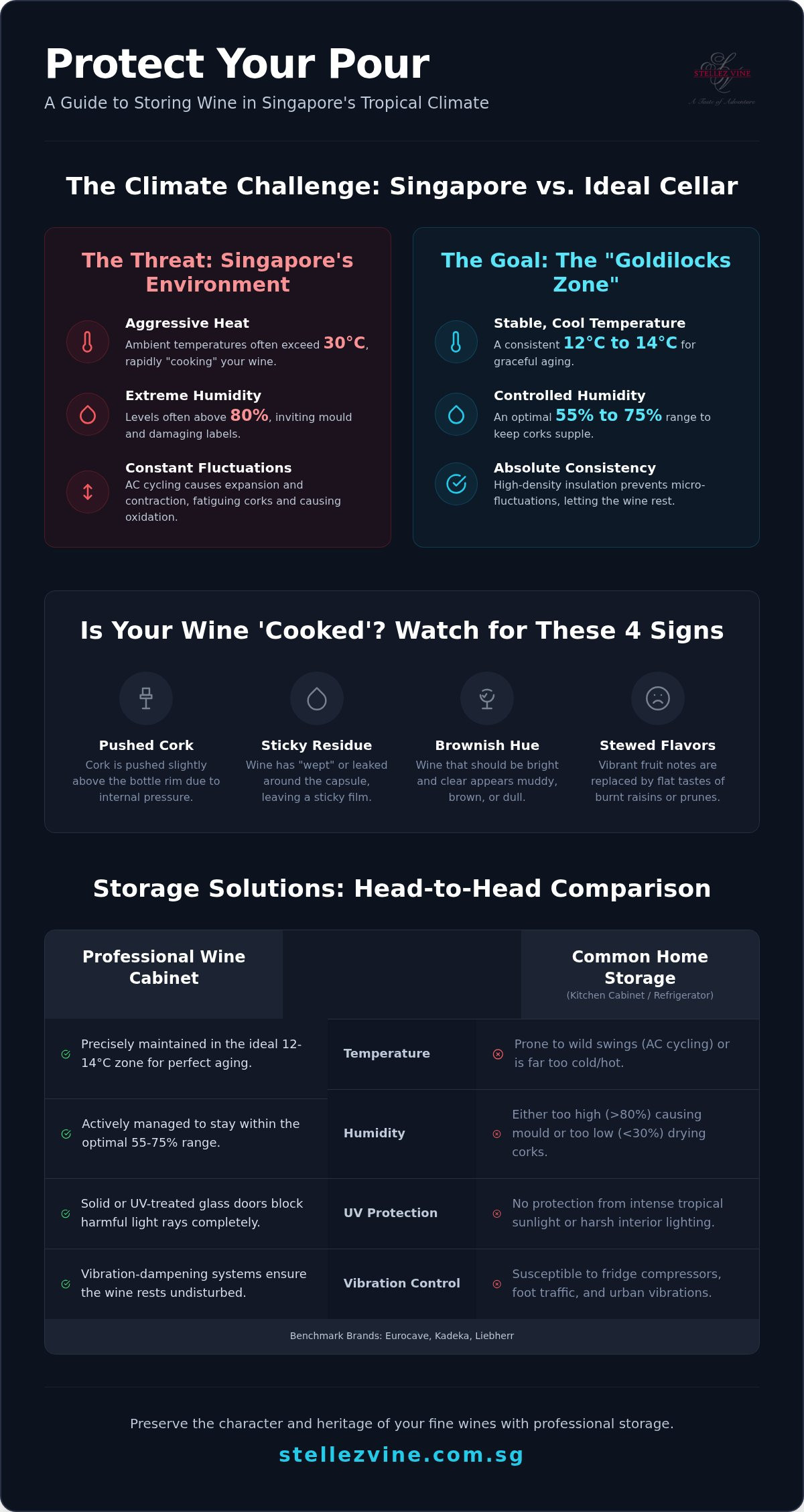
Singapore's tropical environment presents a unique challenge for any collector. While a cellar in Europe might stay naturally cool, a local apartment frequently hits 30°C or higher. Heat acts as a catalyst for chemical reactions that age wine at an unnatural pace. The three factors that have the most direct impact on a bottle's longevity are temperature, light, and humidity. In our local context, heat is the most aggressive adversary.
Heat causes thermal expansion. The liquid inside the bottle expands at a greater rate than the glass, creating significant internal pressure. This force often pushes the cork slightly outward or, in severe cases, drives wine out through the seal. When the temperature eventually drops, a vacuum forms, sucking oxygen back into the bottle. This "breathing" cycle leads to rapid oxidation. Understanding how to store wine Singapore requires acknowledging that residential air conditioning is rarely enough. Most home units are turned off when residents leave for the day, leading to massive temperature spikes that stress the wine's delicate structure.
You'll recognize a "cooked" bottle by its flat, stewed flavors. Instead of the vibrant fruit and crisp acidity intended by the winemaker, the wine tastes of burnt raisins or prunes. Watch for these physical signs of heat damage:
Corks that have pushed slightly above the rim of the bottle.
Sticky residue or "weeping" visible around the capsule.
A muddy, brownish hue in wines that should be bright and clear.
Temperature Fluctuations vs. Constant Heat
A steady 20°C environment is significantly better for your collection than a cycle that swings between 12°C and 25°C. These fluctuations cause the liquid to expand and contract repeatedly, which fatigues the cork and disrupts the aging process. Professional storage solutions use high-density insulation to prevent these micro-fluctuations. In contrast, the frequent AC cycling common in Singaporean apartments creates a seesaw effect that prevents the wine from reaching a state of graceful maturation.
The Humidity Factor: Friend or Foe?
Humidity is a double-edged sword. While 70% is the global benchmark for keeping corks supple and airtight, Singapore's ambient humidity often exceeds 80%. This extreme moisture invites label-destroying mould and can damage original wooden crates. Conversely, using a standard kitchen refrigerator is equally dangerous. These units are designed to strip moisture from the air, often dropping humidity below 30%. This shrivels the cork, allows oxygen to enter, and can ruin a fine vintage within months.
Mastering the Four Pillars of Professional Wine Preservation
Professional preservation relies on a precise synergy of environmental factors. To truly understand how to store wine Singapore collectors must target the "Goldilocks Zone" of 12°C to 14°C. This specific range is the global benchmark for slow, graceful maturation. Temperatures colder than this stunt the wine's development, while anything warmer risks premature oxidation and the loss of subtle aromatic layers. Consistency is your goal; even a few degrees of daily drift can fatigue the cork and compromise the seal.
While temperature is the headline, humidity is the silent guardian of your collection. Unlike generic advice found in temperate climates, Singaporean collectors must manage excess moisture. You must keep the cork supple to prevent air ingress, yet levels consistently above 80% invite label-destroying mould and damage to original wooden crates. Professional cabinets from benchmark brands like Eurocave or Liebherr maintain a precise 55% to 75% range. This ensures the cork remains tight and elastic without sacrificing the aesthetic value of your investment.
Darkness and UV Shielding
Singapore’s intense tropical sunlight is a hidden threat to high-rise dwellers. UV rays penetrate standard glass and trigger chemical reactions in the wine's organic compounds. This leads to "light-struck" aromas that resemble wet wool or cardboard. Clear glass bottles, common for Rosé and White wines, are particularly vulnerable to this degradation. When selecting a storage solution, prioritize solid doors or triple-glazed, UV-treated glass to preserve the liquid's integrity against the glare of the city.
The Silent Spoiler: Urban Vibration
Modern urban living introduces constant micro-vibrations from nearby construction, MRT lines, or even heavy kitchen appliances. These tremors are subtle but destructive over time. They agitate the liquid, preventing tannins from settling and disrupting the delicate chemical evolution required for aging reds. High-end cabinets utilize specialized vibration-dampening technology and quiet compressors to create a perfectly still environment. For the best results, place your unit on a solid, level surface away from AC compressors or laundry areas.
Protecting your investment requires more than a simple cooler; it demands a curated environment that respects the craftsmanship of the winemaker. Explore our range of professional storage solutions and South African fine wines to ensure every bottle you open is a masterpiece of flavor.
Evaluating Your Options: Professional Wine Cabinets vs. Passive Storage
Passive storage is a dangerous myth in the tropics. While a dark cupboard or under-bed space might suffice in London or Melbourne, these areas in a Singaporean home often become stagnant heat traps. Without active cooling, your wine faces temperatures consistently above 30°C, which rapidly degrades the complex compounds that give fine wine its character. Understanding how to store wine Singapore collectors must distinguish between short-term chillers and professional aging cabinets.
Wine chillers are designed to bring bottles to serving temperature. They often lack the sophisticated humidity controls and vibration-dampening systems essential for years of maturation. For those serious about their collection, deciding if long term wine storage Singapore is worth the investment comes down to a simple calculation. The cost of a professional cabinet is a small fraction of the value of a ruined collection of rare vintages.
Premium Brands Comparison: Eurocave, Liebherr, and Kadeka
Selecting the right technology is an exercise in curation. We focus on three benchmark brands that excel in the unique conditions of the Singaporean market:
Eurocave: The undisputed gold standard. These units are handpicked for collectors who demand the absolute best in long-term aging and heritage preservation.
Liebherr: Renowned for German precision. Their cabinets offer exceptional temperature stability with multi-zone technology, allowing you to store and serve at different temperatures simultaneously.
Kadeka: A reliable, high-performance favorite. These units are specifically tailored for modern Singaporean apartments, offering sleek designs and efficient cooling without compromising on quiet operation.
Capacity and Space Planning
Never buy a cabinet that only fits your current inventory. Your passion will grow; your storage must anticipate it. We recommend the 25% buffer rule. If you currently own 40 bottles, select a unit that holds at least 50. This avoids overcrowding, which can restrict vital airflow between bottles and lead to uneven cooling zones within the unit.
Consider your lifestyle when choosing between single-zone and multi-zone units. If you primarily collect reds for long-term aging, a single-zone cabinet set at 12°C is ideal. If you frequently host and need whites or Champagnes ready to pour, a multi-zone Liebherr or Kadeka cabinet offers the necessary flexibility. Integrate these units into your home away from direct sunlight and heat-generating appliances to ensure maximum energy efficiency and a whisper-quiet experience.
Actionable Guidance: Setting Up Your Home Storage Solution
Successful preservation begins with strategic placement. While many generic guides suggest the kitchen, this is often the hottest room in a Singaporean home due to cooking heat and lack of consistent airflow. To master how to store wine Singapore collectors should position their cabinets in a cool, dry corner away from windows, ovens, and external walls that bake in the afternoon sun. External walls in high-rise apartments can radiate significant heat long after sunset, forcing your unit to work harder and increasing energy consumption.
Patience is vital when your new cabinet arrives. You must allow the unit to sit upright and unplugged for at least 24 hours before turning it on. This "resting period" lets the refrigerant gases and compressor oils settle after the journey to your home. Once active, organize your bottles to facilitate airflow. Avoid pushing bottles flush against the back wall, as this can block the cooling plate and create localized "hot spots" or excessive frost buildup. Use a standalone digital hygrometer to verify that your internal climate remains within the benchmark 55% to 75% humidity range.
Maintenance for Tropical Longevity
Singapore's relentless humidity demands proactive maintenance. Most professional units from Eurocave or Kadeka include active charcoal filters to strip odors from the air. Replace these annually to ensure your corks don't absorb stagnant apartment smells. During the intense monsoon season, you might notice light condensation on the glass door. Simply wipe this away with a microfiber cloth to prevent moisture from seeping into the seals. Perform the "paper test" every six months: trap a sheet of paper in the door; if it slides out easily, your seals may need cleaning or replacement to maintain an airtight sanctuary.
Inventory Management Basics
Protect the aesthetic value of your collection by using clear plastic sleeves for your most prized labels. This prevents the regulated humidity from causing the edges to peel or develop damp spots over time. For your daily drinkers, employ a "First In, First Out" (FIFO) system to ensure no bottle sits past its prime. Digital tracking apps are an excellent way to manage a growing collection, helping you locate specific vintages without keeping the cabinet door open for extended periods, which causes temperature spikes.
Ready to elevate your home storage? Explore our curated selection of professional wine cabinets and discover the perfect benchmark solution for your Singaporean residence.
Savour the Results: Curating Your Collection with Stellez Vine
The journey of a collector doesn't end at the point of purchase; it begins with the first sip of a perfectly preserved bottle. When you master how to store wine Singapore, you unlock the true potential of the winemaker's craft. A premium wine is a living investment that evolves over time, and your storage environment is the silent partner in that maturation. Stable conditions ensure that the vibrant fruit and complex aromas captured at the vineyard remain intact until the moment the cork is pulled.
Collectors often wonder, is a wine fridge worth it Singapore? The answer becomes clear when you experience the difference between a heat-stressed bottle and one aged in a controlled sanctuary. Professional storage transforms the tasting experience, revealing silkier tannins and deeper secondary flavours that simply cannot develop in a fluctuating tropical climate. At Stellez Vine Singapore, we provide the synergy between world-class technology and exceptional vintages, ensuring your collection remains a source of pride and pleasure.
Handpicked Selections for Your New Cellar
We act as a knowledgeable filter for the global market, selecting only the finest labels that reward patient aging. Discover the rugged elegance of South African gems like Savage Wines or the artisanal depth of AA Badenhorst. These are wines of character and heritage that thrive in a stable environment. For those seeking investment-grade French reds, Chateau Canon Chaigneau offers remarkable aging potential, while the high-altitude excellence of Matias Riccitelli from Argentina brings a unique, refined adventure to your palate. Each bottle is a handpicked benchmark of its region, waiting to reach its peak in your home cellar.
The Stellez Vine Singapore Experience: Expert Support and Delivery
Our commitment to quality extends from the vineyard to your final pour. We provide a seamless, reliable experience through a three-step approach to service: select your vintage, secure your storage, and savor the evolution. Our national delivery team ensures temperature stability during transit, maintaining the cold chain even in the midday sun. Beyond the bottle, we offer professional-grade glassware to elevate your tasting ritual. If you're unsure which unit fits your lifestyle, our consultative team will help you choose the ideal Eurocave or Liebherr model tailored to your specific space and collection goals. Trust us to be your partner in building a world-class wine collection in the heart of Singapore.
Savour the Sophistication of Every Aged Pour
Securing the longevity of your collection requires a shift from passive storage to professional preservation. By mastering the balance of stable temperatures, regulated humidity, and vibration control, you transform your home into a benchmark cellar. Understanding how to store wine Singapore collectors know that every bottle is a living piece of heritage that demands an environment free from tropical heat spikes and urban tremors. Your investment deserves more than a dark cupboard; it requires a sanctuary that respects the slow, chemical evolution of fine vintage.
As an official partner for Eurocave and Liebherr, Stellez Vine has provided expert local knowledge to collectors since 2009. We bridge the gap between the vineyard and your glass, offering a handpicked selection of award-winning international labels that are built to age gracefully. Don't let the climate dictate the quality of your next tasting experience. Elevate your collection with professional storage solutions from Stellez Vine and invest in the technology that honors the winemaker's craft. Your future self will thank you for every perfectly matured glass you savor.
Frequently Asked Questions
Can I store wine in a regular kitchen refrigerator for a few months?
Storing wine in a standard kitchen refrigerator for more than a few days is not recommended. These units are designed to keep food at roughly 4°C, which is far too cold for wine and stunts its development. Even worse, kitchen fridges strip moisture from the air, causing corks to shrivel and oxidize the liquid. The constant vibration of the motor further compromises the wine's integrity, making a dedicated chiller a far superior choice.
What is the ideal temperature for storing red wine in Singapore?
The ideal temperature for red wine maturation is between 12°C and 14°C. While some believe reds prefer warmer environments, this "Goldilocks Zone" is the global standard for slow, graceful aging. In Singapore, ambient temperatures of 30°C will cook your wine within months. Maintaining this specific range prevents the loss of delicate aromatics and ensures the tannins evolve into a smooth, refined profile rather than becoming harsh or flat.
How do I prevent mould from growing on my wine labels in high humidity?
You can prevent mould by maintaining internal humidity between 55% and 75% using a professional wine cabinet. In Singapore's ambient 80%+ humidity, labels are highly susceptible to moisture damage. For prized bottles, apply clear plastic sleeves to shield the paper from dampness. This curatorial approach preserves the aesthetic and resale value of your collection without interfering with the essential gas exchange required for the wine to breathe.
Do I really need a wine fridge if my home is always air-conditioned?
A dedicated wine fridge remains essential even in air-conditioned homes. Most residential AC units are switched off when you leave for work, leading to drastic temperature swings that fatigue the cork and stress the wine. A professional cabinet provides the 24/7 stability that Singaporean apartments lack. It offers the precise insulation and vibration-free technology required to protect your investment from the city's unique urban and climatic challenges.
What happens to wine if it gets too hot for a short period?
Heat spikes cause the liquid to expand, creating internal pressure that can compromise the cork's seal. This process, known as thermal expansion, leads to rapid oxidation once the bottle cools and air is sucked back in. You'll notice the wine develops "stewed" flavors, tasting more like burnt fruit or prunes than the vibrant, complex masterpiece intended by the winemaker. Even a single afternoon in a hot car can cause permanent damage.
Is it better to store wine bottles horizontally or vertically?
Store bottles with natural corks horizontally to keep the wine in constant contact with the closure. This keeps the cork moist and expanded, ensuring an airtight seal that prevents oxygen from entering. While screwcaps are more flexible, horizontal storage remains the most space-efficient way to organize your collection. This practice is a fundamental part of how to store wine Singapore collectors use to guarantee long-term quality and cork integrity.
How long can I store an opened bottle of wine in Singapore?
An opened bottle typically lasts one to three days if recorked and stored in a wine fridge. Singapore's high ambient heat accelerates the oxidation process the moment the seal is broken. To preserve the sensory experience, use a vacuum pump to remove excess air and keep the bottle away from light. Even with these precautions, the wine's delicate aromatics will begin to fade significantly after the second day, especially for lighter whites.
Why does vibration matter for wine storage in an apartment?
Vibration is a silent spoiler that agitates the wine's delicate chemical structure. In modern Singaporean apartments, micro-vibrations from nearby construction, MRT lines, or heavy appliances prevent sediment and tannins from settling properly. This disruption halts the evolution of the wine's texture and can lead to a gritty, disjointed palate. High-end cabinets utilize specialized dampening technology to ensure your vintages mature in absolute, undisturbed stillness, protecting the wine's long-term finesse.


Comments