
Temperature Controlled Wine Cabinet Singapore: The Collector’s 2026 Guide
- Stellez Vine

- 11 hours ago
- 12 min read
A single afternoon of Singapore’s relentless heat is enough to irreversibly "cook" a vintage that took a decade to mature. For the discerning enthusiast, securing a high-performance temperature controlled wine cabinet Singapore is no longer a simple lifestyle choice; it's a critical act of preservation. You recognize that true luxury lies in the details, yet the fear of rising electricity costs or intrusive compressor noise often creates hesitation when selecting a home for your bottles.
We agree that your collection deserves better than a standard refrigerator or a dark cupboard. This 2026 guide promises to simplify your search for the ultimate storage solution, balancing technical excellence with the aesthetic demands of a refined interior. You'll discover how to replicate the geological stability of a European limestone cellar right in the heart of the tropics while ensuring your investment appreciates in value and flavor.
Prepare to explore an expert comparison of industry benchmarks like Eurocave and Liebherr, alongside the practical versatility of Kadeka. We break down everything from dual-zone precision to the latest energy efficiency standards, ensuring your liquid assets remain protected, silent, and ready to savor at a moment's notice.
Table of Contents
The Critical Role of Temperature Control in Singapore’s Tropical Climate
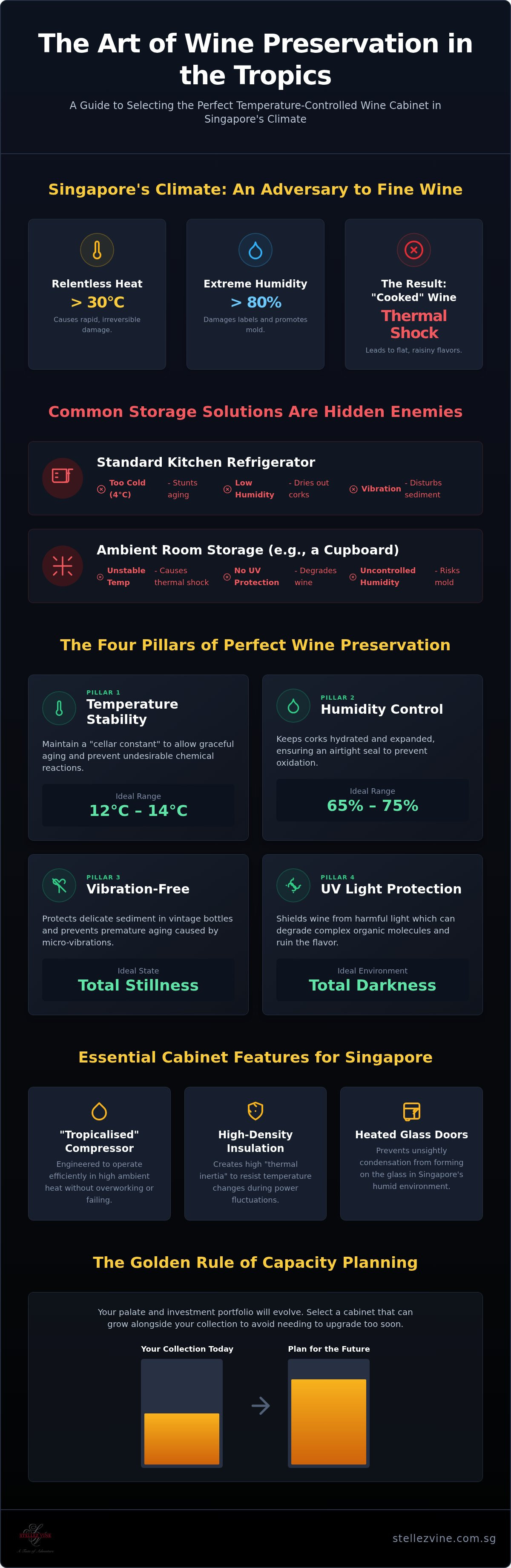
Singapore’s climate is a relentless adversary for any serious wine collector. With ambient temperatures frequently hovering above 30°C and humidity levels often exceeding 80%, the environment is the literal opposite of a traditional European cave. When wine is exposed to these conditions, it suffers from "thermal shock." This phenomenon occurs when rapid temperature fluctuations cause the liquid inside the bottle to expand and contract. This movement puts immense pressure on the cork, often breaking the seal and allowing oxygen to seep in. The result is a "cooked" wine that has lost its vibrant fruit notes, replaced by a flat, raisiny character that no amount of decanting can fix.
You might think a standard kitchen refrigerator offers a safe haven, but it's actually a hidden enemy. Kitchen fridges are designed to drop temperatures rapidly to keep perishables safe, often lingering around 4°C. This is far too cold for wine, as it stunts the natural ageing process. Even worse, the low humidity in a standard fridge dries out corks, while the constant vibration from the motor disturbs the delicate sediment in your vintage bottles. To truly protect your liquid assets, you must adhere to the fundamental principles of wine storage, which dictate a steady "cellar constant" of 12°C to 14°C. Achieving this level of precision requires a dedicated temperature controlled wine cabinet Singapore collectors can rely on to mimic the geological stability of a subterranean cellar.
Heat, Humidity, and the Singaporean Apartment
Living in a high-rise apartment presents unique challenges for wine preservation. High ambient humidity can lead to unsightly condensation on the glass doors of inferior cabinets, which eventually damages labels and encourages mold. Professional-grade cabinets solve this with heated glass technology and advanced hygrometry management. Maintaining a humidity level of 65% to 75% is non-negotiable; it keeps the cork elastic and the seal airtight. For those cellaring delicate French or robust South African labels, ensuring your unit features a "tropicalised" compressor is vital. These components are specifically engineered to operate efficiently in Southeast Asia’s heat without overworking or failing during a mid-year heatwave.
Thermal Stability vs. Simple Cooling
It's important to distinguish between a simple wine chiller and a professional wine cabinet. A chiller is designed for short-term serving, while a cabinet is built for long-term maturation. The primary difference lies in insulation and thermal inertia. Thermal inertia refers to the ability of a wine cabinet’s internal mass and high-density insulation to resist rapid temperature changes during external fluctuations or power outages. Premium cabinets use thick, injected polyurethane foam walls that act as a thermal buffer. This ensures that even if the power flickers, your temperature controlled wine cabinet Singapore remains a stable, silent sanctuary for your most prized vintages.
Precision, Protection, and Performance: The Four Pillars of Preservation
To achieve the "cellar constant" discussed previously, a temperature controlled wine cabinet Singapore must do more than just blow cold air. It must act as a precision instrument, balancing four distinct engineering pillars. Temperature consistency is the first priority. A cabinet's duty cycle should be so stable that liquid temperature remains virtually flat, even as the ambient air in your kitchen or lounge fluctuates. Research into the scientific impact of temperature on wine shows that even minor thermal shifts can trigger undesirable chemical reactions, stripping a wine of its complexity long before its time.
Hygrometry management is equally vital. While basic chillers often strip moisture from the air, a professional cabinet maintains a steady 65% to 75% humidity level. This keeps the cork hydrated and expanded, ensuring an airtight seal against the oxidation risks inherent in Singapore’s humid environment. Without this balance, even the most prestigious labels will eventually succumb to the drying effects of internal cooling systems.
The Silent Killer: Vibration and Sediment
Vibration is often overlooked, yet it's a primary cause of premature ageing. Micro-vibrations from a standard compressor can keep sediment in suspension, preventing the slow, graceful integration of tannins. This is especially critical for high-character bottles like Matias Riccitelli wine Singapore collectors prize for their purity and precision. Look for units with decoupled compressors and shock-absorption systems that isolate the storage shelves from the motor's mechanical energy. In these units, quietness isn't just about acoustics; it's about chemical preservation.
UV Protection and Air Quality
Light is the final adversary. UV rays can degrade phenolics, leading to "light-strike" which creates unpleasant, wet-cardboard aromas in white wines and sparkling varietals. Most premium units feature triple-glazed, Argon-filled glass doors with built-in UV filters to block harmful spectra. Additionally, look for active charcoal filtration. This system purifies the air entering the cabinet, preventing "fridge smells" or ambient odors from penetrating the cork and tainting the wine's bouquet. Natural airflow systems are generally superior to forced air, as they maintain a more consistent humidity profile without drying out labels.
Selecting the right temperature controlled wine cabinet Singapore requires looking beyond the price tag to these technical foundations. If you're ready to upgrade your storage, you can explore our curated range of professional cabinets designed specifically for the tropics.
Eurocave vs. Liebherr vs. Kadeka: Selecting Your Benchmark
Choosing a temperature controlled wine cabinet Singapore requires you to weigh heritage against high-tech innovation. It's a decision that defines how you interact with your collection daily. We've handpicked three brands that set the global benchmark for preservation. Each brand offers a distinct philosophy, from the artisanal precision of French craftsmanship to the sleek efficiency of German engineering. Selecting the right one depends entirely on whether you're building a "working" cellar for frequent entertaining or a "sanctuary" for long-term investment.
The comparative landscape in 2026 is shaped by new regulations and evolving design trends. All cabinets imported into Singapore are now subject to the Mandatory Energy Labelling Scheme (MELS) and Minimum Energy Performance Standards (MEPS). This shift has pushed brands to innovate, ensuring that even the most powerful compressors remain whisper-silent and energy-efficient. Whether you prioritize the tactile feel of solid oak shelving or the modern allure of borderless black glass, your choice should reflect a commitment to quality that matches the labels inside.
Eurocave: The Connoisseur’s Choice
Eurocave remains the undisputed gold standard for those who view wine as a legacy. Their French-made cabinets, particularly the La Première and Pure series, are engineered with a single-minded focus on slow maturation. These units don't just cool; they breathe. The patented Main du Sommelier shelving system is a revelation in ergonomics. It uses individual, bi-material cradles to support each bottle, effectively dampening micro-vibrations while allowing for optimal airflow. If you're currently debating if is a wine fridge worth it in Singapore, consider the protection Eurocave offers your most delicate Burgundies or aged South African reds. It's not an appliance; it's a professional-grade cellar in a compact footprint.
Liebherr and Kadeka: Innovation for the Modern Home
Liebherr and Kadeka represent the vanguard of modern convenience and sleek integration. Liebherr’s Vinidor range is a masterpiece of flexibility, offering up to three independent temperature zones. This allows you to keep your vintage Champagnes at a crisp 7°C while your Bordeaux matures at a steady 12°C. Their German engineering focuses heavily on energy efficiency, making them a sustainable choice for the eco-conscious collector.
Kadeka has become a firm favorite in Singapore for its Signature Series, which blends high performance with a minimalist aesthetic. These units are designed for seamless kitchen integration, featuring telescopic shelving that glides with effortless precision. When comparing these brands, consider these three factors:
Shelving Flexibility: Eurocave offers the most "cradled" protection, while Kadeka provides superior visual accessibility.
Zone Options: Liebherr leads in multi-zone precision for diverse collections.
Aesthetic Integration: Kadeka’s borderless black glass is unmatched for modern, high-end interiors.
Regardless of your choice, a premium temperature controlled wine cabinet Singapore ensures your collection remains a source of pride and perfect flavor.
Curating Your Collection: Sizing and Organisation Strategies
Buying for today is the most common mistake new collectors make. Your passion will grow, and your inventory will likely follow suit faster than you anticipate. When selecting a temperature controlled wine cabinet Singapore, apply the "Golden Rule" of capacity: always choose a unit with at least 25% more storage than you currently need. This buffer ensures you have space for those unexpected auction wins or seasonal releases without overcrowding the shelves, which can impede the vital airflow necessary for consistent cooling.
Placement within your home is equally critical for long-term performance. Even the most advanced "tropicalised" units shouldn't be forced to fight unnecessary battles. Position your cabinet away from direct sunlight and heat-generating appliances like ovens or dishwashers. In a Singaporean apartment, a cool, shaded corner of the dining room or a dedicated pantry area is ideal. Proper placement reduces the mechanical stress on the compressor, ensuring your investment remains silent and efficient for years to come.
Maximising Capacity and Accessibility
Efficiency is about more than just bottle count; it's about how easily you can reach your favorites. Sliding shelves offer effortless access and are perfect for a "working" collection, while fixed storage shelves allow you to stack bottles for bulk ageing. Consider the physical diversity of your collection. Standard Bordeaux bottles are the industry benchmark, but you'll need adjustable shelving to accommodate the wider bases of Champagne, the length of tapered Riesling bottles, or the sheer scale of Magnums. Many premium units now feature customizable LED lighting, allowing you to showcase your labels as a piece of living art without introducing harmful heat.
The Dual-Zone Debate
The choice between single and dual-zone storage depends entirely on your drinking habits. A single-zone cabinet is the purist’s choice for long-term cellaring, maintaining a uniform 12°C for all varietals. However, if you enjoy having bottles ready to serve at a moment's notice, a dual-zone unit is indispensable. This allows you to mature your heavy reds in one section while keeping crisp whites or sparkling wines at a chilled serving temperature in the other.
This versatility is particularly useful when managing a diverse portfolio, such as a mix of South African vs Argentinian wine, where serving temperatures can vary significantly between a bold Malbec and a delicate Chenin Blanc. Maintaining two distinct climates within a single cabinet is a sophisticated engineering feat that requires advanced thermal separation to prevent temperature bleed. If you're ready to find the perfect fit for your home, you can browse our wine cabinet collection to discover the ideal balance of size and functionality.
Elevate Your Oenological Journey with Stellez Vine
Investing in a temperature controlled wine cabinet Singapore is a significant milestone for any collector. It's a transition from simply buying bottles to actively preserving a legacy. When you choose to source your storage from a dedicated wine merchant rather than a generic appliance retailer, you ensure your cabinet is selected with the "bottle in mind." We understand the nuances of a delicate South African Pinotage and the structural needs of a vintage Bordeaux because we curate the wines ourselves. This dual expertise allows Stellez Vine Singapore to recommend solutions that respect the chemistry of the wine as much as the aesthetics of your home.
Stellez Vine Singapore offers a handpicked selection of the world's most trusted brands, including the artisanal precision of Eurocave, the German engineering of Liebherr, and the modern versatility of Kadeka. Our role is to act as your trusted gatekeeper, simplifying the technical landscape of 2026 energy ratings and tropicalised compressors. We provide a "Total Experience" that extends beyond the hardware. By pairing your new cabinet with a curated wine selection, you can begin filling your shelves with benchmark labels the moment your unit is commissioned.
Expert Consultation and After-Sales Support
Singaporean homes present unique architectural challenges, from high-rise humidity to specific floor plan constraints. Our team provides personalized consultations to help you calculate the perfect capacity for your space, ensuring you don't fall foul of the "Golden Rule" mentioned earlier. We manage the entire logistics chain, providing seamless delivery and professional installation across the island. As a registered Singapore company since 2009, Stellez Vine Singapore offers the localized attentiveness you need when navigating warranties and long-term maintenance. You aren't just buying a fridge; you're gaining a reliable partner dedicated to the health of your collection.
Start Your Professional Cellar Today
The path from a casual enthusiast to a serious collector is defined by the quality of your storage. By securing a stable, cellar-like environment today, you safeguard your liquid investments against the tropical heat for decades to come. Our digital showroom is designed to provide clear paths to purchase, offering straightforward technical specifications alongside lifestyle inspiration. Elevate your home and protect your passion with a solution that reflects your commitment to living well. Explore our premium wine cabinets and discover the benchmark of preservation today.
Secure Your Legacy: The Future of Your Collection
Safeguarding your investment against the relentless heat requires more than just a chiller; it demands a dedicated temperature controlled wine cabinet Singapore that replicates the geological perfection of a traditional cellar. You now understand that precision in hygrometry and vibration neutralization are the true guardians of flavor. Whether you favor the heritage of Eurocave or the modern efficiency of Liebherr and Kadeka, your selection should reflect the high standard of the labels you curate.
Since 2009, Stellez Vine Singapore has acted as a trusted gatekeeper for collectors across the island. As an authorized dealer for the world's most sophisticated storage brands, we provide the expertise, professional installation, and fast delivery required to protect your liquid assets. We simplify the transition from enthusiast to serious collector, ensuring your bottles age gracefully and are always ready to savor at their absolute peak.
Take the next step in your oenological journey today. Savour the Excellence: Browse Our Curated Wine Cabinets and find the perfect sanctuary for your vintages.
Frequently Asked Questions
What is the ideal temperature for a wine cabinet in Singapore?
The universal benchmark for long-term cellaring is a steady 12°C to 14°C for all varietals. While serving temperatures vary, this specific range ensures slow and stable maturation for both reds and whites. Maintaining this "cellar constant" is the primary duty of any temperature controlled wine cabinet Singapore collectors use to protect their investment from the relentless tropical heat.
Is a dual-zone wine cabinet better than a single-zone?
A single-zone cabinet is superior for dedicated long-term ageing, while a dual-zone unit is better for those who want bottles ready to serve. If your goal is to mature a consistent collection of reds, a single-zone provides better thermal stability. You should choose a dual-zone model if you frequently entertain and need whites chilled at 7°C alongside reds at 16°C.
How much electricity does a wine cabinet use in Singapore?
Modern cabinets are highly efficient, especially under the 2026 Mandatory Energy Labelling Scheme (MELS) in Singapore. A mid-sized, well-insulated unit typically consumes about as much energy as a standard household refrigerator. High-density polyurethane foam and "tropicalised" compressors ensure the unit doesn't overwork, even when ambient temperatures in your apartment rise during the day.
Can I use a regular fridge to store my wine collection?
No, a regular kitchen fridge is unsuitable for fine wine storage because it's designed for perishables, not preservation. Kitchen fridges are too cold, lack humidity control, and produce constant vibrations that disturb delicate sediment. The low humidity inside a domestic fridge will eventually dry out your corks, leading to oxidation and the permanent degradation of your wine's flavor profile.
How long do wine cabinets like Eurocave or Liebherr last?
Premium brands like Eurocave and Liebherr are engineered to last 15 to 20 years or more with proper maintenance. These units use high-grade components designed for continuous, silent operation. Regular servicing, such as cleaning the condenser and replacing charcoal filters annually, ensures your temperature controlled wine cabinet Singapore remains a reliable sanctuary for your collection for decades.
Do I need a built-in or free-standing wine cabinet?
Your choice depends on your specific floor plan and aesthetic goals. Built-in units are designed for seamless integration into kitchen cabinetry with specialized front-venting systems. Free-standing units require clearance around the sides and back for heat dissipation. Built-in models offer a sleek, high-end look, while free-standing models provide more flexibility if you decide to rearrange your home layout.
What is the difference between a wine chiller and a temperature-controlled wine cabinet?
A wine chiller is a short-term serving appliance, whereas a temperature-controlled cabinet is a professional cellaring tool. Chillers often lack the sophisticated humidity management, vibration dampening, and UV protection found in professional cabinets. If you intend to age wine for more than a few months, a dedicated cabinet is the only way to ensure proper chemical maturation.
How does humidity control work in a premium wine cabinet?
Premium cabinets use thermal pumps and specialized materials like lava stones or clay balls to maintain humidity between 65% and 75%. This system recycles moisture from the air and distributes it evenly throughout the unit. This prevents the cork from shrinking in Singapore's dry air-conditioned environments, ensuring the seal remains airtight and the bottle labels stay pristine.


Comments